Loading...
Done
Germany's Angelique Kerber reacts after popping a bottle of champagne, a day following her win in the final match at the Australian Open tennis tournament, at the Government House in Melbourne, Australia, January 31, 2016. (Photo by Issei Kato/Reuters)

Germany's Angelique Kerber reacts after popping a bottle of champagne, a day following her win in the final match at the Australian Open tennis tournament, at the Government House in Melbourne, Australia, January 31, 2016. (Photo by Issei Kato/Reuters)
Details
01 Feb 2016 13:38:00
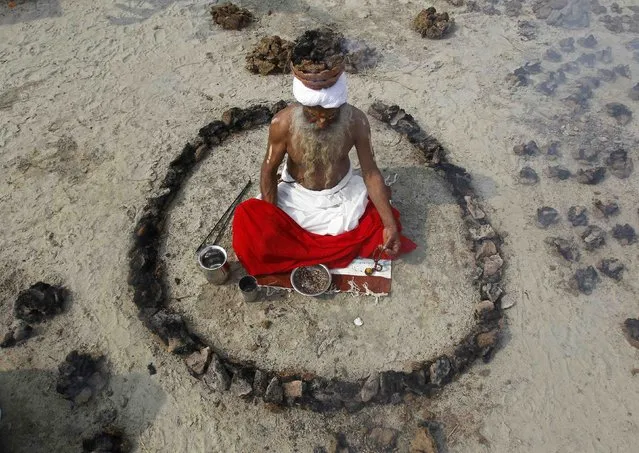
A Sadhu or a Hindu holy man offers prayers while sitting inside a circle of burning “Upale” (or dried cow dung cakes) on the occasion to mark the Basant or spring festival, on the banks of river Ganga in the northern Indian city of Allahabad January 24, 2015. Basant is celebrated mainly in the northern Indian states marking the start of the spring season. (Photo by Jitendra Prakash/Reuters)

A Sadhu or a Hindu holy man offers prayers while sitting inside a circle of burning “Upale” (or dried cow dung cakes) on the occasion to mark the Basant or spring festival, on the banks of river Ganga in the northern Indian city of Allahabad January 24, 2015. Basant is celebrated mainly in the northern Indian states marking the start of the spring season. (Photo by Jitendra Prakash/Reuters)
Details
25 Jan 2015 09:07:00
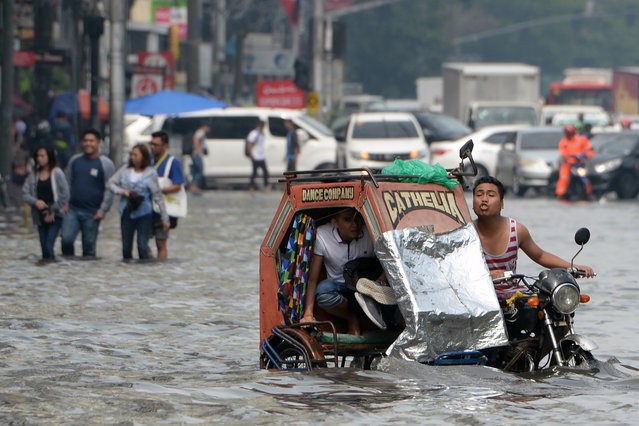
A commuter holding his shoes rides on a tricyle through a flooded street, caused by a heavy downpour brought about by the southwest moonson, in Manila on August 2, 2019. (Photo by Ted Aljibe/AFP Photo)

A commuter holding his shoes rides on a tricyle through a flooded street, caused by a heavy downpour brought about by the southwest moonson, in Manila, Philippines on August 2, 2019. (Photo by Ted Aljibe/AFP Photo)
Details
27 Aug 2019 00:03:00
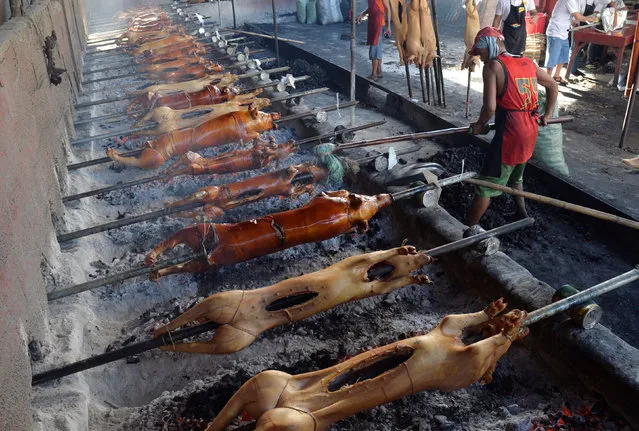
A worker roasts rows of freshly slaughtered pigs, known locally as “lechon” and famously served as main courses during the New Year revelry, at a store in Manila, Philippines, December 31, 2016. (Photo by Ezra Acayan/Reuters)

A worker roasts rows of freshly slaughtered pigs, known locally as “lechon” and famously served as main courses during the New Year revelry, at a store in Manila, Philippines, December 31, 2016. (Photo by Ezra Acayan/Reuters)
Details
10 Jun 2017 08:20:00
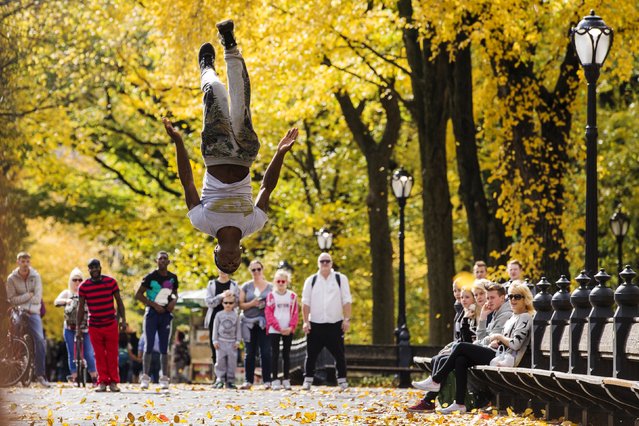
A street performer jumps in the air inside Central Park as the colors of autumn become more prevalent in New York, October 29, 2015. (Photo by Lucas Jackson/Reuters)

A street performer jumps in the air inside Central Park as the colors of autumn become more prevalent in New York, October 29, 2015. (Photo by Lucas Jackson/Reuters)
Details
31 Oct 2015 08:08:00
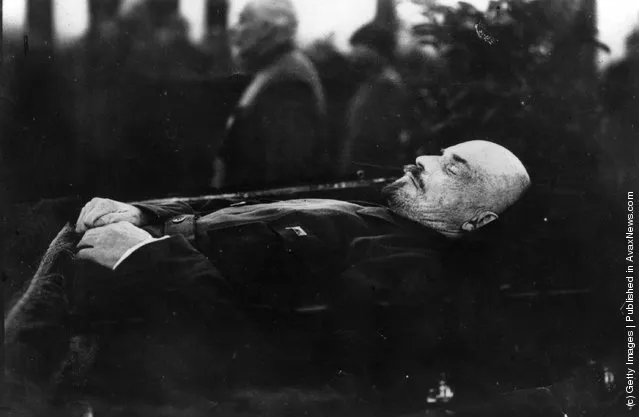
1924:  Vladimir Ilyich Lenin lying in state in the Kremlin

Photo: Vladimir Ilyich Lenin (1870 – 1924) lying in state in the Kremlin. (Photo by Hulton Archive/Getty Images). 1924

Important! For the same article in Russian language click here.

Something quite intriguing is happening within Russian-speaking internet during the last few – should you type a fully academic inquiry (at least, according to Russian academic requirements) in national search engines for "Lenin's mausoleum" – the first thing you get (even in top 10 searches) is website pages talking about black magic and occult. Website authors view this construction differently, but unconditionally agree on one thing: the mausoleum of the "leader of the world proletariat” – the essence of a magical artifact, a sort of “energy vampire”. It was built with a certain purpose: to drain the energy out of miserable Soviet citizens on one hand; and to poison the anthroposphere of one-sixth part of the earth with its vibes (the exact territory that was occupied by the former Soviet Union), depriving the Russian people of will to resist on the other hand. Complete nonsense? No doubt. Nevertheless, an intriguing one. Well, probably because some oddities do exist in mausoleum's history. These oddities are the thing we are going to discuss this time. First, let me refresh you memory on the subject.
Details
16 Oct 2011 11:27:00
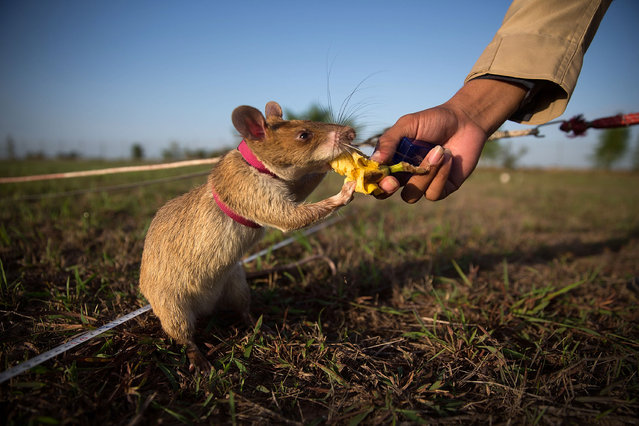
A mine detection rat is given banana as a reward after successfully identifying an inactive mine on July 2, 2015 in Siem Reap, Cambodia. (Photo by Taylor Weidman/Getty Images)

A mine detection rat is given banana as a reward after successfully identifying an inactive mine on July 2, 2015 in Siem Reap, Cambodia. The Cambodian Mine Action Center (CMAC) working with the Belgian NGO APOPO has recently begun testing the feasability of using large mine detection rats from Tanzania to help clear fields of mines and unexploded ordnance in one of the most bombed and mined countries in the world. (Photo by Taylor Weidman/Getty Images)
Details
03 Jul 2015 13:31:00
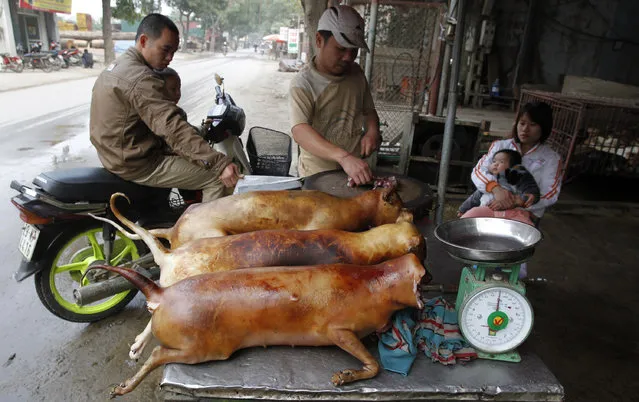
A vendor (C) cuts slaughtered dogs for sale at his roadside stall in Duong Noi village, outside Hanoi December 16, 2011. While animal rights activists have condemned eating dog meat as cruel treatment of the animals, it is still an accepted popular delicacy for some Vietnamese, as well in some other Asian countries. (Photo by Reuters/Kham)

A vendor (C) cuts slaughtered dogs for sale at his roadside stall in Duong Noi village, outside Hanoi December 16, 2011. While animal rights activists have condemned eating dog meat as cruel treatment of the animals, it is still an accepted popular delicacy for some Vietnamese, as well in some other Asian countries. Duong Noi is well-known as a dog-meat village, where hundreds of dogs are killed each day for sale as popular traditional food. Dog-eating as a custom is rooted in Vietnam and was developed as a result of poverty. One kilogram of dog meat costs about 130,000 dongs ($6.2). (Photo by Reuters/Kham)

Details
16 Jul 2013 11:40:00