Madson of Santos reacts during the match between Santos and Palmeiras as part of Brasileirao Series A 2022 at Vila Belmiro Stadium on May 29, 2022 in Santos, Brazil. (Photo by Carla Carniel/Reuters)
Moana Mason, 8, participates in the People's Summit event on Guajara Bay during the COP30 U.N. Climate Summit, Wednesday, November 12, 2025, in Belem, Brazil. (Photo by Joshua A. Bickel/AP Photo)
A man celebrates the start of the New Year, backdropped by fireworks exploding in the background over Copacabana Beach in Rio de Janeiro, Brazil, Saturday, January 1, 2022. (Photo by Bruna Prado/AP Photo)
These images offer a rare glimpse of life within remote Brazilian tribes. Award winning photographer Ricardo, 47, said: “The pictures show the traditional way of life of these people who live in harmony with nature. The photos provide an overview of the contemporary situation of the indigenous people in Brazil”. Here: Bej indian in the Xingu river, state of Mato Grosso, Brazil on December 20, 2015 .(Photo by Ricardo Stuckert/Caters News Agency)
Jesus Christ The Redeemer is seen during sunrise in Rio de Janeiro, Brazil August 2, 2016. Christ the Redeemer is an Art Deco statue of Jesus Christ in Rio de Janeiro, Brazil, created by Polish-French sculptor Paul Landowski and built by the Brazilian engineer Heitor da Silva Costa, in collaboration with the French engineer Albert Caquot. The face was created by the Romanian artist Gheorghe Leonida1. (Photo by Kai Pfaffenbach/Reuters)
A follower of the Afro-Brazilian religion Umbanda pays tribute for Iemanja, goddess of the sea, in Copacabana Beach in Rio de Janeiro, Brazil December 29, 2017. Hundreds of practitioners of Brazil's Afro-Brazilian Candomble and Umbanda faiths have gathered at Rio de Janeiro's Copacabana beach to honor Yemanja. Worshippers were mostly dressed in white as they launched their offerings to Iemanja: small boats with flowers and bowls with candles and fruits. (Photo by Ricardo Moraes/Reuters)
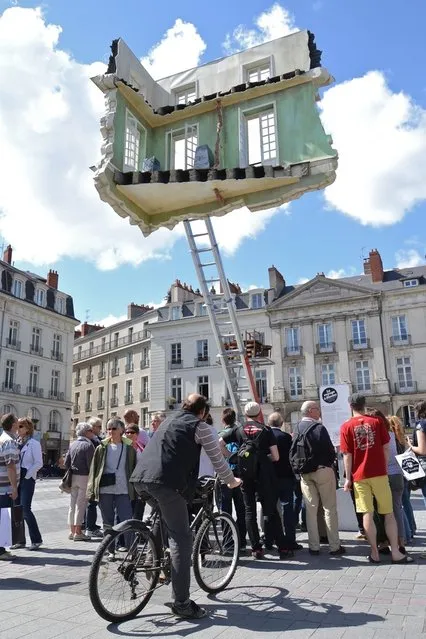
Like a scene from a fantasy movie, a dilapidated room that appears to have been literally ripped out of a building remains suspended in mid air above Nantes, France. Its walls were torn apart, revealing bricks below the plaster, and wood floors reveal the joists inside. The floating room is accessible via a ladder. The gravity defying surreal installation is the work of Argentinean artist Leandro Erlich. The large-scale piece, called “Monte-meubles – L’ultime déménagement” (literally - The Furniture Lift – The Ultimate Moving Out), was created for the biannual Le Voyage a Nantes, an art festival which turns the entire French city into an art gallery.
Flying squirrels are not capable of powered flight like birds or bats; instead, they glide between trees. They are capable of obtaining lift within the course of these flights, with flights recorded to 90 meters (295 ft). The direction and speed of the animal in midair is varied by changing the positions of its two arms and legs, largely controlled by small cartilaginous wrist bones. This changes the tautness of the patagium, a furry parachute-like membrane that stretches from wrist to ankle. It has a fluffy tail that stabilizes in flight. The tail acts as an adjunct airfoil, working as an air brake before landing on a tree trunk.