Loading...
Done
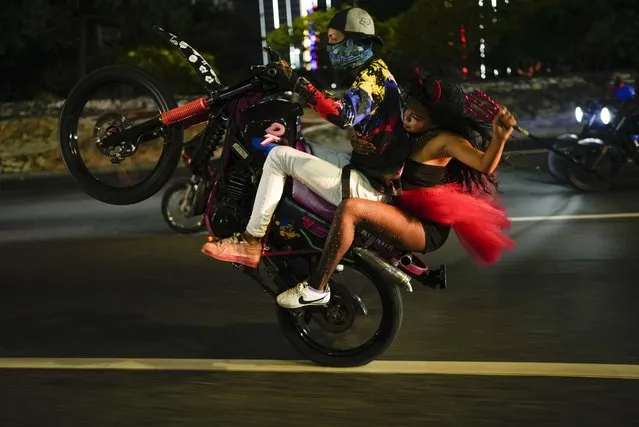
A motorcyclist pops a wheelie as a woman wearing a devil costume holds on, during a night rally celebrating Halloween, in Caracas, Venezuela, Saturday, October 29, 2022. (Photo by Ariana Cubillos/AP Photo)

A motorcyclist pops a wheelie as a woman wearing a devil costume holds on, during a night rally celebrating Halloween, in Caracas, Venezuela, Saturday, October 29, 2022. (Photo by Ariana Cubillos/AP Photo)
Details
10 Dec 2023 03:58:00
A model presents a creation by a Mexican designer during a catwalk show promoting diversity and inclusion to foster acceptance and removal of barriers that disabled people face in the country, in Mexico City, Mexico on October 26, 2022. (Photo by Quetzalli Nicte-Ha/Reuters)

A model presents a creation by a Mexican designer during a catwalk show promoting diversity and inclusion to foster acceptance and removal of barriers that disabled people face in the country, in Mexico City, Mexico on October 26, 2022. (Photo by Quetzalli Nicte-Ha/Reuters)
Details
15 Dec 2023 06:00:00
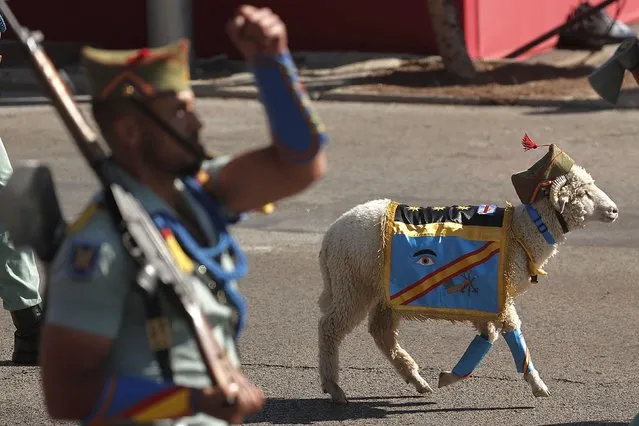
Spanish lamb march during a military parade on the national holiday known as “Hispanidad” or Hispanic Day in Madrid, Spain on October 12, 2022. (Photo by Burak Akbulut/Anadolu Agency via Getty Images)

Spanish lamb march during a military parade on the national holiday known as “Hispanidad” or Hispanic Day in Madrid, Spain on October 12, 2022. (Photo by Burak Akbulut/Anadolu Agency via Getty Images)
Details
22 Dec 2023 00:27:00
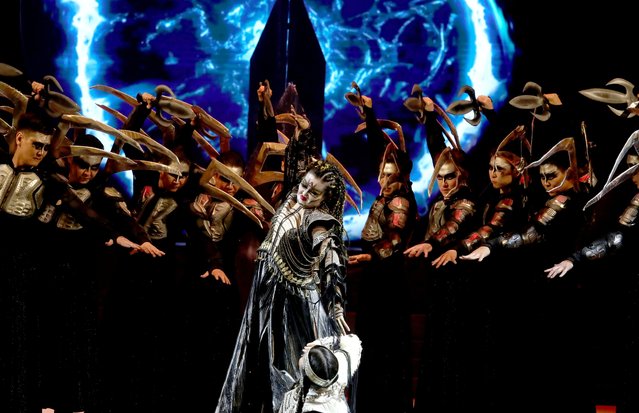
Yakut artists present a performance based on the national Yakut epic “Olonkho” on the stage of the Kyrgyz Academic Opera and Ballet Theater in Bishkek, Kyrgyzstan, 24 April 2024. The State Opera and Ballet Theater of the Republic of Sakha (Yakutia) is on tour in Bishkek on April 24 and 26. (Photo by Igor Kovalenko/EPA/EFE)

Yakut artists present a performance based on the national Yakut epic “Olonkho” on the stage of the Kyrgyz Academic Opera and Ballet Theater in Bishkek, Kyrgyzstan, 24 April 2024. The State Opera and Ballet Theater of the Republic of Sakha (Yakutia) is on tour in Bishkek on April 24 and 26. (Photo by Igor Kovalenko/EPA/EFE)
Details
04 Aug 2025 03:38:00
Among the fish populations that could be harmed by the Xayaburi dam in Laos is the critically endangered Mekong giant catfish, considered by the Guinness Book of World Records to be the world’s largest freshwater fish. The fish, which grows to 650 pounds and about 10 feet long, is only found in the Mekong River. It is migratory, moving between downstream habitats in Cambodia upstream to northern Thailand and Laos each year to spawn. Some experts fear the Xayaburi dam could block the migration and drive the giant catfish to extinction

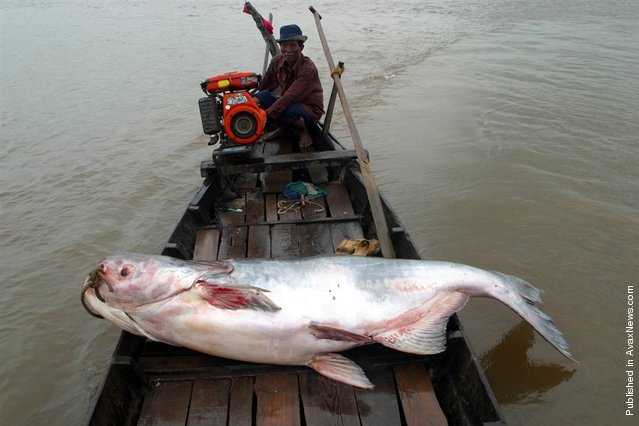
Among the fish populations that could be harmed by the Xayaburi dam in Laos is the critically endangered Mekong giant catfish, considered by the Guinness Book of World Records to be the world’s largest freshwater fish. The fish, which grows to 650 pounds and about 10 feet long, is only found in the Mekong River. It is migratory, moving between downstream habitats in Cambodia upstream to northern Thailand and Laos each year to spawn. Some experts fear the Xayaburi dam could block the migration and drive the giant catfish to extinction. (Photo by Courtesy of Zeb Hogan/University of Nevada, Reno)
Details
20 Apr 2012 13:10:00
Dust covered seats are pictured inside the lounge of the Jaisalmer Airport in desert state of Rajasthan, India, August 13, 2015. (Photo by Anindito Mukherjee/Reuters)

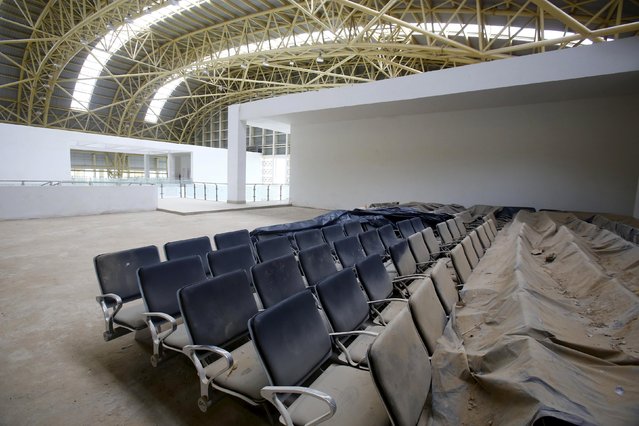
Dust covered seats are pictured inside the lounge of the Jaisalmer Airport in desert state of Rajasthan, India, August 13, 2015. Two-and-a-half years after the completion of a new $17 million terminal building, the airport in Jaisalmer, a small and remote desert city in India's western Rajasthan state, stands empty. (Photo by Anindito Mukherjee/Reuters)
Details
20 Aug 2015 13:26:00
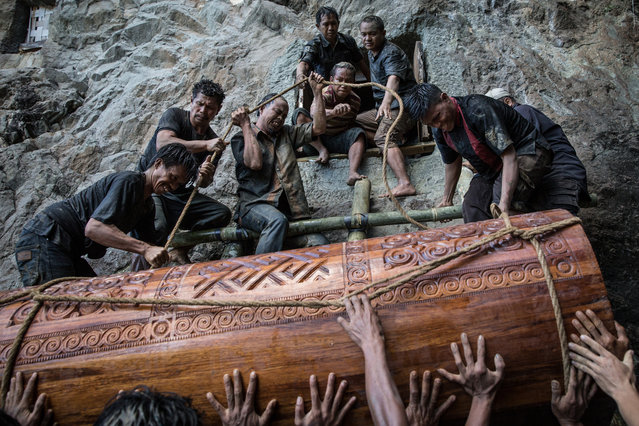
It is said that Torajans are people who “live to die”. For this Indonesian ethnic group, funerals are such extravagant events that they sometimes attract tourists. Families can postpone burials years (and the deceased are considered sick and hosted at home until the funeral) until the family can raise enough money and gather as many relatives as possible. And then it’s a jubilant multiday social event with a parade, dances and animal sacrifices. Agung Parameswara photographed these funerary practices when he traveled to South Sulawesi province, where the Torajans live. But often, their funeral isn’t the last time the dead are seen. In August, crypts are opened, coffins are slid back out and bodies delicately unsheathed. This tender ritual is known as Ma’Nene, which is customarily performed every few years. (Photo by Agung Parameswara/The Washington Post)

It is said that Torajans are people who “live to die”. For this Indonesian ethnic group, funerals are such extravagant events that they sometimes attract tourists. Families can postpone burials years (and the deceased are considered sick and hosted at home until the funeral) until the family can raise enough money and gather as many relatives as possible. And then it’s a jubilant multiday social event with a parade, dances and animal sacrifices. Agung Parameswara photographed these funerary practices when he traveled to South Sulawesi province, where the Torajans live. (Photo by Agung Parameswara/The Washington Post)
Details
06 Oct 2016 09:15:00
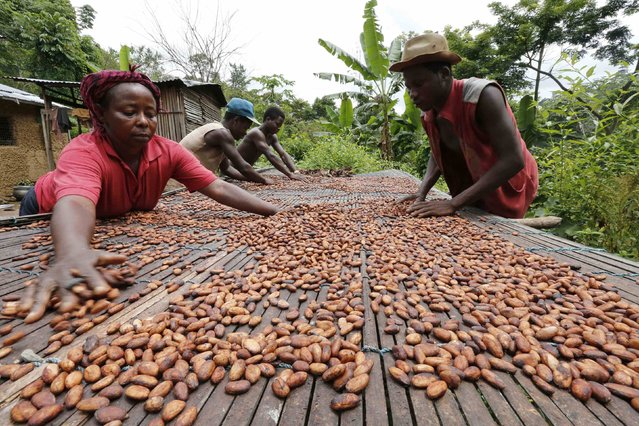
People work with cocoa beans in Enchi June 17, 2014. Picture taken June 17, 2014. Ghana emerged as a success story during the 2000s, when war, political instability and a disastrous liberalization brought Ivory Coast's cocoa sector to its knees. Ghana's output more than tripled from 340,000 tons in the 2001/02 season to a record 1,025,000 tons a decade later. Strict controls cemented its reputation as a producer of top quality beans, establishing a brand that fetches a premium. (Photo by Thierry Gouegnon/Reuters)

People work with cocoa beans in Enchi June 17, 2014. Picture taken June 17, 2014. Ghana emerged as a success story during the 2000s, when war, political instability and a disastrous liberalization brought Ivory Coast's cocoa sector to its knees. Ghana's output more than tripled from 340,000 tons in the 2001/02 season to a record 1,025,000 tons a decade later. Strict controls cemented its reputation as a producer of top quality beans, establishing a brand that fetches a premium. (Photo by Thierry Gouegnon/Reuters)

Details
03 Aug 2014 07:17:00