Loading...
Done
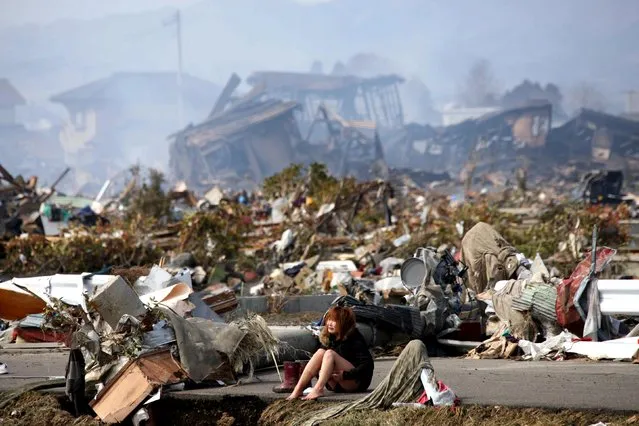
A woman cries while sitting on a road amid the destroyed city of Natori, Miyagi Prefecture in northern Japan March 13, 2011, after a massive earthquake and tsunami that are feared to have killed more than 10,000 people. (Photo by Asahi Shimbun/Reuters)

A woman cries while sitting on a road amid the destroyed city of Natori, Miyagi Prefecture in northern Japan March 13, 2011, after a massive earthquake and tsunami. Five years on from the tsunami that triggered meltdowns at Japan's Fukushima nuclear plant, the page is anything but turned. A magnitude 9 earthquake and towering tsunami on March 11, 2011 killed nearly 16,000 people along Japan's northeastern coast and left more than 2,500 missing. The 10-metre (33-foot) tsunami swept away everything in its path, including houses, ships, cars and farm buildings. (Photo by Asahi Shimbun/Reuters)
Details
09 Mar 2016 12:40:00
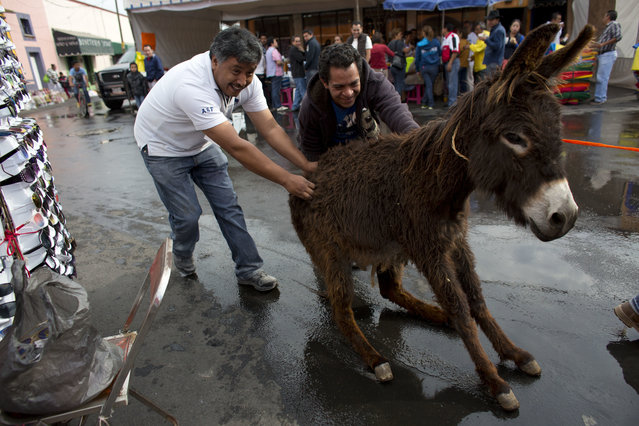
In this May 1, 2016 photo, a reluctant donkey is alternately pushed and pulled and enticed with carrots toward town hall in order to be dressed for the costume competition at the annual donkey festival in Otumba, Mexico state, Mexico. Otumba was an important donkey market during Spanish colonial times, standing at the crossroads of major roads leading to Mexico City, where the beasts pulled heavy loads and carried travelers. Today, however, farmers use tractors and pickup trucks, and the donkey population is in decline. (Photo by Rebecca Blackwell/AP Photo)

In this May 1, 2016 photo, a reluctant donkey is alternately pushed and pulled and enticed with carrots toward town hall in order to be dressed for the costume competition at the annual donkey festival in Otumba, Mexico state, Mexico. Otumba was an important donkey market during Spanish colonial times, standing at the crossroads of major roads leading to Mexico City, where the beasts pulled heavy loads and carried travelers. Today, however, farmers use tractors and pickup trucks, and the donkey population is in decline. (Photo by Rebecca Blackwell/AP Photo)
Details
04 May 2016 11:55:00
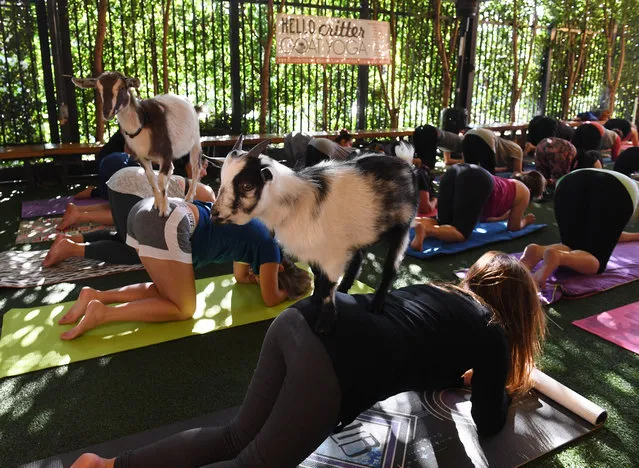
Yoga students take a class with Nigerian Dwarf goats held by the 'Hello Critter Goat Yoga' team at the Golden Road Pub in Los Angeles, California on May 7, 2018. The goat yoga fitness craze is sweeping the United States with classes now held in pubs, farms and halls across the country. (Photo by Mark Ralston/AFP Photo)

Yoga students take a class with Nigerian Dwarf goats held by the 'Hello Critter Goat Yoga' team at the Golden Road Pub in Los Angeles, California on May 7, 2018. The goat yoga fitness craze is sweeping the United States with classes now held in pubs, farms and halls across the country. (Photo by Mark Ralston/AFP Photo)
Details
12 May 2018 09:28:00
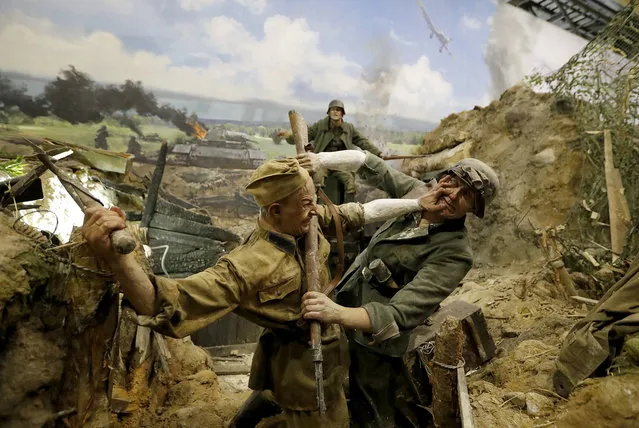
A scene showing one of the first trench battles is prepared for the opening of the 3D Panorama exhibition “Memory talks. The road through war” in the former Sevcabel port in St. Petersburg, Russia, 16 September 2019. (Photo by Anatoly Maltsev/EPA/EFE)

A scene showing one of the first trench battles is prepared for the opening of the 3D Panorama exhibition “Memory talks. The road through war” in the former Sevcabel port in St. Petersburg, Russia, 16 September 2019. Various 3D dioramas – containing genuine wartime items such as aircraft, tanks and artillery in original size – allow visitors to walk through scenes from the beginning to the end of WWII without any museum barriers. The exhibition opens from 19 September 2019 to May 2020. (Photo by Anatoly Maltsev/EPA/EFE)
Details
19 Sep 2019 00:01:00


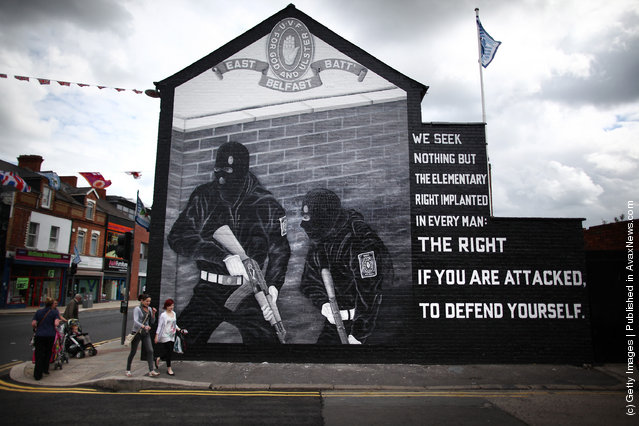
People walk past a mural depicting Ulster Volunteer Force gunmen in the mainly protestant area of East Belfast on June 23, 2011 in Northern Ireland. The Short Strand and Newtonards Road areas of East Belfast remained mostly peaceful after Protestant and Catholics groups were involved in a stand-off overnight. (Photo by Peter Macdiarmid/Getty Images)
Details
24 Jun 2011 09:53:00
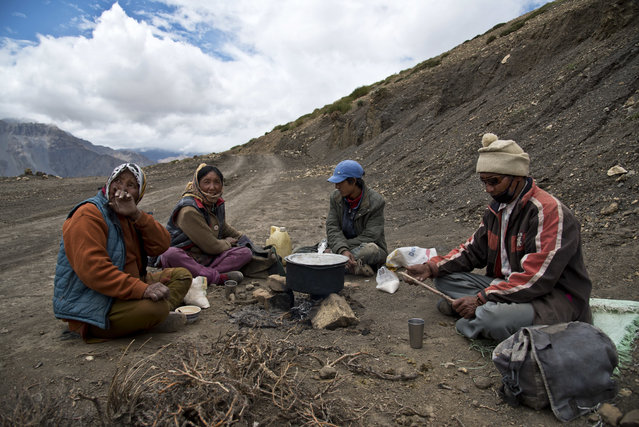
In this August 17, 2016, photo, from left to right, Chhering Chodom, 60, Tashi Yangzom, 50, Lobsang Chhering, 27, and Dorje Tandup, 58, drink milk tea on the side of the road. For centuries, the sleepy valley nestled in the Indian Himalayas remained a hidden Buddhist enclave forbidden to outsiders. Enduring the harsh year-round conditions of the high mountain desert, the people of Spiti Valley lived by a simple communal code – share the Earth's bounty, be hospitable to neighbors, and eschew greed and temptation at all turns. That's all starting to change, for better or worse. Since India began allowing its own citizens as well as outsiders to visit the valley in the early 1990s, tourism and trade have boomed. And the marks of modernization, such as solar panels, asphalt roads and concrete buildings, have begun to appear around some of the villages that dot the remote landscape at altitudes above 4,000 meters (13,000 feet). (Photo by Thomas Cytrynowicz/AP Photo)

In this August 17, 2016, photo, from left to right, Chhering Chodom, 60, Tashi Yangzom, 50, Lobsang Chhering, 27, and Dorje Tandup, 58, drink milk tea on the side of the road. For centuries, the sleepy valley nestled in the Indian Himalayas remained a hidden Buddhist enclave forbidden to outsiders. Enduring the harsh year-round conditions of the high mountain desert, the people of Spiti Valley lived by a simple communal code – share the Earth's bounty, be hospitable to neighbors, and eschew greed and temptation at all turns. That's all starting to change, for better or worse. (Photo by Thomas Cytrynowicz/AP Photo)
Details
15 Sep 2016 09:22:00
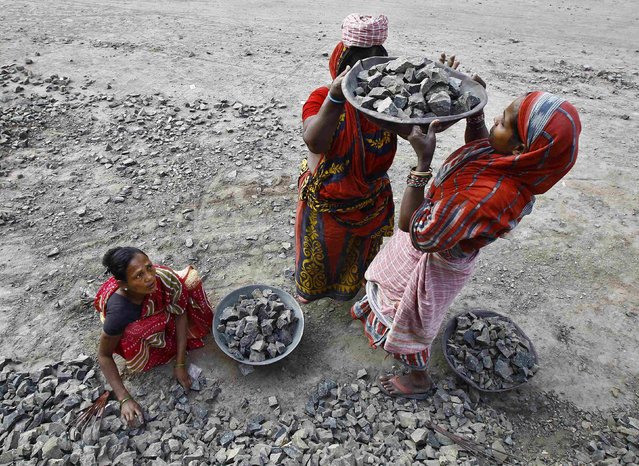
Women labourers work at the construction site of a road in Kolkata January 8, 2015. Across towns and cities in India, it is not uncommon to see women cleaning building sites, carrying bricks and or shoveling gravel - helping construct the infrastructure necessary for the country's economic and social development. (Photo by Rupak De Chowdhuri/Reuters)

Women labourers work at the construction site of a road in Kolkata January 8, 2015. Across towns and cities in India, it is not uncommon to see women cleaning building sites, carrying bricks and or shoveling gravel – helping construct the infrastructure necessary for the country's economic and social development. They help build roads, railway tracks, airports, and offices. They lay pipes for clean water supplies, cables for telecommunications, and dig the drains for sewage systems. But although women make up at least 20 percent of India's 40 million construction workers, they are less recognized than male workers with lower pay and often prone to safety hazards and sexual harassment. They are often unaware of their rights or scared to complain, say activists now trying to campaign for better treatment of women in the construction industry. (Photo by Rupak De Chowdhuri/Reuters)
Details
15 Jan 2015 13:47:00
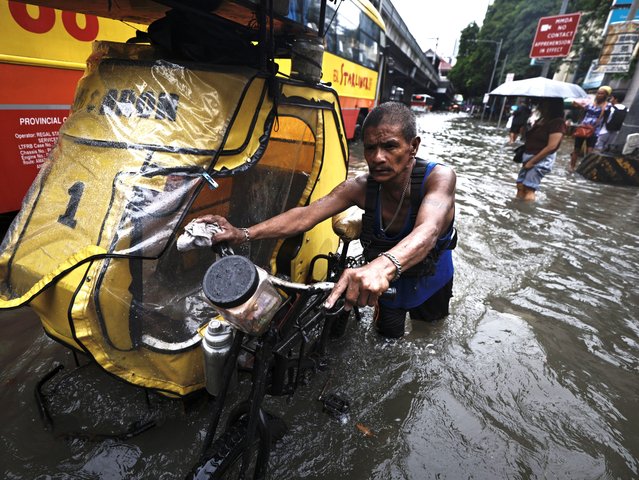
Filipinos wade through floodwaters along a road in Manila, Philippines, 22 August 2025. The National Disaster Risk Reduction and Management Council (NDRRMC) on 22 August raised its alert level and warned residents of flooding in low-lying areas and landslides in mountainous communities brought by a storm. The government weather bureau said a Tropical Cyclone Wind Signal Number 01 is raised over 17 areas due to Tropical Depression “Isang”, which made landfall over the Aurora province. (Photo by Francis R. Malasig/EPA)

Filipinos wade through floodwaters along a road in Manila, Philippines, 22 August 2025. The National Disaster Risk Reduction and Management Council (NDRRMC) on 22 August raised its alert level and warned residents of flooding in low-lying areas and landslides in mountainous communities brought by a storm. The government weather bureau said a Tropical Cyclone Wind Signal Number 01 is raised over 17 areas due to Tropical Depression “Isang”, which made landfall over the Aurora province. (Photo by Francis R. Malasig/EPA)
Details
20 Sep 2025 03:43:00