Loading...
Done
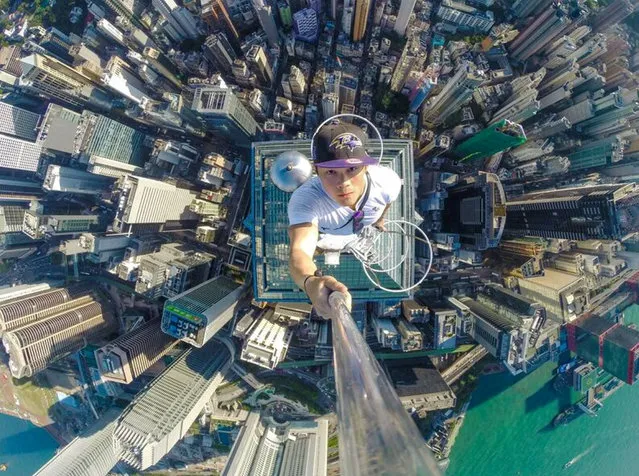
Roof-topping enthusiast Daniel Lau takes a selfie with high-rise buildings down below as he stands on the top of a skyscraper in Hong Kong, China on August 15, 2017. Welcome to “roof-topping”, where daredevils take pictures of themselves standing on the tops of tall buildings, or in some cases even dangling from them, without any safety equipment. A craze that began in Russia has now taken hold in Hong Kong, one of the world's most vertical cities, with dramatic results. “I'm an explorer”, said Daniel Lau, one of the three who climbed to the top of The Center. A student, he said roof-topping was “a getaway from my structured life”. “Before doing this, I lived like an ordinary person, having a boring life”, he said. “I wanted to do something special, something memorable. I want to let people see Hong Kong, the place they are living, from a new perspective”. Mr Lau said he had been inspired by Russian climbers and that he was unafraid of the vertiginous heights he scales. (Photo by ImagineChina/Rex Features/Shutterstock)

Roof-topping enthusiast Daniel Lau takes a selfie with high-rise buildings down below as he stands on the top of a skyscraper in Hong Kong, China on August 15, 2017. A craze that began in Russia has now taken hold in Hong Kong, one of the world's most vertical cities. Mr Lau said he had been inspired by Russian climbers and that he was unafraid of the vertiginous heights he scales. (Photo by ImagineChina/Rex Features/Shutterstock)
Details
16 Aug 2017 07:23:00
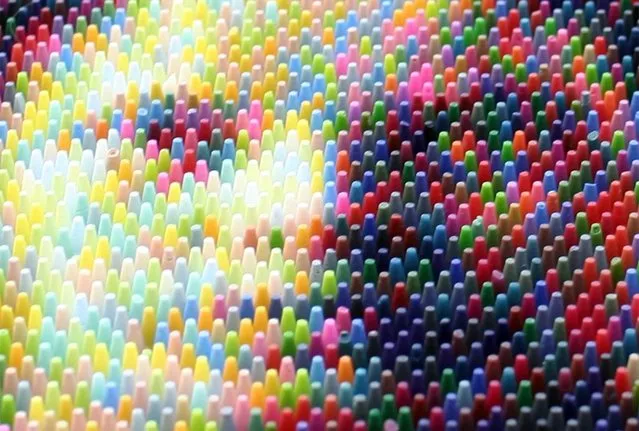
Art by Christian Faur

Christian Faur is an artist based in Granville, Ohio. Looking for a new technique, he experimented with painting with wax, but he didn’t feel the results were satisfactory.Then, at Christmas in 2005, his young daughter opened a box of 120 Crayola crayons he’d bought her, and everything clicked into place. Faur decided he would create pictures out of the crayons themselves, packing thousands of them together so they become like the colored pixels on a TV screen. He starts each work by scanning a photo into a computer and breaking the image down into colored blocks He then draws a grid that shows him exactly where to place each crayon The finished artworks are packed tightly into wooden frames. He actually makes the crayons himself, hand-casting each one in a mould.
Details
28 Jul 2012 10:03:00
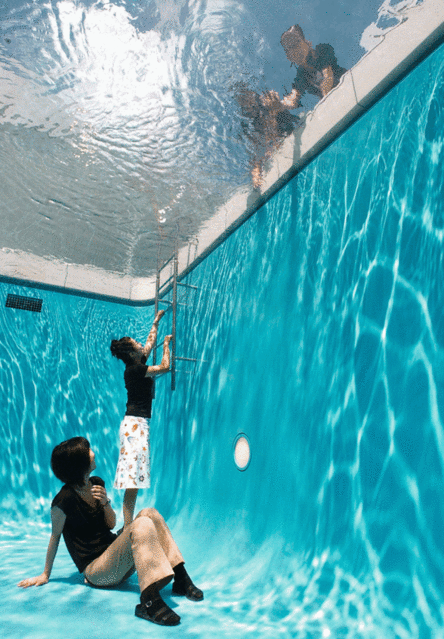
Swimming Pool Art Installation by Leandro Erlich

In one of the Museum’s courtyards is a swimming pool framed by a limestone deck. When seen from the deck, the pool appears to be filled with deep, shimmering water. In fact, however, a layer of water only some 10 centimeters deep is suspended over transparent glass. Below the glass is an empty space with aquamarine walls that viewers can enter. The work sets up an unfolding sequence of experiences—we view the pool through the glass wall enclosing the courtyard; from the deck, looking down into the pool; and from the interior of the pool, looking up. The Swimming Pool might hence be considered a place where, slowly, with time, different perspectives and perceptions of self and others all come to intersect.
Details
25 Aug 2012 07:31:00
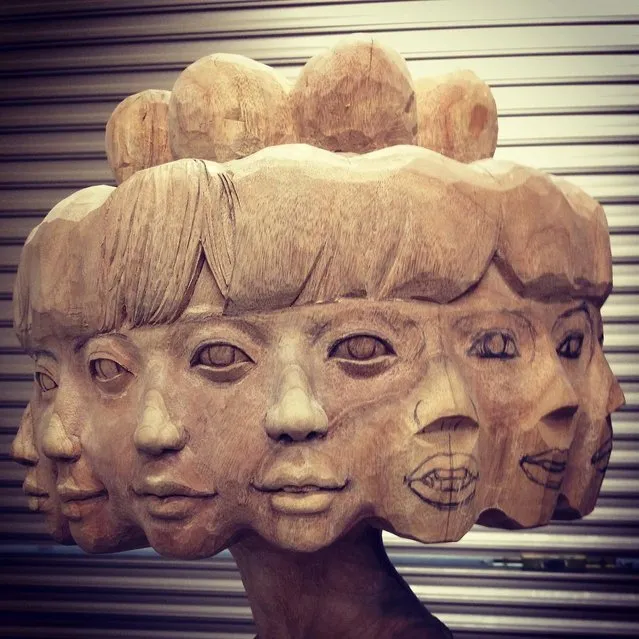
Sculpture By Yoshitoshi Kanemaki

There are many ways to interpret the creations of Yoshitoshi Kanemaki, whose works usually involve sculptures of people where two or more characters have merged into a single being. Possibly, Yoshitoshi Kanemaki is trying to express through his sculptures that everyone’s soul is multifaceted. Good emotions are mixed with the bad, love is mixed with hate, contempt with admiration. How often do you hear that a person loves someone deeply, while doing completely horrendous things, unable to see that he or she is destroying their object of love? Nevertheless, we should be thankful to the nature for all the different emotions that we are able to feel. Unlike animals, who only show simple forms of emotions, such as anger, happiness, and a few others, human soul is much deeper, allowing us to feel a full plethora of emotions. (Photo by Yoshitoshi Kanemaki)
Details
20 Nov 2014 12:26:00
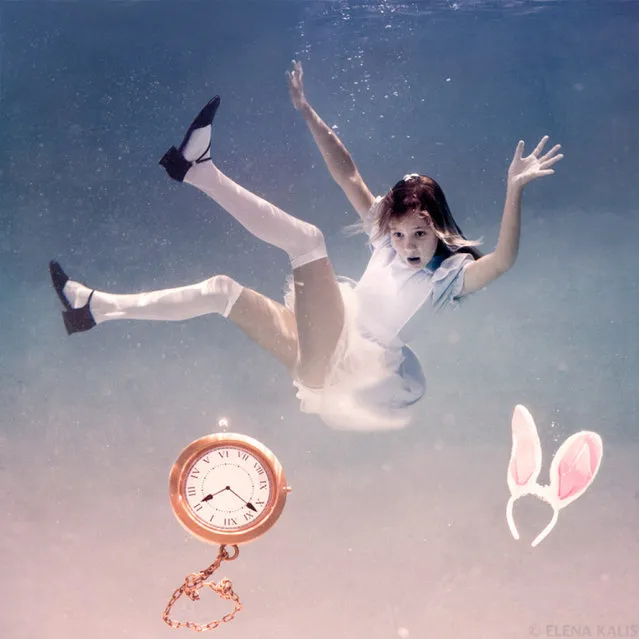
“Alice in Waterland” by Photographer Elena Kalis

“Alice in Waterland” is a beautiful series of photographs re-imagining the Lewis Carroll classic underwater. It’s a creation of photographer Elena Kalis, who lives on a small island in The Bahamas, surrounded, she says, “by pristine clear warm water. Underwater is where I spend a lot of time; snorkeling, diving, photographing. It is fascinating how the world changes down below: light, sound, gravity and proportions are different from what we are used to”. (Photo by Elena Kalis)
Details
02 Aug 2013 10:31:00


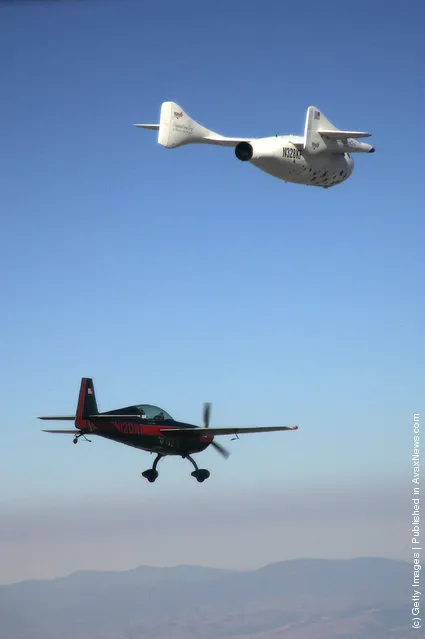
“SpaceShipOne was a suborbital air-launched spaceplane that completed the first manned private spaceflight in 2004. That same year, it won the US$10 million Ansari X Prize and was immediately retired from active service. Its mothership was named “White Knight”. Both craft were developed and flown by Mojave Aerospace Ventures, which was a joint venture between Paul Allen and Scaled Composites, Burt Rutan's aviation company. Allen provided the funding of approximately US$25 million”. – Wikipedia

Photo: A chase plane follows SpaceShipOne after it reached a height of 62 miles in the first non-governmental flight to leave the Earth's atmosphere on June 21, 2004 in Mojave, California. SpaceShipOne spacecraft was carried to a height of 50,000 by the twin-turbojet high-altitude research aircraft, “White Knight”, where it was launched for its final climb. The space effort was funded by Microsoft co-founder Paul Allen and headed by aerospace engineer Burt Rutan. (Photo by Jim Campbell-Pool/Getty Images)
Details
26 Jun 2011 09:56:00
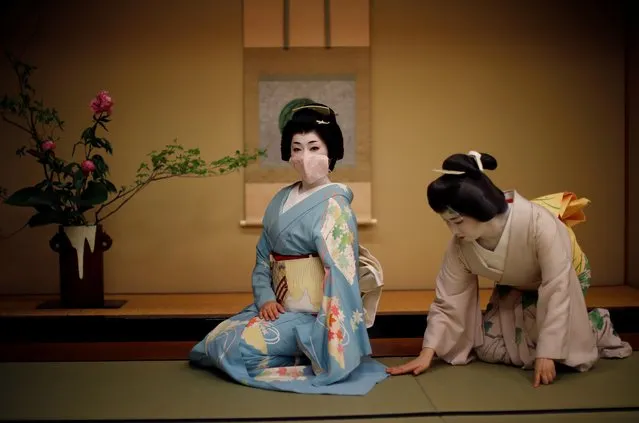
Mayu adjusts Koiku’s kimono, as Koiku wears a protective face mask while posing for a photograph, before they work at a party where they will entertain with other geisha at Japanese luxury restaurant Asada in Tokyo, Japan, June 23, 2020. The coronavirus pandemic has made Tokyo's geisha fear for their centuries-old profession as never before. Though the number of geisha - famed for their witty conversation, beauty and skill at traditional arts - has been falling for years, they were without work for months due to Japan's state of emergency and now operate under awkward social distancing rules. Engagements are down 95 percent, and come with new rules: no pouring drinks for customers or touching them even to shake hands, and sitting 2 meters apart. Masks are hard to wear with their elaborate wigs, so they mostly don't. “I was just full of anxiety”, said Mayu, 47. “I went through my photos, sorted my kimonos ... The thought of a second wave is terrifying”. (Photo by Kim Kyung-Hoon/Reuters)

Mayu adjusts Koiku’s kimono, as Koiku wears a protective face mask while posing for a photograph, before they work at a party where they will entertain with other geisha at Japanese luxury restaurant Asada in Tokyo, Japan, June 23, 2020. (Photo by Kim Kyung-Hoon/Reuters)
Details
23 Jul 2020 00:03:00
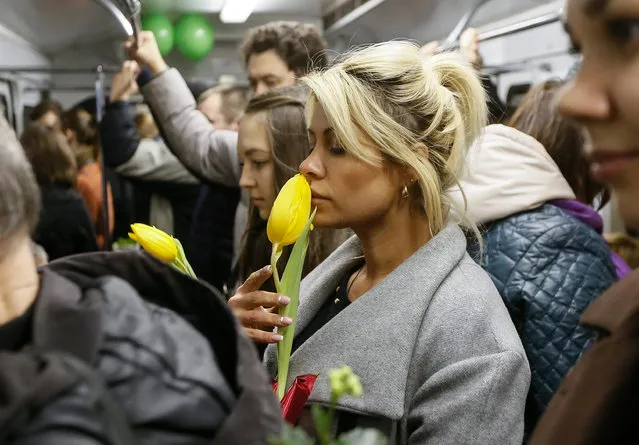
Female metro passengers hold flowers presented to them by metro workers, prior to International Women's Day in Kiev, Ukraine, 02 March 2016. (Photo by Sergey Dolzhenko/EPA)

Female metro passengers hold flowers presented to them by metro workers, prior to International Women's Day in Kiev, Ukraine, 02 March 2016. The hustle and bustle of the morning commute is broken up by an unexpected surprise. The first passengers to step on the train receive – a warm welcome and a pot of flowers. One woman says, “It's very nice. All the running around and then you're given a flower, it's not often. It's very nice. I'm going to take care of this flower”. International Women's Day first emerged from the activities of labour movements at the turn of the twentieth century, in North America and across Europe, it is celebrated on March 08 in many countries around the world. (Photo by Sergey Dolzhenko/EPA)
Details
03 Mar 2016 11:34:00