Loading...
Done
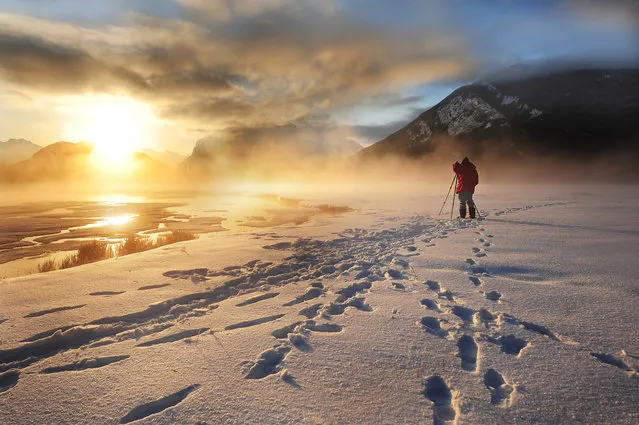
“Artist of the light”. While shooting sunrise in the Vermilion lakes area of Banff national park, Canada, I met a fellow photographer on the scene. Most of the time, we tried not to get in each other's way, however, just by accident, I snapped a picture with him in it working on his tripod settings, and it turned out to be a great photo compared to my sunrise shots. (Photo and caption by Victor Liu/National Geographic Traveler Photo Contest)

“Artist of the light”. While shooting sunrise in the Vermilion lakes area of Banff national park, Canada, I met a fellow photographer on the scene. Most of the time, we tried not to get in each other's way, however, just by accident, I snapped a picture with him in it working on his tripod settings, and it turned out to be a great photo compared to my sunrise shots. (Photo and caption by Victor Liu/National Geographic Traveler Photo Contest)

ATTENTION! All pictures are presented in high resolution. To see Hi-Res images – just TWICE click on any picture. In other words, click small picture – opens the BIG picture. Click BIG picture – opens VERY BIG picture.
Details
27 Jun 2013 13:11:00
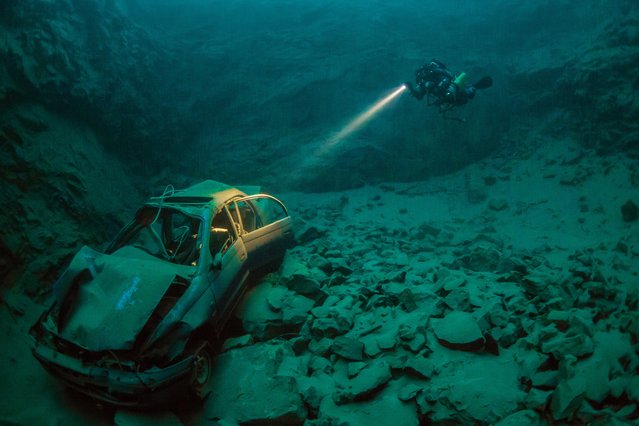
Wide-angle category winner. Part of the Illusion by Marcus Blatchford (UK). Location: National Dive & Activity Centre, Chepstow, Wales. “This is the deepest inland dive centre in the UK. The dive plan was to explore the deep end, but this time I dived ‘unplugged’ (without my strobes). With the exception of this change to my camera technique, there were no planned shots I wanted to achieve – just a fun dive with ad-hoc photos along the way. Shortly after this photo was captured, in 6C water and two hours of decompression ahead of us, we turned and started the long ascent back to the surface”. (Photo by Marcus Blatchford/Underwater Photographer of the Year 2016)

Wide-angle category winner. Part of the Illusion by Marcus Blatchford (UK). Location: National Dive & Activity Centre, Chepstow, Wales. “This is the deepest inland dive centre in the UK. The dive plan was to explore the deep end, but this time I dived ‘unplugged’ (without my strobes). With the exception of this change to my camera technique, there were no planned shots I wanted to achieve – just a fun dive with ad-hoc photos along the way. Shortly after this photo was captured, in 6C water and two hours of decompression ahead of us, we turned and started the long ascent back to the surface”. (Photo by Marcus Blatchford/Underwater Photographer of the Year 2016)
Details
18 Feb 2016 13:44:00
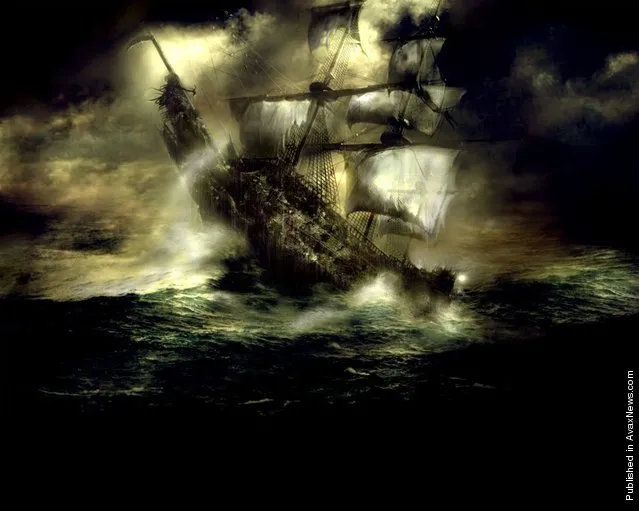
Ocean voyage

Do you think that history is a science? Well, not exactly. First, and foremost, history is the state's “legend of wars”, it’s official regalia. Of course, public historians are not interested in scientific truth – quite the opposite. In this respect, any attempt to present a state’s history as altruistic and benevolent as possible is welcomed and encouraged – as opposed to any revisionism attempts that may be more accurate. In this matter, Chinese have surpassed us all – they revised in highly creative manner (but rather shamelessly) the technology already invented by Europeans, a process that resulted in oldest state on the planet. Here is an interesting paradox: ask any sinologist about the Middle Kingdom during second century B.C., and he will describe it to you in such a vivid manner as if he has been living there all his life – but as soon as you will ask him to describe Chinese history in the 19-20th centuries… let's say, his eagerness will be greatly diminished. However, we will discuss China in a different article, and in the meantime we will try to understand how exactly historic “legend of wars” is formed and functions – based on a specific and well-known example. A great example is Ferdinand Magellan's first voyage around the world.
Details
14 Nov 2011 09:11:00
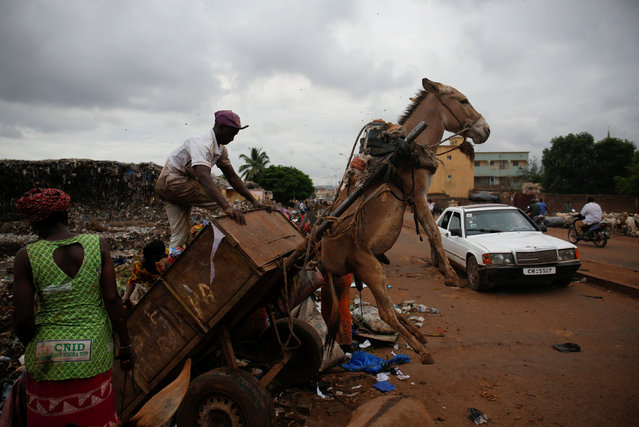
A waste picker unloads garbage at a waste transfer station in Bamako, Mali, August 19, 2018. In the Malian capital of Bamako, donkey carts driven by young men like 19-year-old Arouna Diabate play a vital role battling the fast-growing city's waste problem. Every morning before dawn, Diabate hitches his donkey to a cart and sets off on his rounds, going door-to-door to collect household garbage which he delivers to a local waste transfer station for a monthly salary of around $35. “I won't be picking up trash with a donkey cart for the rest of my life, but for now people appreciate us because we help clean up the homes of Bamako”, Diabate said. (Photo by Luc Gnago/Reuters)

A waste picker unloads garbage at a waste transfer station in Bamako, Mali, August 19, 2018. In the Malian capital of Bamako, donkey carts driven by young men like 19-year-old Arouna Diabate play a vital role battling the fast-growing city's waste problem. Every morning before dawn, Diabate hitches his donkey to a cart and sets off on his rounds, going door-to-door to collect household garbage which he delivers to a local waste transfer station for a monthly salary of around $35. “I won't be picking up trash with a donkey cart for the rest of my life, but for now people appreciate us because we help clean up the homes of Bamako”, Diabate said. (Photo by Luc Gnago/Reuters)
Details
18 Sep 2018 00:01:00
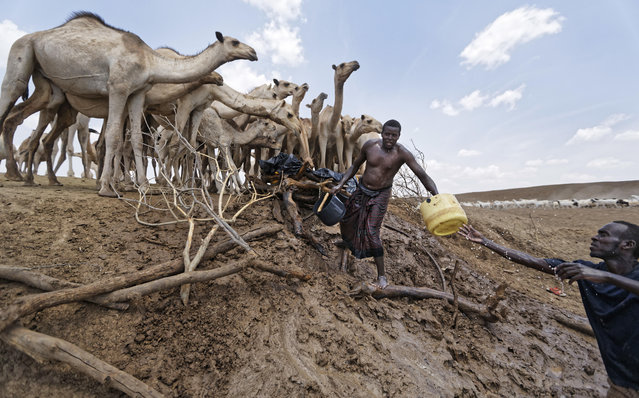
Camel herders scoop up water in plastic buckets from one of the few watering holes in the area, to water their animals near the drought-affected village of Bandarero, near Moyale town on the Ethiopian border, in northern Kenya, Friday, March 3, 2017. The U.N. humanitarian chief, Stephen O'Brien, toured Bandarero village on Friday and called on the international community to act to “avert the very worst of the effects of drought and to avert a famine to make sure we don't go from what is deep suffering to a catastrophe”. (Photo by Ben Curtis/AP Photo)

Camel herders scoop up water in plastic buckets from one of the few watering holes in the area, to water their animals near the drought-affected village of Bandarero, near Moyale town on the Ethiopian border, in northern Kenya, Friday, March 3, 2017. The U.N. humanitarian chief, Stephen O'Brien, toured Bandarero village on Friday and called on the international community to act to “avert the very worst of the effects of drought and to avert a famine to make sure we don't go from what is deep suffering to a catastrophe”. (Photo by Ben Curtis/AP Photo)
Details
05 Mar 2017 00:03:00
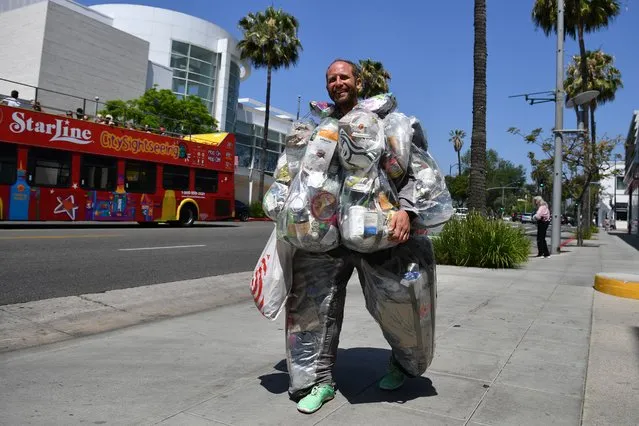
Environmental activist Rob Greenfield walks around Beverly Hills, California on May 16, 2022 wearing a suit filled with every piece of trash he has generated living and consuming like a typical American for one month to raise awareness about how much garbage just one person generates. Greenfield is currently on day 27 of the 30-day project and is wearing 63 lbs (28,5kg) of trash. We all know someone with a rubbish fashion sense, but Rob Greenfield is proud to be wearing garbage – it's all part of a plan to show just how much trash we unthinkingly throw away every month. The campaigner is wandering the streets of Los Angeles and surrounding cities in a specially designed suit that holds all of the junk he has produced over the last few weeks. (Photo by Robyn Beck/AFP Photo)

Environmental activist Rob Greenfield walks around Beverly Hills, California on May 16, 2022 wearing a suit filled with every piece of trash he has generated living and consuming like a typical American for one month to raise awareness about how much garbage just one person generates. (Photo by Robyn Beck/AFP Photo)
Details
25 May 2022 05:06:00
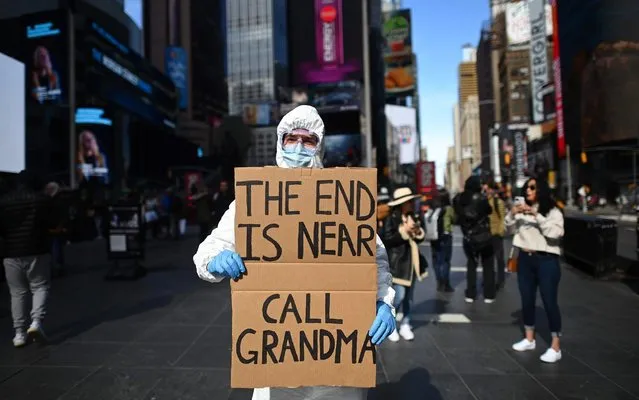
A man wearing a hazmat suit and a mask holds a sign reading “The end is near – call grandma” at Times Square on March 14, 2020 in New York City. The World Health Organization said March 13, 2020 it was not yet possible to say when the COVID-19 pandemic, which has killed more than 5,000 people worldwide, will peak. “It's impossible for us to say when this will peak globally”, Maria Van Kerkhove, who heads the WHO's emerging diseases unit, told a virtual press conference, adding that “we hope that it is sooner rather than later”. (Photo by Johannes Eisele/AFP Photo)

A man wearing a hazmat suit and a mask holds a sign reading “The end is near – call grandma” at Times Square on March 14, 2020 in New York City. The World Health Organization said March 13, 2020 it was not yet possible to say when the COVID-19 pandemic, which has killed more than 5,000 people worldwide, will peak. “It's impossible for us to say when this will peak globally”, Maria Van Kerkhove, who heads the WHO's emerging diseases unit, told a virtual press conference, adding that “we hope that it is sooner rather than later”. (Photo by Johannes Eisele/AFP Photo)
Details
16 Mar 2020 00:07:00
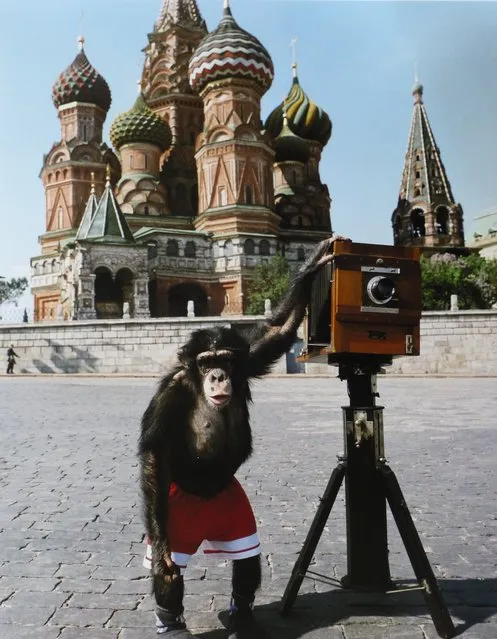
Picture by Guzelian GUZELIAN: SAY BANANAS! COLLECTION OF PHOTOGRAPHS TAKEN BY A MONKEY GO UNDER THE HAMMER. A collection of one-of-a-kind photographs is set to go under the hammer - so unique because the set was taken by a CHIMPANZEE. The pictures, which will be sold at Sotheby's Auction House, London, on June 5, are expected to fetch between £50,000 - £70,000.

“As is probably stated somewhere in the theory of infinity, if you give an infinite amount of monkeys an infinite number of old-timey Polaroid cameras, one will eventually take “artistic” blurry photos of historical sites in Moscow which will then be auctioned at Sotheby's for an estimated $75,000 – $100,000. Fortunately for every simian art fan with a spare $100k, we are currently living in the very universe in which that concept is reality. Eighteen photographs by – and of – Mikki The Chimpanzee are going to auction on June 5, 2013”. – Callie Beusman via Jezebel.com. (Photo by Guzelian)
Details
21 May 2013 09:31:00