A fan cheers during the African Cup of Nations Group F soccer match between DR Congo and Zambia in San Pedro, Ivory Coast, Wednesday, January 17, 2024. (Photo by Themba Hadebe/AP Photo)
Festivalgoers are seen running to the gates during the the first weekend of the Coachella Valley Music and Arts Festival at the Empire Polo Club on Friday, April 12, 2024, in Indio, Calif. (Photo by Amy Harris/Invision/AP Photo)
An artist carries a clay statue of Lord Vishwakarma to the market for sale before the Vishwakarma Puja festival in Nepal, Kathmandu on September 16, 2025. The festival, celebrated on September 17 this year, honors Lord Vishwakarma, regarded as the divine engineer and craftsman, and involves prayers for creativity, prosperity, and protection of tools and workplaces. (Photo by Safal Prakash Shrestha/ZUMA Press Wire/Rex Features/Shutterstock)
“Panopticons is an arts and regeneration project of the East Lancashire Environmental Arts Network managed by Mid Pennine Arts. It involved the construction of series of 21st-century landmarks, or Panopticons (structures providing a comprehensive view), across East Lancashire, England, as symbols of the renaissance of the area”. – Wikipedia
Photo: “Singing Ringing Tree. The Singing Ringing Tree is a musical sculpture overlooking Burnley. It was designed by architects Mike Tonkin and Anna Liu of Tonkin Liu and constructed from pipes of galvanised steel”. (Photos by WandereringSoul/Mark Tighe)
Lake Baikal is the world's oldest lake, at 25 million years (possibly older), and deepest, averaging 744.4 metres (2,442 ft).
Located in the south of the Russian region of Siberia, between Irkutsk Oblast to the northwest and the Buryat Republic to the southeast, it is the most voluminous freshwater lake in the world, containing roughly 20% of the world's unfrozen surface fresh water.
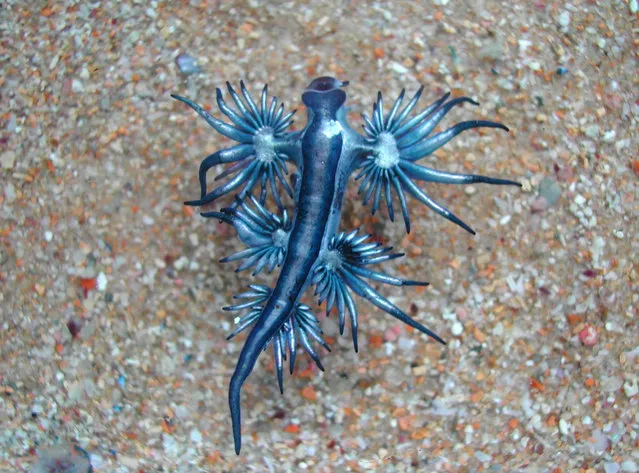
Glaucus atlanticus (common names sea swallow, blue glaucus, blue sea slug and blue ocean slug) is a species of small-sized blue sea slug, a pelagic aeolid nudibranch, a marine gastropod mollusk in the family Glaucidae. This is the only species in the genus Glaucus, but is closely related to Glaucilla marginata, which sometimes is included in Glaucus.