Loading...
Done
A girl reacts as coloured water is thrown on her face while celebrating Holi, the Festival of Colours, in Mumbai, India, March 13, 2017. (Photo by Shailesh Andrade/Reuters)

A girl reacts as coloured water is thrown on her face while celebrating Holi, the Festival of Colours, in Mumbai, India, March 13, 2017. (Photo by Shailesh Andrade/Reuters)
Details
16 Mar 2017 00:06:00
28 year old Rupa has her hair shaven to donate to the Gods at the Thiruthani Murugan Temple November 10, 2016 in Thiruttani, India. Rupa donated her hair with the wish that her daughter's illness is cured. The process of shaving ones hair and donating it to the Gods is known as tonsuring. It is common for Hindu believers to tonsure their hair at a temple as a young child, and also to celebrate a wish coming true, such as the birth of a baby or the curing of an illness. The “temple hair”, as it's known, is then auctioned off to a processing plant and then sold as pricey wigs and weaves in the US, Europe and Africa. (Photo by Allison Joyce/Getty Images)

28 year old Rupa has her hair shaven to donate to the Gods at the Thiruthani Murugan Temple November 10, 2016 in Thiruttani, India. Rupa donated her hair with the wish that her daughter's illness is cured. The process of shaving ones hair and donating it to the Gods is known as tonsuring. It is common for Hindu believers to tonsure their hair at a temple as a young child, and also to celebrate a wish coming true, such as the birth of a baby or the curing of an illness. The “temple hair”, as it's known, is then auctioned off to a processing plant and then sold as pricey wigs and weaves in the US, Europe and Africa. (Photo by Allison Joyce/Getty Images)
Details
21 Nov 2016 10:30:00
Ecuadorian indigenous people celebrate the festival of the moon or Kulla Raymi, in Quito, Ecuador, 21 September 2021. A circle on the ground made up of fruits and inside the Andean symbol of the chacana, multinational geometric flags and a cross that symbolizes the four cardinal points, were the setting in which the festival of the moon, the Kulla, was commemorated this Tuesday. Raymi, on a hill in Quito. It is one of the four most significant festivities of the Andean agroecological calendar, which commemorates the beginning of life and exalts women as the maximum representation of fertility. (Photo by Jose Jacome/EPA/EFE)

Ecuadorian indigenous people celebrate the festival of the moon or Kulla Raymi, in Quito, Ecuador, 21 September 2021. A circle on the ground made up of fruits and inside the Andean symbol of the chacana, multinational geometric flags and a cross that symbolizes the four cardinal points, were the setting in which the festival of the moon, the Kulla, was commemorated this Tuesday. Raymi, on a hill in Quito. It is one of the four most significant festivities of the Andean agroecological calendar, which commemorates the beginning of life and exalts women as the maximum representation of fertility. (Photo by Jose Jacome/EPA/EFE)
Details
22 Sep 2021 09:01:00
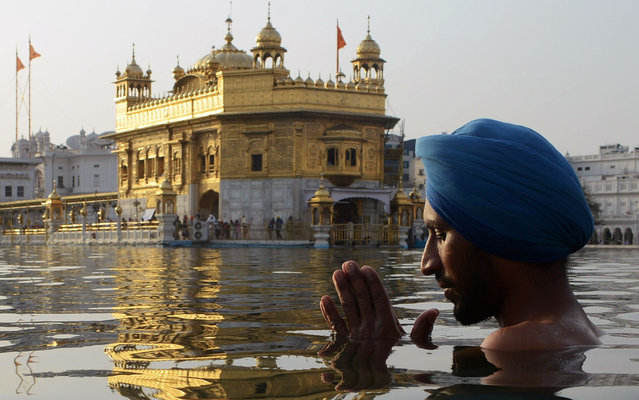
An Indian Sikh devotee takes a dip in the holy sarover (water tank) at the Golden Temple on the eve of “Ghallughara Diwas”, the 29th Anniversary of Operation Bluestar, in Amritsar on June 5, 2013. The 1984 assault on the Golden Temple complex by the Indian army was conducted in an attempt to arrest separatists Sikh leader Sant Jarnail Singh Bhindranwale and his militant followers who had initiated a movement for a separate Sikh state. (Photo by Narinder Nanu/AFP Photo)

An Indian Sikh devotee takes a dip in the holy sarover (water tank) at the Golden Temple on the eve of “Ghallughara Diwas”, the 29th Anniversary of Operation Bluestar, in Amritsar on June 5, 2013. The 1984 assault on the Golden Temple complex by the Indian army was conducted in an attempt to arrest separatists Sikh leader Sant Jarnail Singh Bhindranwale and his militant followers who had initiated a movement for a separate Sikh state. (Photo by Narinder Nanu/AFP Photo)
Details
08 Jun 2013 11:00:00
Aquarium visitors attend a dinner party in an underwater tunnel in Tianjin, China on September 15, 2016. (Photo by Feature China/Barcroft Images)

Aquarium visitors attend a dinner party in an underwater tunnel in Tianjin, China on September 15, 2016. Tianjin Haichang Polar Ocean World opened in the city of Tianjin, southeast of Beijing, in 2010. It gives visitors a chance to see more than 150 large animals from the Arctic and Antarctic regions, including polar bears. (Photo by Feature China/Barcroft Images)
Details
16 Sep 2016 11:18:00
Peruvian shamans holding a figure of a Nino Jesus (Child Jesus) and a snake perform a ritual at the Rimac river to fight the negative effects of the Nino weather phenomena over Nature, in Lima, October 1, 2015. (Photo by Mariana Bazo/Reuters)

Peruvian shamans holding a figure of a Nino Jesus (Child Jesus) and a snake perform a ritual at the Rimac river to fight the negative effects of the Nino weather phenomena over Nature, in Lima, October 1, 2015. (Photo by Mariana Bazo/Reuters)
Details
03 Oct 2015 08:07:00
A man photographs Anila Quayyum Agha's “Intersections” art work on the first day of ArtPrize at the Grand Rapids Art Museum in Grand Rapids, Mich. on Wednesday, September 24, 2014. (Photo by Emily Rose Bennett/AP Photo/The Grand Rapids Press)

A man photographs Anila Quayyum Agha's “Intersections” art work on the first day of ArtPrize at the Grand Rapids Art Museum in Grand Rapids, Mich. on Wednesday, September 24, 2014. (Photo by Emily Rose Bennett/AP Photo/The Grand Rapids Press)
Details
27 Sep 2014 12:04:00
Picture of a float taking part in the “White Day” parade during the Carnival of Blacks and Whites in Pasto, Colombia on January 6, 2024. The Blacks and Whites carnival has its origins in a mix of Andean, Amazonian and Pacific cultural expressions, and it celebrates the ethnic diversity in the region and was proclaimed by UNESCO as intangible cultural heritage in 2009. (Photo by Joaquín Sarmiento/AFP Photo)

Picture of a float taking part in the “White Day” parade during the Carnival of Blacks and Whites in Pasto, Colombia on January 6, 2024. The Blacks and Whites carnival has its origins in a mix of Andean, Amazonian and Pacific cultural expressions, and it celebrates the ethnic diversity in the region and was proclaimed by UNESCO as intangible cultural heritage in 2009. (Photo by Joaquín Sarmiento/AFP Photo)
Details
17 Mar 2025 03:56:00