Loading...
Done
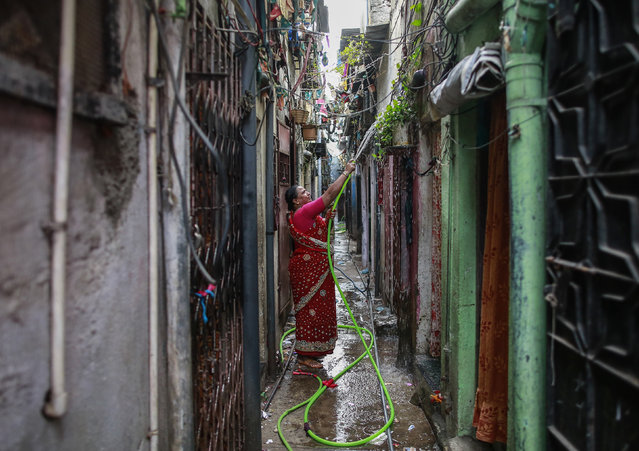
A woman waters the plants outside her house in an alley at a slum in Mumbai October 28, 2014. (Photo by Danish Siddiqui/Reuters)

A woman waters the plants outside her house in an alley at a slum in Mumbai October 28, 2014. (Photo by Danish Siddiqui/Reuters)
Details
29 Oct 2014 11:55:00
An alpaca chewing a leaf is pictured on November 18,  2014 in the zoo of  Frankfurt am Main, Germany. (Photo by Frank Rumpenhorst/AFP Photo/DPA)

An alpaca chewing a leaf is pictured on November 18, 2014 in the zoo of Frankfurt am Main, Germany. (Photo by Frank Rumpenhorst/AFP Photo/DPA)
Details
22 Nov 2014 14:07:00
Serbian police officers of the Special Anti-Terrorist Unit pose for a picture in their base outside Belgrade October 8, 2014. (Photo by Marko Djurica/Reuters)

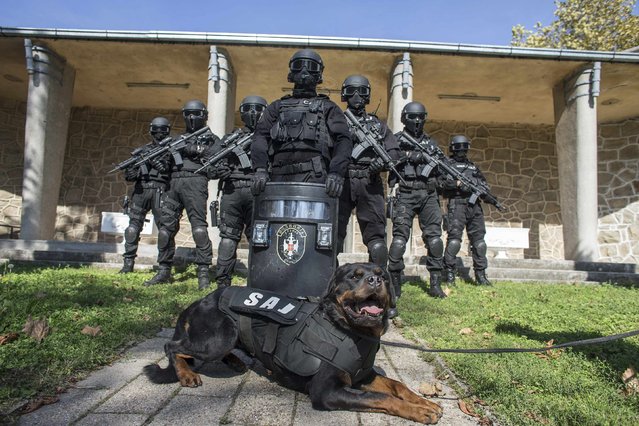
Serbian police officers of the Special Anti-Terrorist Unit pose for a picture in their base outside Belgrade October 8, 2014. When the killing of an unarmed black teenager by a white policeman in Ferguson, Missouri, in August sparked sometimes violent protests, the response of police in camouflage gear and armoured vehicles wielding stun grenades and assault rifles seemed more like a combat operation than a public order measure. Some U.S. police departments have recently acquired U.S. military-surplus hardware from wars abroad, but there are many law enforcers around the world whose rules of engagement also allow the use of lethal force with relatively few restrictions. But for every regulation that gives police wide scope to use firearms, there is another code that sharply limits their use. In Serbia, police may use measures ranging from batons to special vehicles, water cannon and tear gas on groups of people who have gathered illegally and are behaving in a way that is violent or could cause violence, but they may use firearms only when life is endangered. (Photo by Marko Djurica/Reuters)
Details
27 Nov 2014 14:53:00
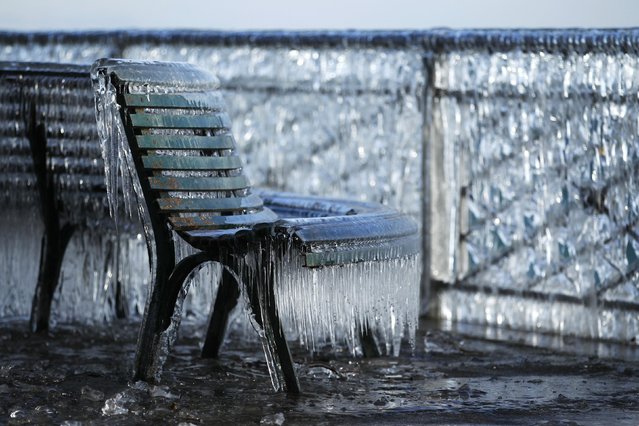
A frozen public bench is seen next to a lake side due to the heavy wind conditions in Geneva February 8, 2015. (Photo by Pierre Albouy/Reuters)

A frozen public bench is seen next to a lake side due to the heavy wind conditions in Geneva February 8, 2015. (Photo by Pierre Albouy/Reuters)
Details
19 Feb 2015 14:52:00
In this February 28, 2015 photo, teammates struggle to lift a bull off the trapped leg of a charro, during the bull riding event at a charreada in Mexico City. National Charros Association President Manuel Basurto Rojas said: “We in charreria are taking things into our own hands. We have codes, we have rules, for how to treat the animals. On the other hand, there is a lot of danger involved for the men doing these tricks”. (Photo by Rebecca Blackwell/AP Photo)

In this February 28, 2015 photo, teammates struggle to lift a bull off the trapped leg of a charro, during the bull riding event at a charreada in Mexico City. National Charros Association President Manuel Basurto Rojas said: “We in charreria are taking things into our own hands. We have codes, we have rules, for how to treat the animals. On the other hand, there is a lot of danger involved for the men doing these tricks”. (Photo by Rebecca Blackwell/AP Photo)
Details
15 Mar 2015 06:44:00
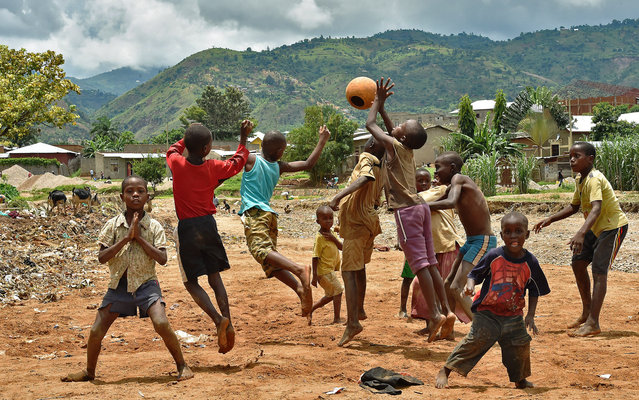
Children play football in Bujumbura, Burundi on March 19, 2015. (Photo by Carl de Souza/AFP Photo)

Children play football in Bujumbura, Burundi on March 19, 2015. (Photo by Carl de Souza/AFP Photo)
Details
21 Mar 2015 12:25:00
A wide-angle view shows the ascent of the shuttle Challenger on January 28, 1986. In the seconds after ignition, the rocket engines' hot blast began the process of destruction. (Photo by NASA)

A wide-angle view shows the ascent of the shuttle Challenger on January 28, 1986. In the seconds after ignition, the rocket engines' hot blast began the process of destruction. (Photo by NASA)
Details
28 Jan 2016 12:28:00
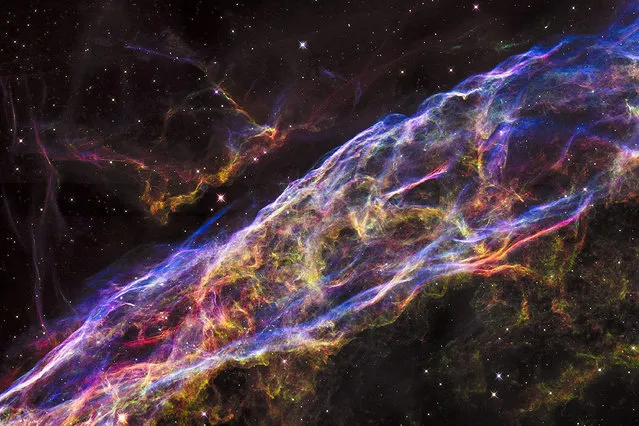
A small section of the expanding remains of the Veil Nebula, a massive star that exploded about 8,000 years ago. The entire nebula is 110 light-years across, covering six full moons on the sky as seen from Earth, and resides about 2,100 light-years away in the constellation Cygnus, the Swan. (Photo by Reuters/NASA/ESA/Hubble)

A small section of the expanding remains of the Veil Nebula, a massive star that exploded about 8,000 years ago. The entire nebula is 110 light-years across, covering six full moons on the sky as seen from Earth, and resides about 2,100 light-years away in the constellation Cygnus, the Swan. (Photo by Reuters/NASA/ESA/Hubble)
Details
29 Feb 2016 11:30:00