Loading...
Done
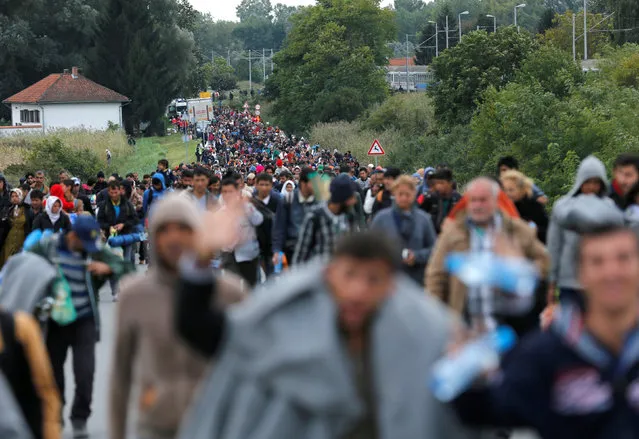
A year after hundreds of thousands of migrants and refugees snaked their way across southeastern Europe and onto television screens worldwide, the roads through the Balkans are now clear, depriving an arguably worsening tragedy of its poignant visibility. Europe's migrant crisis is at the very least numerically worse than it was last year. More people are arriving and more are dying. (Photo by Antonio Bronic/Reuters)

A year after hundreds of thousands of migrants and refugees snaked their way across southeastern Europe and onto television screens worldwide, the roads through the Balkans are now clear, depriving an arguably worsening tragedy of its poignant visibility. Reuters photographer, Antonio Bronic revisiting the people-packed locations where he and his colleagues captured last year's diaspora, found empty roads, unencumbered railway tracks and bucolic countryside. (Photo by Antonio Bronic/Reuters)


Details
12 Aug 2016 12:10:00
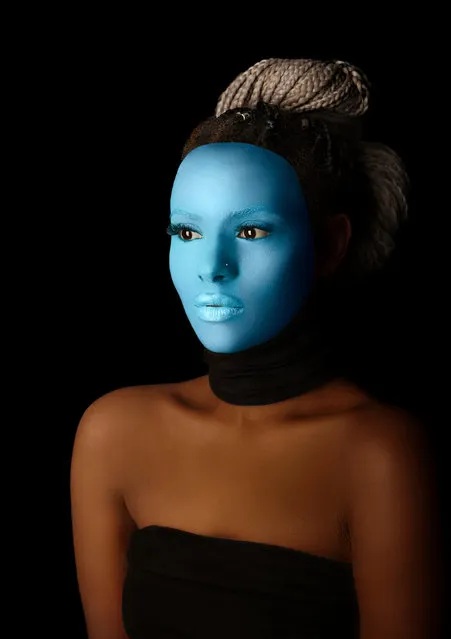
Brtukan. “Being a girl of colour in a society where the majority of the people are white, I have had to get used to all the different ways people approach me. From being asked what kind of rap music you listen to and how you wash your hair, to getting told, “you don’t sound black”, “you’re pretty for a black girl” or “you’re not that black so it’s OK”, as if being black is such a bad thing”. (Photo by Lisa Minogue/The Guardian)

As part of FLAIR Melbourne – a Flinders Lane art festival – Melbourne’s Lisa Minogue presents stylised photographic portraits of Australian women of colour, their faces painted vibrantly to accentuate their individuality and encourage the viewer to study each face more closely. Minogue asked each woman the same question: “What do the words “coloured girl” mean to you?”. (Photo by Lisa Minogue/The Guardian)
Details
17 Aug 2016 11:16:00
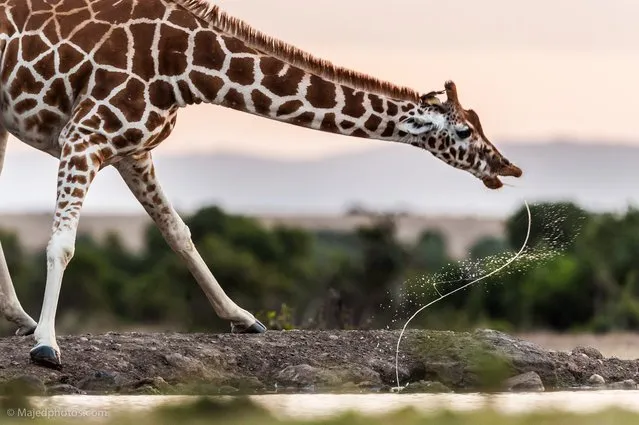
“We just want to move to search to the Leopard at that morning but we found a group of giraffes come toward a small lake and start drinking it was a nice moment when the Giraffe finish from drinking and leave a letters S with motion in the air”. (Photo and caption by Majed Ali)

National Geographic invites photographers from around the world to enter the 2013 National Geographic Photography Contest. The grand-prize winner will receive $10,000 (USD) and a trip to National Geographic headquarters in Washington, D.C., to participate in the annual National Geographic Photography Seminar in January 2014. Photo: “We just want to move to search to the Leopard at that morning but we found a group of giraffes come toward a small lake and start drinking it was a nice moment when the Giraffe finish from drinking and leave a letters “S” with motion in the air”. (Photo and caption by Majed Ali/National Geographic Photography Contest)
Details
15 Nov 2013 14:34:00
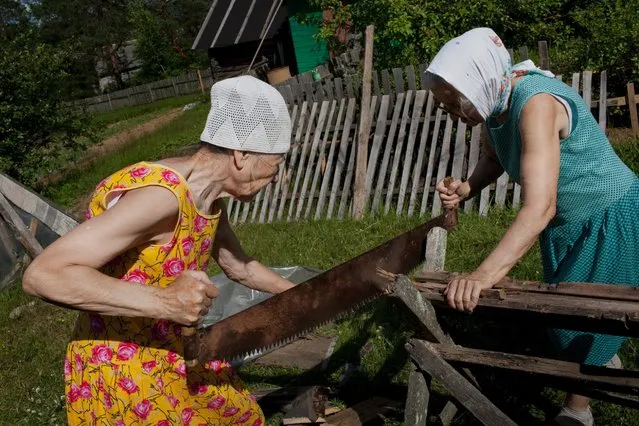
“Two-Handed Saw, 2014”. “Most of the neighbors have switched to power tools to run their households, the buzz of chain saws and weed-whackers overpowering the quieter sounds of country life, but my aunts hold on to the two-handed saw that's decades old, the sickle and scythe that need to be sharpened and polished after each use, the old axe that's becoming heavier each year. Each of these objects is familiar, holding memories of their brother, who succumbed to cancer a few years ago, of days before my grandfather lost his vision in the 50's, of busier days and longer futures”, Sablin told. (Photo by Nadia Sablin)

In northwest Russia, in a small village called Alekhovshchina, Nadia Sablin's aunts spend the warmer months together in the family home and live as the family has always lived, chopping wood to heat the house and making their own clothes. Sablin's book of photographs, “Aunties: The Seven Summers of Alevtina and Ludmila”, is published by Duke University Press. Here: “Two-Handed Saw, 2014”. (Photo by Nadia Sablin)
Details
25 Feb 2016 12:12:00
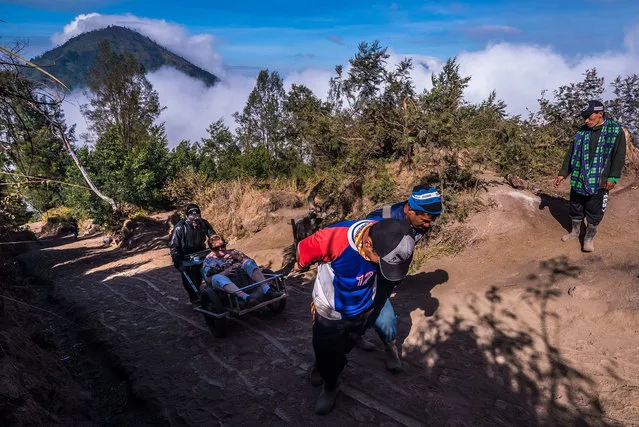
Miners pulling up lazy tourists to the rim of Kawah Ijen (Ijen Volcano), East Java, Indonesia on September 21, 2017. They will earn as much as they would bring down a load of sulfur. Nomadic Explorer, Cultural Lifestyle Photographer Claudio Sieber captured striking images of miners working at Ijen volcanic range in East Java, Indonesia. The sulphur miners risk their lives daily as they climb the active volcano carrying heavy loads, which they sell to sugar refineries. Shortly after midnight curious tourists are flocking in hundreds through the gate of Ijen's foothills to be right on time, driven by the images others took before them. Kawah Ijen is the one of the world's largest acidic volcanic crater lake; famous for its turquoise color as well as the unreal atmosphere it offers during darkness. A dusty path zigzags 3 kilometers up to the crater rim. This doesn't mean anything challenging; in particular, special sights have to be deserved anyway. The irritating smell of sulfur announces the near of the crater's existence. Arriving on the crater's rim the reward for the torture becomes visible. Blue fire darts its tongues through the fumes of sulfur dioxide. Somehow, the spectacle isn't as romantic as expected, since it is also the rough working space of approx. 150 sulfur miners who start their shift at 1 am. Lately, harvesting the abundance of devil's gold received international attention. This did obviously not really improve a miner's lifestyle; neither did it contribute to a better wage. (Photo by Claudio Sieber/Barcroft Images)

Miners pulling up lazy tourists to the rim of Kawah Ijen (Ijen Volcano), East Java, Indonesia on September 21, 2017. They will earn as much as they would bring down a load of sulfur. Nomadic Explorer, Cultural Lifestyle Photographer Claudio Sieber captured striking images of miners working at Ijen volcanic range in East Java, Indonesia. The sulphur miners risk their lives daily as they climb the active volcano carrying heavy loads, which they sell to sugar refineries. (Photo by Claudio Sieber/Barcroft Images)
Details
02 Oct 2017 08:31:00
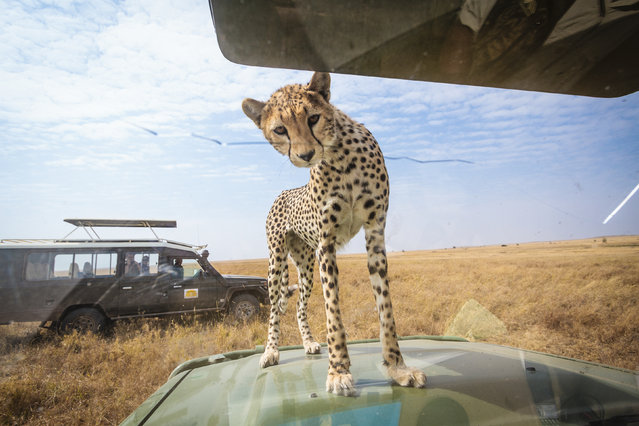
The cheetah peers inside the car to see who is inside. (Photo by Bobby-Jo Clow/Caters News)

“This is the heart-stopping moment a photographer came within inches of a young cheetah when it stuck its head through her sun roof. Australian Bobby-Jo Clow, 31, was on safari in Tanzania when the juvenile started heading towards her Landrover with his sibling. She snapped away as the young male dangled its paws in front of her face and smelt her hair before its mother called it away into the wilds of the Serengeti National Park. But not until Bobby-Jo, a full-time elephant keeper at a Tanzanian Zoo, had leaned forward enough to capture the perfect shot, causing the cheetah to hiss and bare its teeth”. – Caters News. (Photo by Bobby-Jo Clow/Caters News)
Details
16 Mar 2014 08:22:00
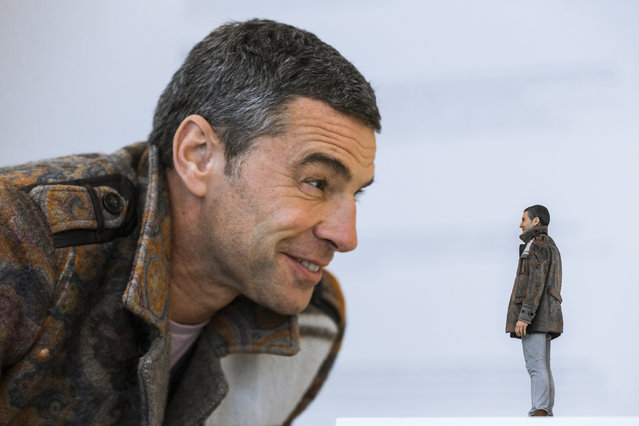
Customer Andreas Kroker looks at a 3D-printed figure of himself at the Twinkind 3D printing studio in Berlin, December 13, 2013. (Photo by Thomas Peter/Reuters)

Customer Andreas Kroker looks at a 3D-printed figure of himself at the Twinkind 3D printing studio in Berlin, December 13, 2013. A 3D-printed likeness is produced by taking a 360 degree photographic scan of a person, which is then rendered into a 3D digital model and retouched to meet the requirements for printing. The printing machine uses this digital model to produce a high-resolution solid figure. Twinkind co-founder Timo Schaedel said, people often come to the session well-groomed, with fresh hair-cuts and their best clothes, “just as they used to do in the past, when they had their portrait taken in a photo studio”. (Photo by Thomas Peter/Reuters)
Details
17 Jul 2014 11:22:00
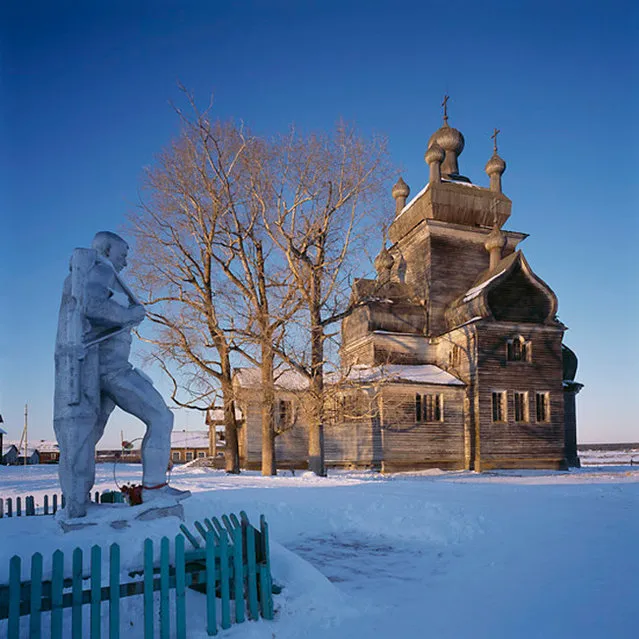
Wooden Churches - Travelling In The Russian North By Richard Davies Part 2

While communism, collectivism, worms, dry rot and casual looting failed to destroy the majestic wooden churches of Russia, it may be ordinary neglect that finally does them in. Dwindled now to several hundred remaining examples, these glories of vernacular architecture lie scattered amid the vastness of the world’s largest country. Just over a decade ago, Richard Davies, a British architectural photographer, struck out on a mission to record the fragile and poetic structures. Austerely beautiful and haunting, “Wooden Churches: Traveling in the Russian North” (White Sea Publishing; $132) is the result. Covering thousands of miles, Mr. Davies described how he and the writer Matilda Moreton tracked down the survivors from among the thousands of onion-domed structures built after Prince Vladimir converted to Christianity in 988.

See also: Wooden Churches Part1
Details
28 Nov 2013 12:13:00