Loading...
Done
Mayu adjusts Koiku’s kimono, as Koiku wears a protective face mask while posing for a photograph, before they work at a party where they will entertain with other geisha at Japanese luxury restaurant Asada in Tokyo, Japan, June 23, 2020. The coronavirus pandemic has made Tokyo's geisha fear for their centuries-old profession as never before. Though the number of geisha - famed for their witty conversation, beauty and skill at traditional arts - has been falling for years, they were without work for months due to Japan's state of emergency and now operate under awkward social distancing rules. Engagements are down 95 percent, and come with new rules: no pouring drinks for customers or touching them even to shake hands, and sitting 2 meters apart. Masks are hard to wear with their elaborate wigs, so they mostly don't. “I was just full of anxiety”, said Mayu, 47. “I went through my photos, sorted my kimonos ... The thought of a second wave is terrifying”. (Photo by Kim Kyung-Hoon/Reuters)

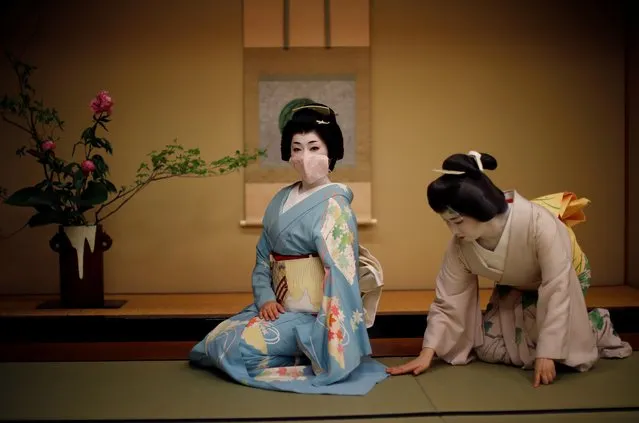
Mayu adjusts Koiku’s kimono, as Koiku wears a protective face mask while posing for a photograph, before they work at a party where they will entertain with other geisha at Japanese luxury restaurant Asada in Tokyo, Japan, June 23, 2020. (Photo by Kim Kyung-Hoon/Reuters)
Details
23 Jul 2020 00:03:00
People attend a master class in Latin American dances on the deck outside No 84 Pavilion in VDNKh Exhibition Centre in Moscow, Russia on July 4, 2020. The event opens this year's season of outdoor dancing in VDNKh. (Photo by Artyom Geodakyan/TASS)

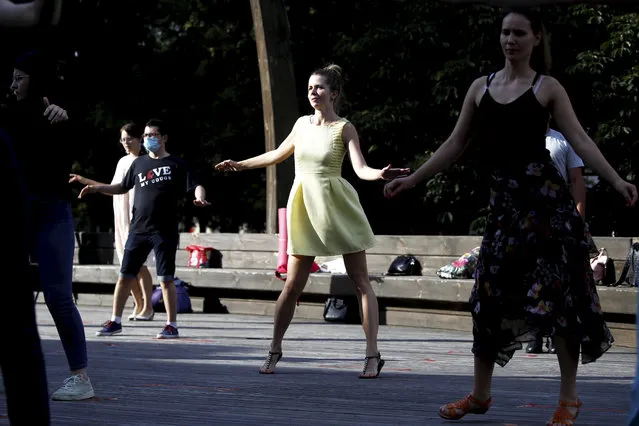
People attend a master class in Latin American dances on the deck outside No 84 Pavilion in VDNKh Exhibition Centre in Moscow, Russia on July 4, 2020. The event opens this year's season of outdoor dancing in VDNKh. (Photo by Artyom Geodakyan/TASS)
Details
24 Jul 2020 00:05:00
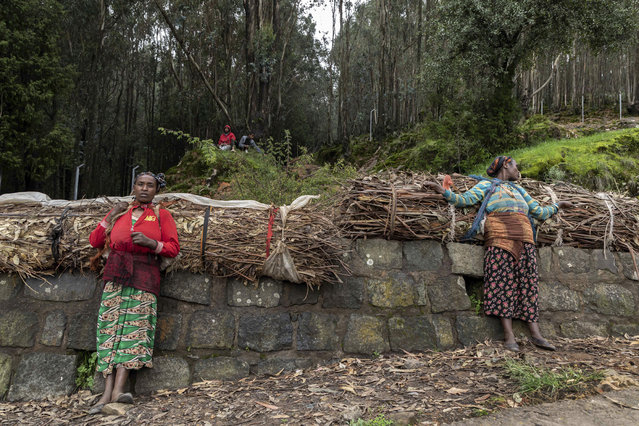
Mare Sorie, left, and her friend Tsehaynesh Golja, right, take a rest as they carry bundles of firewood from the forest around Entoto mountain near Addis Ababa, Ethiopia Friday, July 17, 2020. (Photo by Mulugeta Ayene/AP Photo)

Mare Sorie, left, and her friend Tsehaynesh Golja, right, take a rest as they carry bundles of firewood from the forest around Entoto mountain near Addis Ababa, Ethiopia Friday, July 17, 2020. (Photo by Mulugeta Ayene/AP Photo)
Details
03 Aug 2020 00:03:00
A Gnawa traditional group performs in the city of Essaouira on December 14, 2019, to celebrate the decision of adding the Gnawa culture to UNESCO's list of Intangible Cultural Heritage of Humanity. Gnawa culture, a centuries-old Moroccan practice rooted in music, African rituals and Sufi traditions, was added to UNESCO's list of Intangible Cultural Heritage of Humanity earlier in the week. Gnawa refers to a “set of musical productions, fraternal practices and therapeutic rituals where the secular mixes with the sacred”, according to the nomination submitted by Morocco. Often dressed in colourful outfits, Gnawa musicians play the guenbri, a type of lute with three strings, accompanied by steel castanets called krakebs. (Photo by Fadel Senna/AFP Photo)

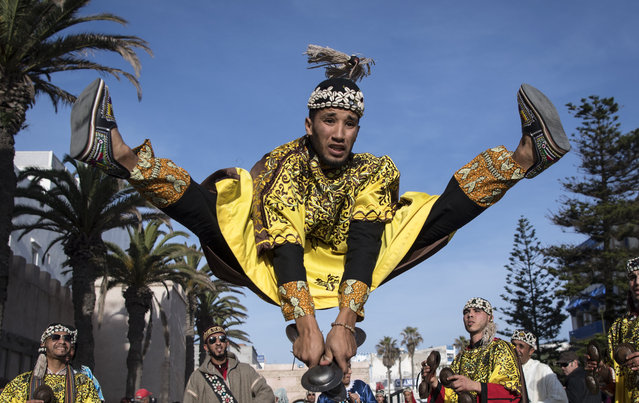
A Gnawa traditional group performs in the city of Essaouira on December 14, 2019, to celebrate the decision of adding the Gnawa culture to UNESCO's list of Intangible Cultural Heritage of Humanity. Gnawa culture, a centuries-old Moroccan practice rooted in music, African rituals and Sufi traditions, was added to UNESCO's list of Intangible Cultural Heritage of Humanity earlier in the week. Gnawa refers to a “set of musical productions, fraternal practices and therapeutic rituals where the secular mixes with the sacred”, according to the nomination submitted by Morocco. Often dressed in colourful outfits, Gnawa musicians play the guenbri, a type of lute with three strings, accompanied by steel castanets called krakebs. (Photo by Fadel Senna/AFP Photo)
Details
18 Dec 2019 00:05:00
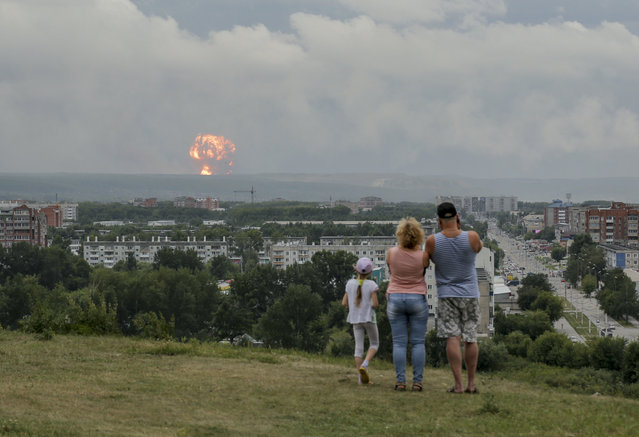
In this photo taken on Monday, August 5, 2019, a family watches explosions at a military ammunition depot near the city of Achinsk in eastern Siberia's Krasnoyarsk region, in Achinsk, Russia. Russian officials say powerful explosions at a military depot in Siberia left 12 people injured and one missing and forced over 16,500 people to leave their homes. (Photo by Dmitry Dub/AP Photo)

In this photo taken on Monday, August 5, 2019, a family watches explosions at a military ammunition depot near the city of Achinsk in eastern Siberia's Krasnoyarsk region, in Achinsk, Russia. Russian officials say powerful explosions at a military depot in Siberia left 12 people injured and one missing and forced over 16,500 people to leave their homes. (Photo by Dmitry Dub/AP Photo)
Details
14 Jan 2020 00:05:00
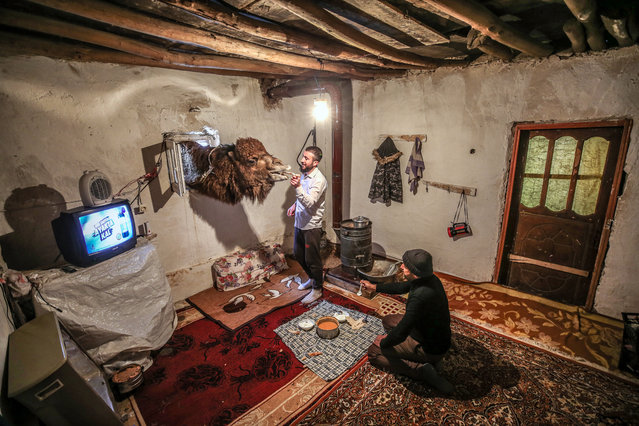
Shepherd brothers Mustafa Erbay and Baran Erbay train their camels on snowy grounds, enabling them to become champions in competitions held in the Aegean and Mediterranean regions in Baskale district of Van, Turkey on February 1, 2020. (Photo by Ozkan Bilgin/Anadolu Agency via Getty Images)

Shepherd brothers Mustafa Erbay and Baran Erbay train their camels on snowy grounds, enabling them to become champions in competitions held in the Aegean and Mediterranean regions in Baskale district of Van, Turkey on February 1, 2020. (Photo by Ozkan Bilgin/Anadolu Agency via Getty Images)
Details
07 Feb 2020 00:01:00
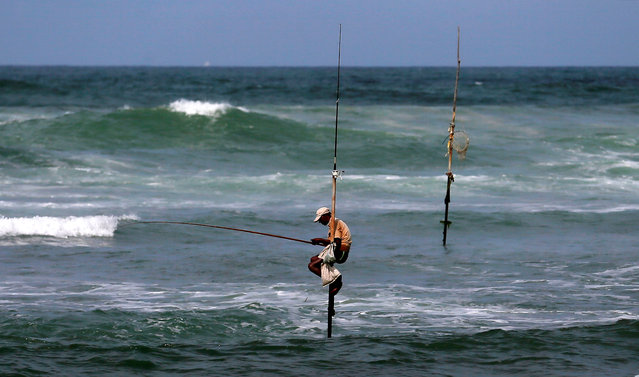
A fisherman waits to catch fish as he sits atop a stilt in the sea in Koggala, Sri Lanka on July 4, 2019. (Photo by Dinuka Liyanawatte/Reuters)

A fisherman waits to catch fish as he sits atop a stilt in the sea in Koggala, Sri Lanka on July 4, 2019. (Photo by Dinuka Liyanawatte/Reuters)
Details
11 Feb 2020 00:03:00
A patient solves a rubik's cube at a temporary hospital converted from “Wuhan Livingroom” in central China's Hubei Province on February 10, 2020. In face of the outbreak of the novel coronavirus pneumonia epidemic, Wuhan authorities have transformed public venues such as exhibition centers and gymnasiums into temporary hospitals. The hospitals have a large capacity of treating patients with mild symptoms and play an important role in isolating the source of infection and cutting off the routes of infection during epidemic prevention. The first batch of patients was hospitalized on Feb. 5. (Photo by Chine Nouvelle/SIPA Press/Rex Features/Shutterstock)

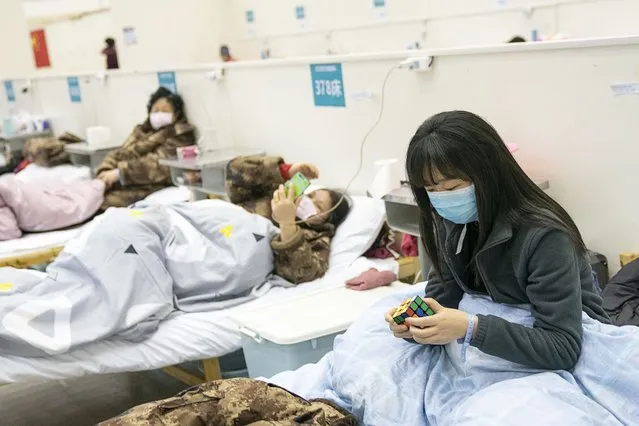
A patient solves a rubik's cube at a temporary hospital converted from “Wuhan Livingroom” in central China's Hubei Province on February 10, 2020. In face of the outbreak of the novel coronavirus pneumonia epidemic, Wuhan authorities have transformed public venues such as exhibition centers and gymnasiums into temporary hospitals. The hospitals have a large capacity of treating patients with mild symptoms and play an important role in isolating the source of infection and cutting off the routes of infection during epidemic prevention. The first batch of patients was hospitalized on Feb. 5. (Photo by Chine Nouvelle/SIPA Press/Rex Features/Shutterstock)
Details
17 Feb 2020 00:07:00