A boatman rests on his boat in the flooded Ganges river under the Shastri bridge at Daraganj Ghat, in Allahabad, India on August 22, 2019. (Photo by Sanjay Kanojia/AFP Photo)
Aerial photo taken on April 20, 2018 shows the view of advection fog above Qingdao, a coastal city in east China' s Shandong Province. (Photo by Lu Hui/Xinhua News Agency/Eyevine)
Actor Mike Lane, standing six feet 10 inches in his stocking feet, makes a perfect monster as he carries actress Nancy Knox down the stairs into Frankenstein's dungeon, February 28, 1958. They have featured parts in the upcoming Boris Karloff movie “Frankenstein 1970”. (Photo by David F. Smith/AP Photo)
Students dressed as Hindu Lord Shiva, also known as Nataraja, the Lord of Dancers, during a religious event in Mumbai, India, August 30, 2018. (Photo by Francis Mascarenhas/Reuters)
Tommy Lindsey holds an enormous maple leaf that he found in Mount Vernon, Wash., October 28, 2013. Lindsey was walking with his family when he picked up the leaf that is more than two feet from stem to tip and more than 21 inches wide. (Photo by Frank Varga/The Skagit Valley Herald)
Missing that old days of gaming when games were GAMES and not a dunghill of marketing bullshit with DLC? Sick of all this "press X to win"? So remember the CLASSIC!
Lake Baikal is the world's oldest lake, at 25 million years (possibly older), and deepest, averaging 744.4 metres (2,442 ft).
Located in the south of the Russian region of Siberia, between Irkutsk Oblast to the northwest and the Buryat Republic to the southeast, it is the most voluminous freshwater lake in the world, containing roughly 20% of the world's unfrozen surface fresh water.
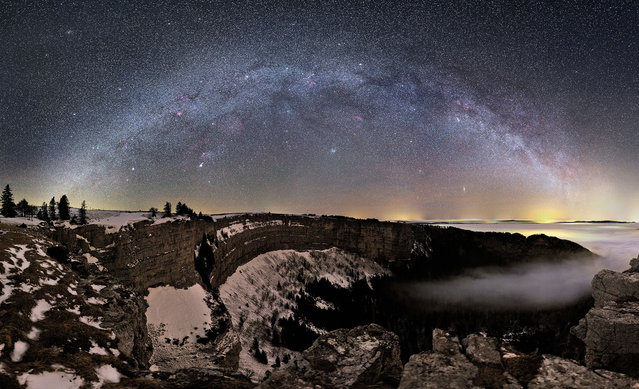
The Milky Way is the galaxy in which Earth is contained. This name derives from its appearance as a dim “milky” glowing band arching across the night sky, in which the naked eye cannot distinguish individual stars. The term “Milky Way” is a translation of the Classical Latin via lactea, from the Hellenistic Greek γαλαξίας κύκλος (pr. galaxías kýklos, “milky circle”). The Milky Way appears like a band because it is a disk-shaped structure being viewed from inside. The fact that this faint band of light is made up of stars was proven in 1610 when Galileo Galilei used his telescope to resolve it into individual stars. In the 1920s, observations by astronomer Edwin Hubble showed that the Milky Way is just one of many galaxies.