Loading...
Done
Demonstrators celebrate with green headscarves - the symbol of abortion rights activists – outside the Argentine Congress in Buenos Aires on December 11, 2020, after legislators passed a bill to legalize abortion. (Photo by Ronaldo Schemidt/AFP Photo)

Demonstrators celebrate with green headscarves - the symbol of abortion rights activists – outside the Argentine Congress in Buenos Aires on December 11, 2020, after legislators passed a bill to legalize abortion. (Photo by Ronaldo Schemidt/AFP Photo)
Details
25 Feb 2021 08:31:00
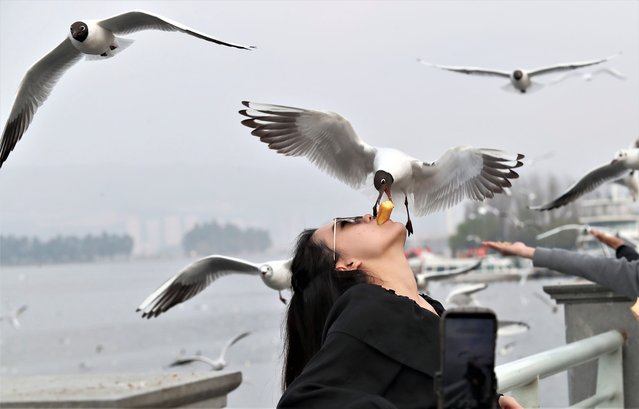
A woman feeds red-billed gulls on the Haigeng Dam of Dian Lake on March 5, 2023 in Kunming, Yunnan Province of China. (Photo by Yang Zheng/VCG via Getty Images)

A woman feeds red-billed gulls on the Haigeng Dam of Dian Lake on March 5, 2023 in Kunming, Yunnan Province of China. (Photo by Yang Zheng/VCG via Getty Images)
Details
14 Mar 2023 05:03:00
Fans of American football gathered at Tottenham Hotspur Stadium to watch the Jacksonville Jaguars win against the Buffalo Bills 25-20 in the NFL on October 08, 2023 in London, England. (Photo by Peter Tarry/The Times)

Fans of American football gathered at Tottenham Hotspur Stadium to watch the Jacksonville Jaguars win against the Buffalo Bills 25-20 in the NFL on October 08, 2023 in London, England. (Photo by Peter Tarry/The Times)
Details
19 Oct 2023 03:14:00
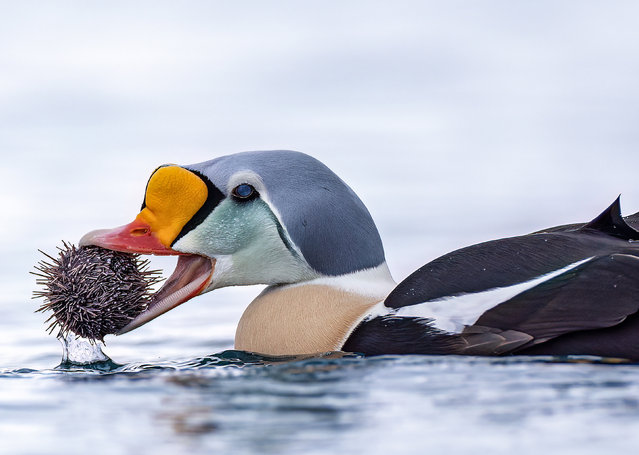
A king eider sea duck tackles a prickly dinner of sea urchin on a lake in Batsfjord, Norway in the last decade of August 2024. The drake’s breeding plumage consists of a distinctive powder-blue head and neck, orange frontal lobe and a red bill. (Photo by Mia Surakka/Solent News)

A king eider sea duck tackles a prickly dinner of sea urchin on a lake in Batsfjord, Norway in the last decade of August 2024. The drake’s breeding plumage consists of a distinctive powder-blue head and neck, orange frontal lobe and a red bill. (Photo by Mia Surakka/Solent News)
Details
01 Sep 2024 03:45:00
Art by Christian Faur

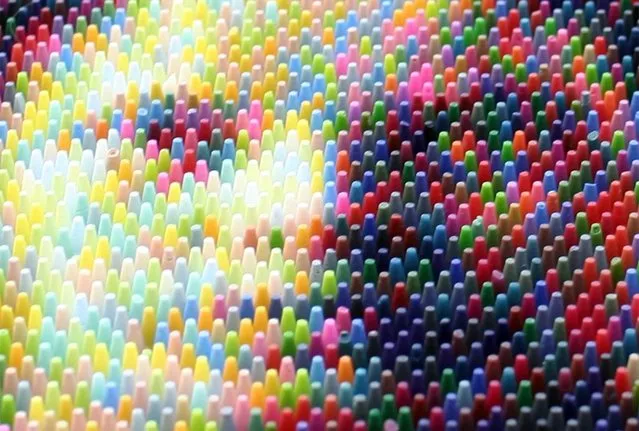
Christian Faur is an artist based in Granville, Ohio. Looking for a new technique, he experimented with painting with wax, but he didn’t feel the results were satisfactory.Then, at Christmas in 2005, his young daughter opened a box of 120 Crayola crayons he’d bought her, and everything clicked into place. Faur decided he would create pictures out of the crayons themselves, packing thousands of them together so they become like the colored pixels on a TV screen. He starts each work by scanning a photo into a computer and breaking the image down into colored blocks He then draws a grid that shows him exactly where to place each crayon The finished artworks are packed tightly into wooden frames. He actually makes the crayons himself, hand-casting each one in a mould.
Details
28 Jul 2012 10:03:00
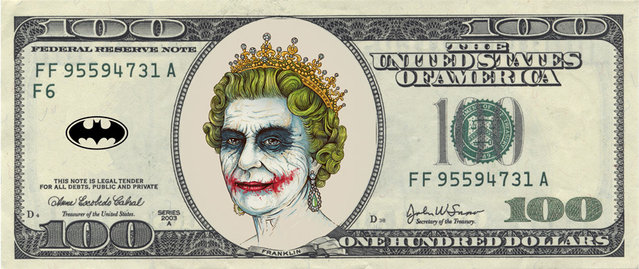
Make Your Franklin By Martin Joubert Part 1

Having $100 in your pocket would be so much cooler if it was designed by Martin Joubert. He went all out and created a number of different designs for the 100 USD banknotes, ranging from silly to witty. We especially liked the one with “That’s right. This is real money” written on it, showing just how many cups of coffee, basketballs, and guns you can buy with 100 dollars. All in all, even the currency that we have today is nothing but paper, even though it looks official and strict. There is nothing backing it up except for our noble military that ensures that Gulf States sell their oil using only the “green” kind of currency. (Photo by Martin Joubert)
Details
17 Dec 2014 11:19:00


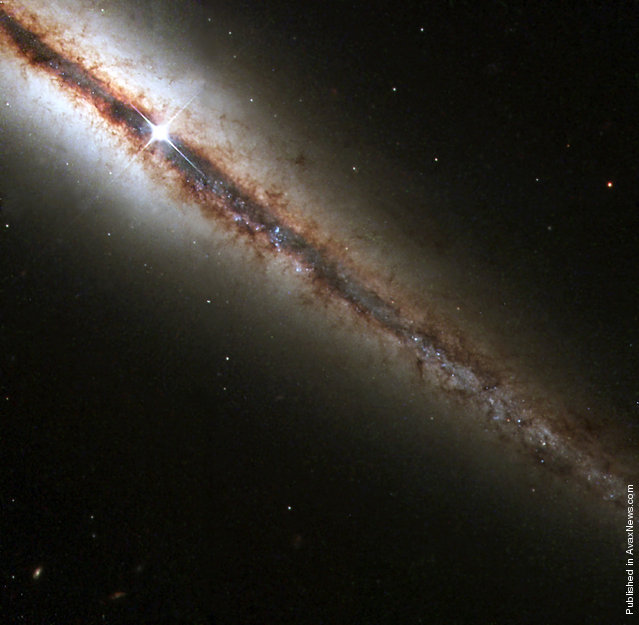
An image produced by the Hubble telescope of the perfectly “edge-on” galaxy, or NGC 4013, March 1, 2001. This new Hubble picture reveals, with great detail, huge clouds of dust and gas extending along, as well as far above, the galaxy's main disk. NGC 4013 is a spiral galaxy, similar to the Milky Way, lying some 55 million light-years from Earth in the direction of the constellation Ursa Major. Viewed face-on, it would look like a nearly circular pinwheel, but NGC 4013 happens to be seen edge-on from our vantage point. Even at 55 million light-years, the galaxy is larger than Hubble's field of view, and the image shows only a little more than half of the object, albeit with unprecedented detail. (Photo Courtesy of NASA/Newsmakers)

Details
28 Feb 2015 22:33:00
The Lun-class Ekranoplane was used by the Soviet Navy starting in 1987, and wasn't retired until the late 1990s, after the Soviet Union's fall. (Igor113)

“The Lun-class ekranoplan (NATO reporting name Duck) was a ground effect vehicle (GEV) designed by Rostislav Evgenievich Alexeev and used by the Soviet and Russian navies from 1987 until sometime in the late 1990s. It “flew” using the lift generated by the ground effect of its large wings when close to the surface of the water – about four metres or less. Although they might look similar and/or have related technical characteristics, ekranoplans like the Lun are not aircraft, seaplanes, hovercraft, or hydrofoils – ground effect is a separate technology altogether. The International Maritime Organization classifies these vehicles as maritime ships. The name Lun comes from the Russian for harrier”. – Wikipedia (Photo by Igor113)
Details
08 Aug 2014 10:51:00