Loading...
Done
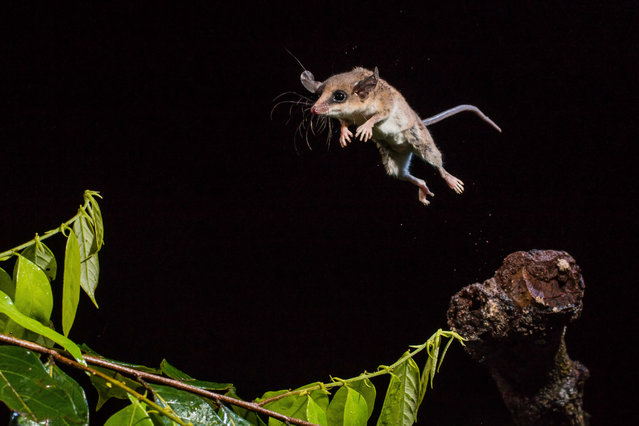
Tropical acrobatics by Adrià López Baucells in Manaus, Brazil. An unidentified South American marsupial, although the characteristic black markings on its face indicate it may be a mouse opossum. These small creatures are nocturnal and feed on bugs, fruit and bird eggs. (Photo by Adrià López Baucells/2019 Royal Society of Biology Photography Competition)

Tropical acrobatics by Adrià López Baucells in Manaus, Brazil. An unidentified South American marsupial, although the characteristic black markings on its face indicate it may be a mouse opossum. These small creatures are nocturnal and feed on bugs, fruit and bird eggs. (Photo by Adrià López Baucells/2019 Royal Society of Biology Photography Competition)
Details
10 Oct 2019 00:03:00
An otter reaches for a snack from a customer at an otter cafe in Tokyo. Asian small-clawed otters are increasingly popular as novelty pets, particularly in Japan. Now international trade in the species may be banned. (Photo by Noriko Hayashi/The New York Times)

An otter reaches for a snack from a customer at an otter cafe in Tokyo. Asian small-clawed otters are increasingly popular as novelty pets, particularly in Japan. Now international trade in the species may be banned. (Photo by Noriko Hayashi/The New York Times)
Details
01 Jan 2020 00:05:00
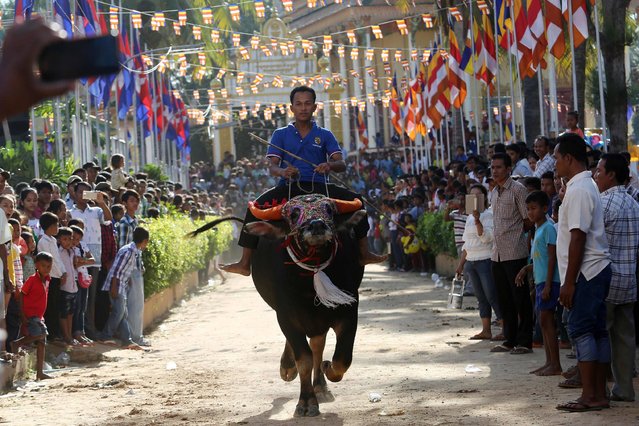
A Cambodian villager rides a buffalo during the Pchum Ben festival, the festival of death, at Vihear Suor village in Kandal province on October 1, 2016. Thousands of Cambodians descended on the small village northeast of the capital on October 1 to cheer on the annual water buffalo race that marks the end of the 15-day festival for the dead. (Photo by Chor Sokunthea/AFP Photo)

A Cambodian villager rides a buffalo during the Pchum Ben festival, the festival of death, at Vihear Suor village in Kandal province on October 1, 2016. Thousands of Cambodians descended on the small village northeast of the capital on October 1 to cheer on the annual water buffalo race that marks the end of the 15-day festival for the dead. (Photo by Chor Sokunthea/AFP Photo)
Details
03 Oct 2016 09:25:00
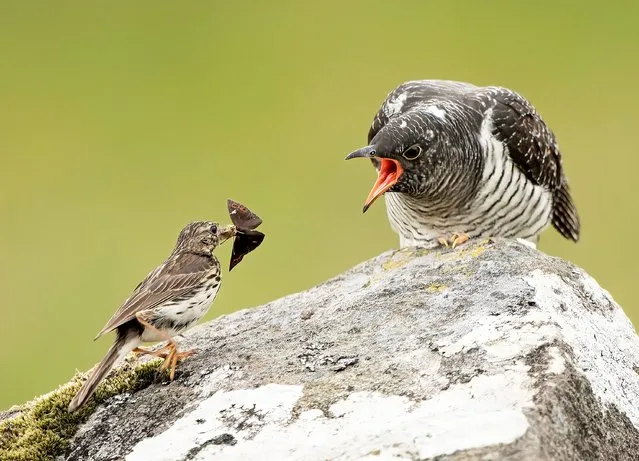
A small meadow pipit (left) is run off her feet as she tries to keep up with the demanding feeding schedule of an imposter - a larger cuckoo (right) on the Isle of Mull, Scotland in August 2022. (Photo by Graeme Cuerden/Solent News & Photo Agency)

A small meadow pipit (left) is run off her feet as she tries to keep up with the demanding feeding schedule of an imposter - a larger cuckoo (right) on the Isle of Mull, Scotland in August 2022. (Photo by Graeme Cuerden/Solent News & Photo Agency)
Details
28 Aug 2022 04:31:00
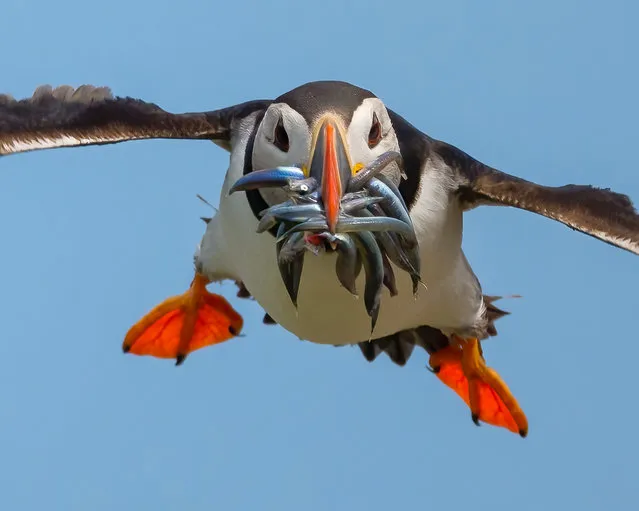
British puffin mid-flight with a beak full of small fish, their favourite foods being sand eels, herring and hake in Farne Islands, United Kingdom in June 2022. These pint-sized creatures are just 12 inches in height and have a wingspan of 25 inches. (Photo by Mathijs van Lisdonk/Media Drum Images)

British puffin mid-flight with a beak full of small fish, their favourite foods being sand eels, herring and hake in Farne Islands, United Kingdom in June 2022. These pint-sized creatures are just 12 inches in height and have a wingspan of 25 inches. (Photo by Mathijs van Lisdonk/Media Drum Images)
Details
16 Dec 2022 05:24:00
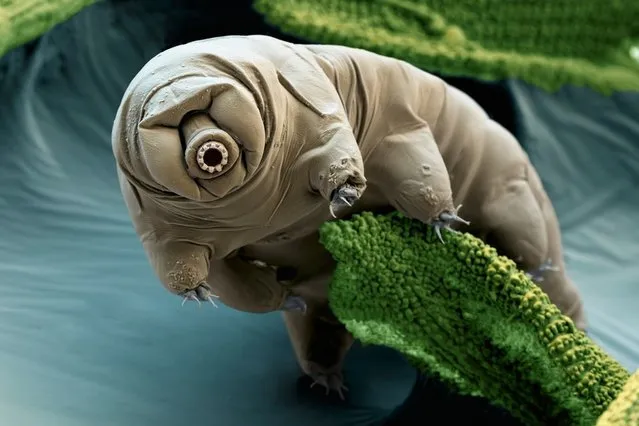
Tardigrades (commonly known as waterbears or moss piglets). (Photo by SPL/East News)

“Tardigrades (commonly known as waterbears or moss piglets) are small, water-dwelling, segmented animals with eight legs. Tardigrades were first discovered in 1773 by Johann August Ephraim Goeze, who called them kleiner Wasserbär, meaning “little water bear” in German. The name Tardigrada means “slow walker” and was given by Lazzaro Spallanzani in 1777. The name water bear comes from the way they walk, reminiscent of a bear's gait. The biggest adults may reach a body length of 1.5 millimetres (0.059 in), the smallest below 0.1 mm. Freshly hatched tardigrades may be smaller than 0.05 mm”. – Wikipedia. Photo: Tardigrades. (Photo by SPL/East News)
Details
26 Sep 2012 09:55:00
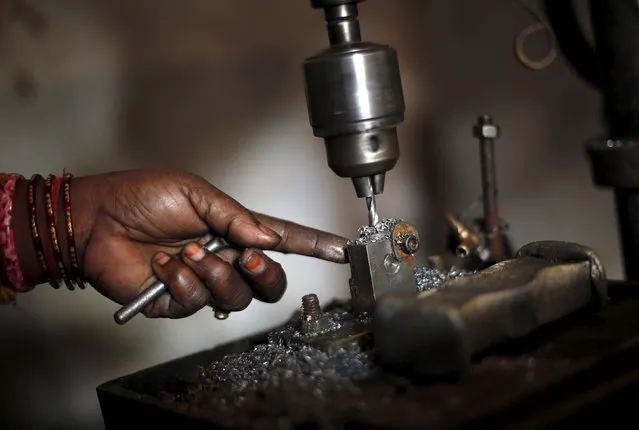
A worker makes auto parts on a machine inside a workshop in Faridabad, India, December 24, 2015. (Photo by Adnan Abidi/Reuters)

A worker makes auto parts on a machine inside a workshop in Faridabad, India, December 24, 2015. Car makers such as Maruti Suzuki India and Hyundai Motor see huge growth in India, set to become the world's third-largest auto market by 2020 as millions buy their first new car. Price tags can be as low as $3,000 for a new Tata Motors Nano mini-car. India is also becoming a low-cost export hub for global car makers such as General Motors and Ford Motor. As the sector expands, some of the work is sub-contracted out to small factories operating on paper-thin margins, where poor contract workers often have little or no access to safety equipment or health benefits. (Photo by Adnan Abidi/Reuters)
Details
23 Jan 2016 13:31:00
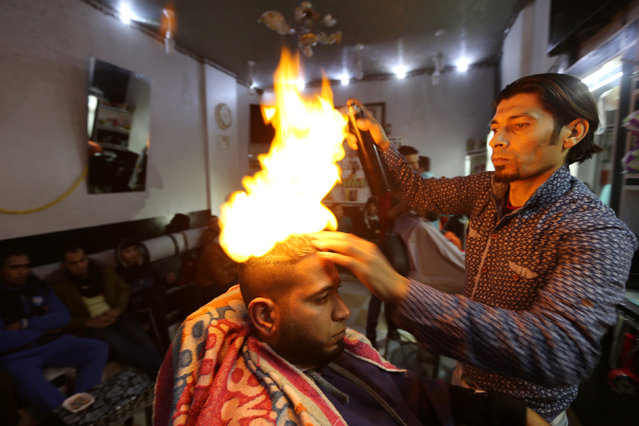
Palestinian barber Ramadan Odwan styles and straightens the hair of a customer with fire at his salon in Rafah, in the southern Gaza Strip February 2, 2017. In Ramadan Odwan's barbershop in Gaza, hair isn't just blow-dried, it's blowtorch-dried. “People have gone crazy about it, many people are curious to go through the experience and they are not afraid”, he told Reuters. “People here love adventures”. Odwan, 37, is not the first stylist in the world to use flame to straighten hair, but his craft is unique in the Gaza Strip. In his salon in the southern Gaza town of Rafah, Odwan applied what he described as a protective liquid coating to a customer's hair – he declined to disclose its contents – before aiming for the head and pressing the button on a small blowtorch. “I control how long I apply fire, I keep it on and off for 10 seconds or 15 seconds. It is completely safe and I have not encountered any accident since I started it two months ago”, Odwan added. Odwan charges 20 shekels ($5.20) for a haircut and fire-straightening. A barber for the past 18 years, he said part of the reason he uses the technique is to show that Palestinian barbers are as “professional as those out there around the world”. (Photo by Ibraheem Abu Mustafa/Reuters)

Palestinian barber Ramadan Odwan styles and straightens the hair of a customer with fire at his salon in Rafah, in the southern Gaza Strip February 2, 2017. In Ramadan Odwan's barbershop in Gaza, hair isn't just blow-dried, it's blowtorch-dried. “People have gone crazy about it, many people are curious to go through the experience and they are not afraid”, he told Reuters. “People here love adventures”. (Photo by Ibraheem Abu Mustafa/Reuters)
Details
11 Feb 2017 00:05:00