A family dressed in traditional chinese clothes celebrates the Chinese New Year in Chinatown in Bangkok, Thailand February 8, 2016. (Photo by Jorge Silva/Reuters)
A woman walks up the steps decorated ahead of the Chinese New Year festival in Beijing, China, Thursday, January 12, 2017. The Chinese Lunar New Year is the most important holiday for Chinese and hundreds of millions are expected to return to their hometown to spend the new year with their family and relatives. (Photo by Ng Han Guan/AP Photo)
Moraine Lake is a glacially-fed lake in Banff National Park, 14 kilometres (8.7 mi) outside the Village of Lake Louise, Alberta, Canada. It is situated in the Valley of the Ten Peaks, at an elevation of approximately 6,183 feet (1,885 m). The lake has a surface area of .5 square kilometres (0.19 sq mi). The lake, being glacially fed, does not reach its crest until mid to late June. When it is full, it reflects a distinct shade of blue. The colour is due to the refraction of light off the rock flour deposited in the lake on a continual basis.
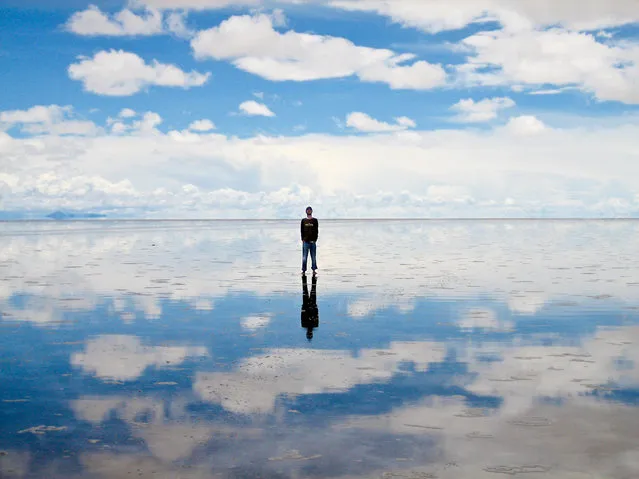
Salar de Uyuni (or Salar de Tunupa) is the world's largest salt flat at 10,582 square kilometers (4,086 sq mi). It is located in the Potosí and Oruro departments in southwest Bolivia, near the crest of the Andes, and is elevated 3,656 meters (11,995 ft) above mean sea level. The Salar was formed as a result of transformations between several prehistoric lakes. It is covered by a few meters of salt crust, which has an extraordinary flatness with the average altitude variations within one meter over the entire area of the Salar.
A dog relaxes in an oxygen capsule “DOGS O2” at the Ownd Cafe on September 13, 2007 in Tokyo, Japan. The capsules come in a variety of sizes available for both dogs and cats for relaxation purposes. (Photo by Koichi Kamoshida/Getty Images)
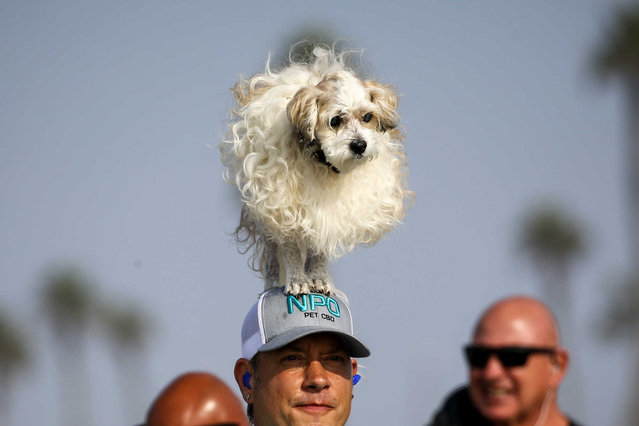
A dog Prince Dudeman stands on the head of Ryan Thor in the annual Surf City Surf Dog event, at Dog Beach in Huntington Beach, Calif., Saturday, September 25, 2021. (Photo by Ringo H.W. Chiu/AP Photo)
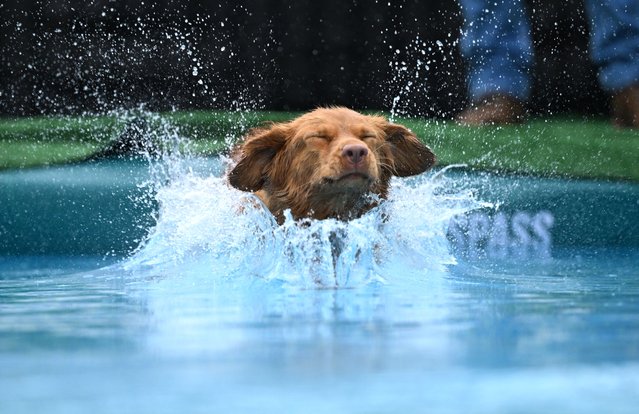
A dog jumps into a pool at the “Dogs and Fun” fair at the Westfalenhallen congress centre in Dortmund, western Germany, on May 23, 2025. Until May 25, dog breeds and dog-related shows, activities and products will be presented during the fair at the Messe Dortmund event venue. (Photo by Ina Fassbender/AFP Photo)
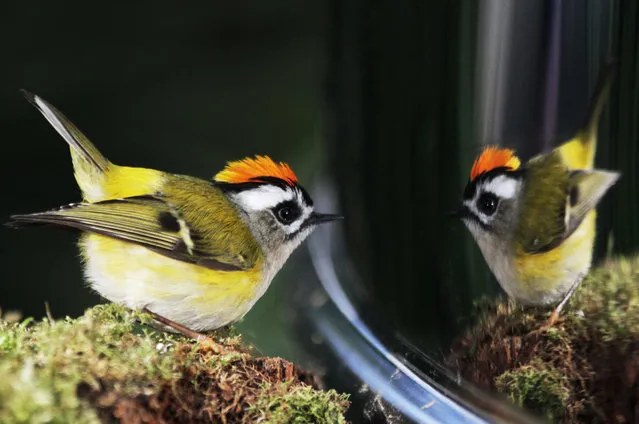
Golden-crowned Kinglets boldly bear their flashy lemon-yellow crest and a black eyebrow stripe. Taking a good look at them might be rather challenging, since they spend most of their time in the dense fir foliage or spruce. However, if you’re patient enough to find them, listen for their shrill, thin song. Though these “little Kings” are only a tad bit larger than a hummingbird, they can survive easily extreme cold by huddling close together. They breed in montane west and the far north and only visit North America during winter.