Loading...
Done
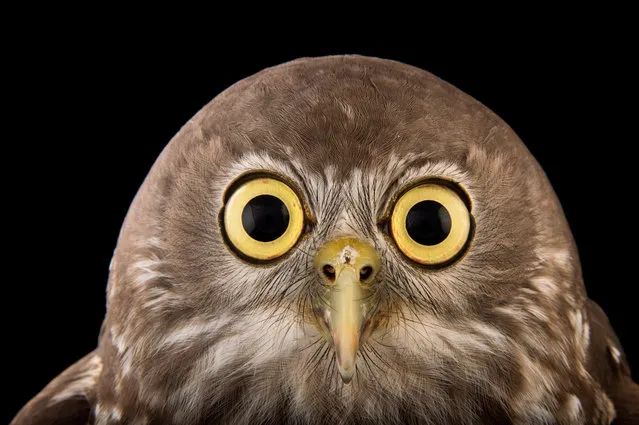
The National Geographic Photo Ark is a travelling exhibition of photographer Joel Sartore’s quest to create a photo archive of biodiversity around the world. So far, Sartore has captured studio portraits of more than 6,000 species – a number that he hopes to double. On 1 July, the ark will open at Melbourne zoo – the first time it has been exhibited in the southern hemisphere. More than 50 portraits will be on display, including many of Australian endangered animals being protected by programs at the zoo itself. These captions have been edited from text supplied by Melbourne zoo. Here: Barking owl. So-named because its call sounds like a barking dog, these birds are native to Australia, Indonesia and Papua New Guinea. In Victoria they are listed as an endangered species, and in 2003 there were estimated to be fewer than 50 breeding pairs. The main threat to the species in Victoria is loss of habitat, especially large trees with hollows in which they can nest and on which many of their prey depend. Apart from a bark, they may utter a chilling scream when they feel threatened. (Photo by Joel Sartore/National Geographic Photo Ark/The Guardian)

The National Geographic Photo Ark is a travelling exhibition of photographer Joel Sartore’s quest to create a photo archive of biodiversity around the world. So far, Sartore has captured studio portraits of more than 6,000 species – a number that he hopes to double. On 1 July, the ark will open at Melbourne zoo – the first time it has been exhibited in the southern hemisphere. More than 50 portraits will be on display, including many of Australian endangered animals being protected by programs at the zoo itself. These captions have been edited from text supplied by Melbourne zoo. Here: Barking owl. (Photo by Joel Sartore/National Geographic Photo Ark/The Guardian)
Details
01 Jul 2017 07:45:00
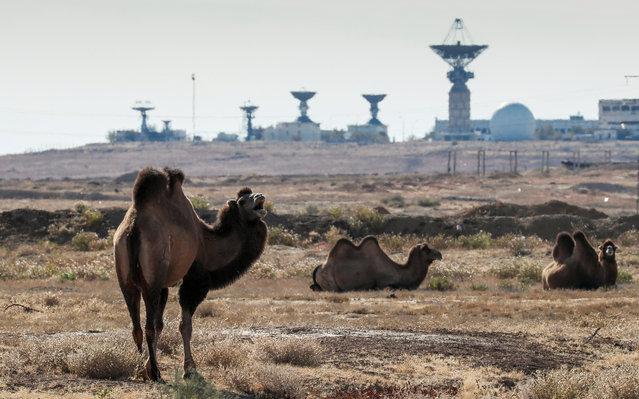
Camels graze in front of a spacecraft tracking station ahead of the Soyuz MS-10 upcoming launch at the Baikonur Cosmodrome, Kazakhstan, October 9, 2018. (Photo by Shamil Zhumatov/Reuters)

Camels graze in front of a spacecraft tracking station ahead of the Soyuz MS-10 upcoming launch at the Baikonur Cosmodrome, Kazakhstan, October 9, 2018. (Photo by Shamil Zhumatov/Reuters)
Details
23 May 2021 07:56:00
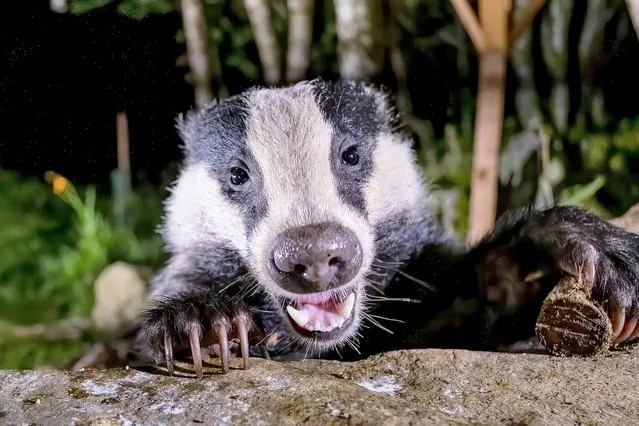
A photographer with a hidden camera took 2,500 photos before this elusive badger was ready for his close-up in September 2020. (Photo by Andy Swinden/BNPS)

A photographer with a hidden camera took 2,500 photos before this elusive badger was ready for his close-up in September 2020. (Photo by Andy Swinden/BNPS)
Details
04 Oct 2020 00:03:00
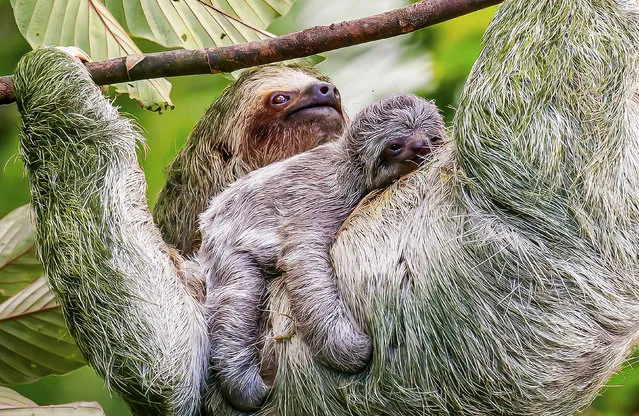
A baby sloth uses his mother as a hammock while she feasts on papayas in Heredia province in Costa Rica in April 2023. (Photo by William Steele/Solent News)

A baby sloth uses his mother as a hammock while she feasts on papayas in Heredia province in Costa Rica in April 2023. (Photo by William Steele/Solent News)
Details
30 Apr 2023 03:22:00
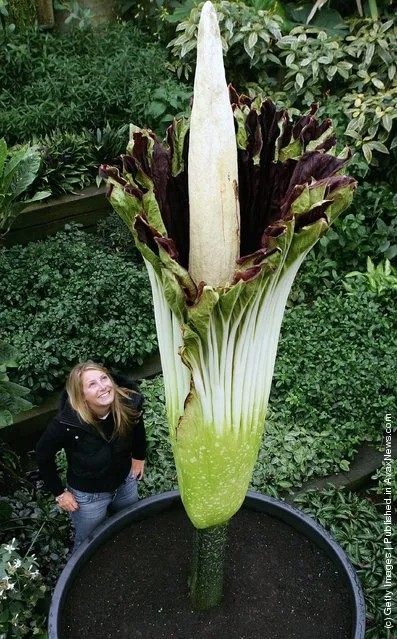
Kew Gardens employee Lauren Bird Royal examines the flowering of the Titan Arum lily at the Botanical Gardens

“The titan arum or Amorphophallus titanum (from Ancient Greek amorphos, “without form, misshapen” + phallos, “phallus”, and titan, “giant”) is a flowering plant with the largest unbranched inflorescence in the world. The titan arum's inflorescence is not as large as that of the Talipot palm, Corypha umbraculifera, but the inflorescence of the Talipot palm is branched rather than unbranched”. – Wikipedia

Photo: Kew Gardens employee Lauren Bird Royal examines the flowering of the Titan Arum lily at the Botanical Gardens at Kew on September 30, 2005 in London, England. For the first time in horticultural history, the Titan Arum lily can be seen at all three active stages in its lifecycle – in flower, fruit and leaf.The flowering corm is nearly three metres tall and weighs 91kg and is very rarely seen outside of the rainforests of Sumatra, Indonesia. (Photo by Scott Barbour/Getty Images)
Details
20 Sep 2011 11:13:00
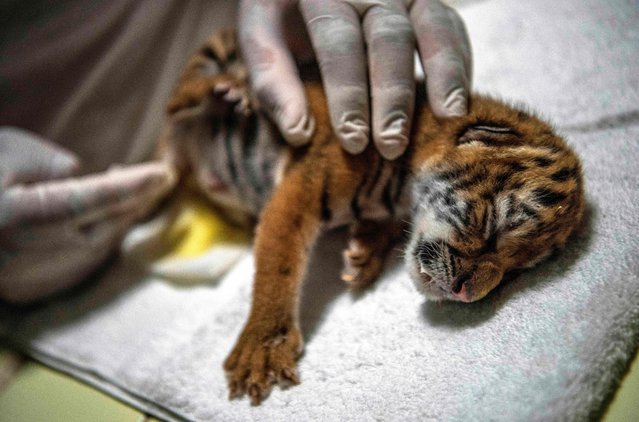
A three-day-old Bengal tiger calf is cared for after being fed at the National Zoo in Masaya on August 30, 2021. A female Bengal tiger calf was born in the National Zoo of Nicaragua, the fourth of this species in risk of extinction born in captivity in the country, and is under special care due to a limited breastfeeding capacity of the mother. (Photo by Inti Ocon/AFP Photo)

A three-day-old Bengal tiger calf is cared for after being fed at the National Zoo in Masaya on August 30, 2021. A female Bengal tiger calf was born in the National Zoo of Nicaragua, the fourth of this species in risk of extinction born in captivity in the country, and is under special care due to a limited breastfeeding capacity of the mother. (Photo by Inti Ocon/AFP Photo)
Details
05 Sep 2021 05:48:00
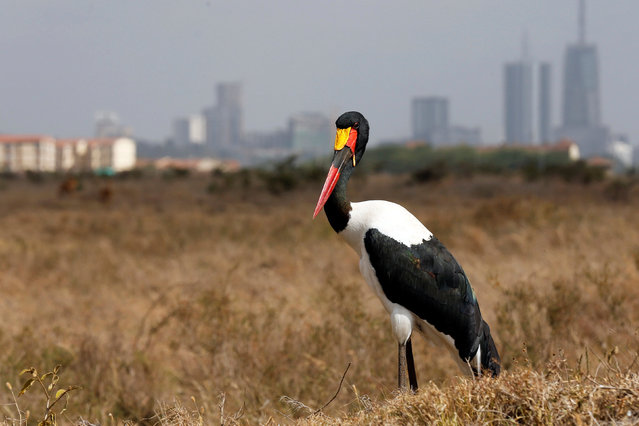
A saddle-billed stork stands in the grassland at the Nairobi National Park near Nairobi, Kenya January 23, 2017. (Photo by Thomas Mukoya/Reuters)

A saddle-billed stork stands in the grassland at the Nairobi National Park near Nairobi, Kenya January 23, 2017. (Photo by Thomas Mukoya/Reuters)
Details
29 Jan 2017 11:32:00
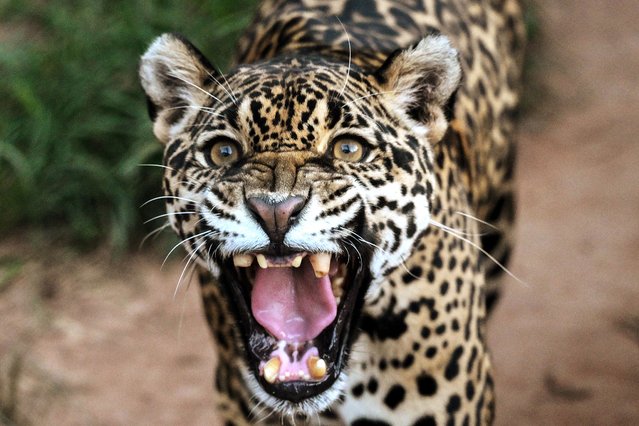
A jaguar (Panthera onca) growls at the Mata Ciliar association, an organization for the conservation of biodiversity, in Jundiai, Sao Paulo state, Brazil on May 29, 2025. Twenty-five pumas and ten jaguars are currently recovering at the Brazilian Center for the Conservation of Neotropical Felines at Mata Ciliar, a site as large as 40 football fields where monkeys, wild dogs, maned wolves, ocelots, and other regional animals are also rehabilitated. (Photo by Nelson Almeida/AFP Photo)

A jaguar (Panthera onca) growls at the Mata Ciliar association, an organization for the conservation of biodiversity, in Jundiai, Sao Paulo state, Brazil on May 29, 2025. Twenty-five pumas and ten jaguars are currently recovering at the Brazilian Center for the Conservation of Neotropical Felines at Mata Ciliar, a site as large as 40 football fields where monkeys, wild dogs, maned wolves, ocelots, and other regional animals are also rehabilitated. (Photo by Nelson Almeida/AFP Photo)
Details
22 Jun 2025 02:21:00