Loading...
Done
Ukrainian platoon commander Mariia talks on the phone in a position in the Donetsk region, Ukraine, Saturday, July 2, 2022. Ukrainian soldiers returning from the frontlines in eastern Ukraine’s Donbas region describe life during what has turned into a grueling war of attrition as apocalyptic. Mariia, 41, said that front-line conditions may vary depending on where a unit is positioned and how well supplied they are. (Photo by Efrem Lukatsky/AP Photo)

Ukrainian platoon commander Mariia talks on the phone in a position in the Donetsk region, Ukraine, Saturday, July 2, 2022. Ukrainian soldiers returning from the frontlines in eastern Ukraine’s Donbas region describe life during what has turned into a grueling war of attrition as apocalyptic. Mariia, 41, said that front-line conditions may vary depending on where a unit is positioned and how well supplied they are. (Photo by Efrem Lukatsky/AP Photo)
Details
14 Aug 2022 04:45:00
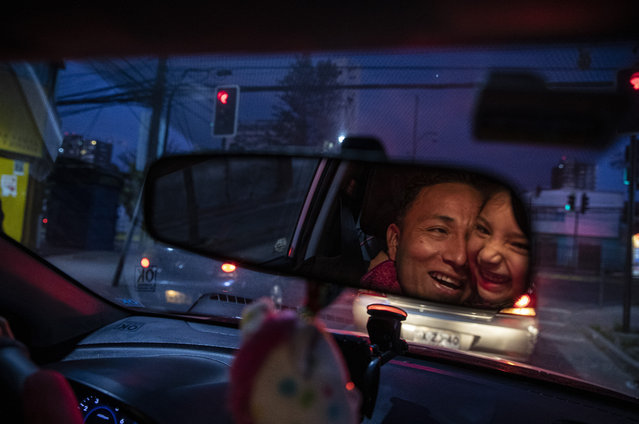
Reflected in the rearview mirror, Jose Collantes gets a hug from daughter Kehity while they're stopped at a red light, as Jose drives his five-year-old home from a playdate in Santiago, Chile, Sunday, September 6, 2020, three months after they lost his wife, her mother, to COVID-19. Their case highlights how COVID-19 deaths the world over are often the beginning of a new personal journey for those affected. (Photo by Esteban Felix/AP Photo)

Reflected in the rearview mirror, Jose Collantes gets a hug from daughter Kehity while they're stopped at a red light, as Jose drives his five-year-old home from a playdate in Santiago, Chile, Sunday, September 6, 2020, three months after they lost his wife, her mother, to COVID-19. Their case highlights how COVID-19 deaths the world over are often the beginning of a new personal journey for those affected. (Photo by Esteban Felix/AP Photo)
Details
15 Oct 2020 00:05:00
Felix Gelin and Claudine Jean describe in sign language how their community, the La Piste encampment, went up in flames this past summer, in Port-au-Prince, Haiti, Sunday, September 20, 2021. According to residents and a United Nations account, police lead the assault at dusk on the encampment, a shelter for deaf and disabled Haitians relocated there by the International Red Cross after the 2010 earthquake leveled the capital. (Photo by Rodrigo Abd/AP Photo)

Felix Gelin and Claudine Jean describe in sign language how their community, the La Piste encampment, went up in flames this past summer, in Port-au-Prince, Haiti, Sunday, September 20, 2021. According to residents and a United Nations account, police lead the assault at dusk on the encampment, a shelter for deaf and disabled Haitians relocated there by the International Red Cross after the 2010 earthquake leveled the capital. (Photo by Rodrigo Abd/AP Photo)
Details
01 Oct 2021 08:41:00
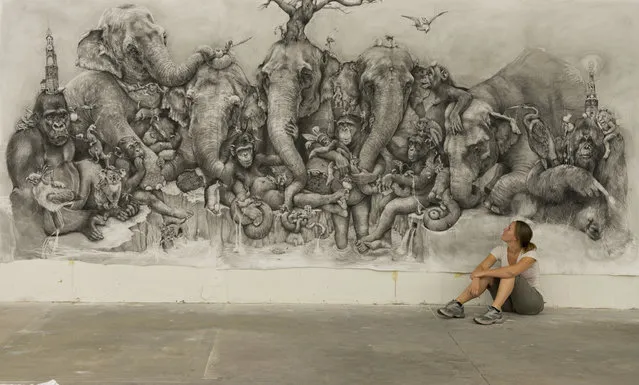
Adonna Khare and her Pencil

Originally hailing from a small town in Iowa, Adonna Khare was this year’s recipient of the Art Prize 2012 for her amazingly detailed large-scale pencil on paper works. All of Khare’s work evolve naturally without much pre-planning, essentially building her pieces as she continues to work.
Details
29 May 2015 15:02:00
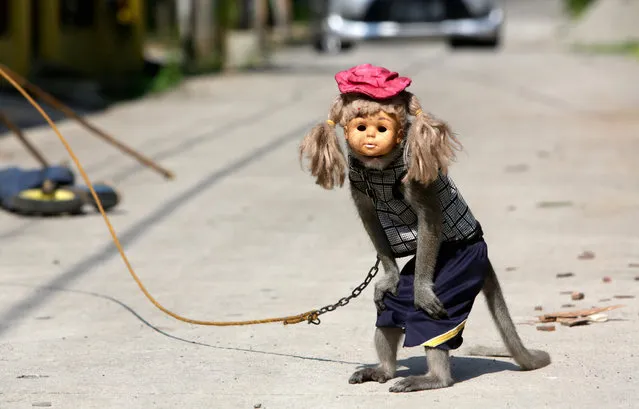
A chained male monkey in a costume and wearing a toy mask performs at a street in Depok, West Java, Indonesia, 30 September 2021. A performing monkey in a street, known as “Topeng Monyet” (lit. Monkey Mask), is a popular form of cheap entertainment in Indonesia, especially on the island of Java. During a street monkey show, a trainer issues orders by pulling the chain tied around the primate's neck, forcing it to perform tricks such as wearing a mask or riding a toy motorcycle. The Indonesian government in 2013 banned the Topeng Monyet in the capital Jakarta to improve public order and ending animal abuse. However, monkey performances are still popular in several other parts of the country, such as West Java, especially after the government lowered the level of Enforcement of Restrictions on Community Activities (PPKM) in a number of areas during the COVID-19 pandemic. (Photo by Adi Weda/EPA/EFE)

A chained male monkey in a costume and wearing a toy mask performs at a street in Depok, West Java, Indonesia, 30 September 2021. A performing monkey in a street, known as “Topeng Monyet” (lit. Monkey Mask), is a popular form of cheap entertainment in Indonesia, especially on the island of Java. (Photo by Adi Weda/EPA/EFE)
Details
16 Oct 2021 09:08:00


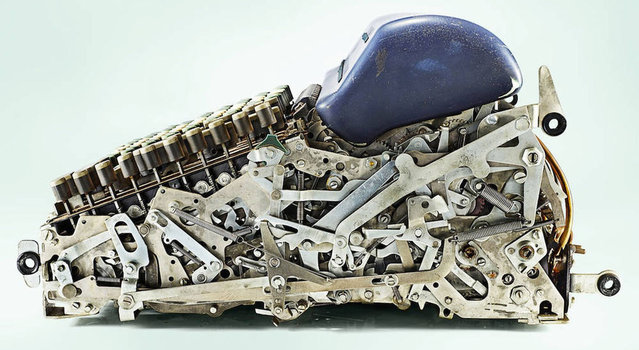
In his newest series of photos called Low Tech, Kevin Twomey artfully captures the complexity of old-style typewriters and similar machines. Despite being completely outdated, you cannot help being amazed at how complicated those “simple” devises really are. Hundreds of little parts were meticulously put together to form a machine that would perform such “basic” functions by today’s standards. Similarly, very few modern people actually think about how complicated the current technology really is. We take for granted streaming videos, GPS, and countless devises that we use every day, while in reality, these things would seem like magic to even the most prominent scientists from only half a century ago. (Photo by Kevin Twomey)
Details
21 Nov 2014 12:42:00
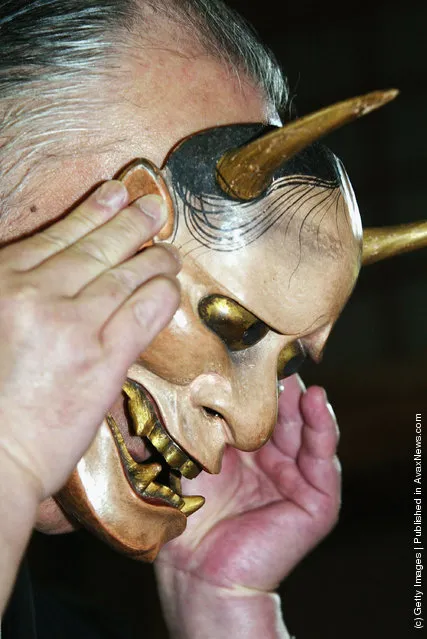
A renowned Noh actor, Otoshige Sakai, demostrates how to put on a Noh mask

“Noh, or Nogaku – derived from the Japanese word for “skill” or “talent” – is a major form of classical Japanese musical drama that has been performed since the 14th century. Many characters are masked, with men playing male and female roles. Traditionally, a Noh “performance day” lasts all day and consists of five Noh plays interspersed with shorter, humorous kyōgen pieces. However, present-day Noh performances often consist of two Noh plays with one Kyōgen play in between”. – Wikipedia

Photo: A renowned Noh actor, Otoshige Sakai, demostrates how to put on a Noh mask, on May 17, 2004 in Tokyo, Japan. (Photo by Koichi Kamoshida/Getty Images)
Details
02 Aug 2011 14:09:00
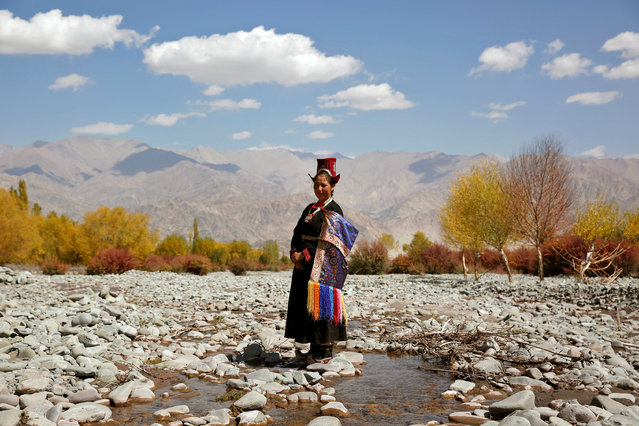
Tsewang Dolma, 33, a farmer and housewife poses for a photograph in Matho, a village nestled high in the Indian Himalayas, India September 29, 2016. When asked how living in the world's fastest growing major economy had affected life, Dolma replied: “Our culture is spoiled now. We don't wear our traditional dress”. (Photo by Cathal McNaughton/Reuters)

Tsewang Dolma, 33, a farmer and housewife poses for a photograph in Matho, a village nestled high in the Indian Himalayas, India September 29, 2016. When asked how living in the world's fastest growing major economy had affected life, Dolma replied: “Our culture is spoiled now. We don't wear our traditional dress”. (Photo by Cathal McNaughton/Reuters)
Details
13 Oct 2016 11:32:00