Loading...
Done
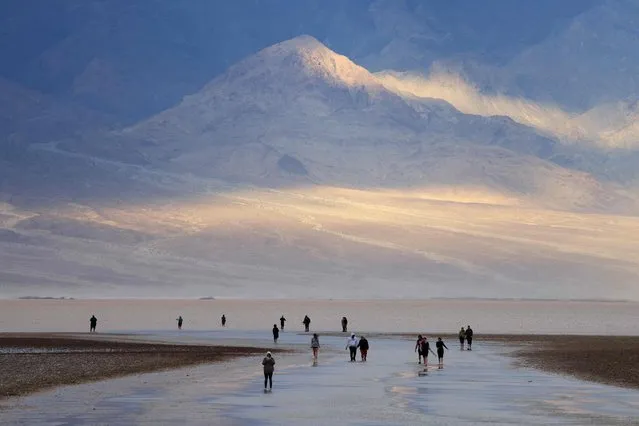
Tourists enjoy the rare opportunity to walk in water as they visit Badwater Basin, the normally driest place in the US, in Death Valley National Park, Inyo County, California on February 18, 2024. Badwater Basin, an endorheic basin in Death Valley National Park, was flooded by Hurricane Hilary in August 2023 and recent rains in California. It is the lowest point in North America, at 282 feet (86 meters) below sea level. (Photo by David Swanson/AFP Photo)

Tourists enjoy the rare opportunity to walk in water as they visit Badwater Basin, the normally driest place in the US, in Death Valley National Park, Inyo County, California on February 18, 2024. Badwater Basin, an endorheic basin in Death Valley National Park, was flooded by Hurricane Hilary in August 2023 and recent rains in California. It is the lowest point in North America, at 282 feet (86 meters) below sea level. (Photo by David Swanson/AFP Photo)
Details
27 Feb 2024 07:33:00
A traditional welcome ceremony prior to the FIFA Women's World Cup Australia & New Zealand 2023 Group D match between China and England at Hindmarsh Stadium on August 01, 2023 in Adelaide / Tarntanya, Australia. (Photo by Naomi Baker – The FA/The FA via Getty Images)

A traditional welcome ceremony prior to the FIFA Women's World Cup Australia & New Zealand 2023 Group D match between China and England at Hindmarsh Stadium on August 01, 2023 in Adelaide / Tarntanya, Australia. (Photo by Naomi Baker – The FA/The FA via Getty Images)
Details
07 Nov 2024 03:53:00
“Tasty Nature” by Dipesh Bhatt. “The blue banded bee (Amegilla cingulata) is pointing this sheath towards the flowers in preparation for sipping nectar”. Taken in Gujarat, India. (Photo by Dipesh Bhatt/2016 Royal Society of Biology Photographer of the Year competition)

“Tasty Nature” by Dipesh Bhatt. “The blue banded bee (Amegilla cingulata) is pointing this sheath towards the flowers in preparation for sipping nectar”. Taken in Gujarat, India. (Photo by Dipesh Bhatt/2016 Royal Society of Biology Photographer of the Year competition)
Details
30 Sep 2016 09:32:00
Dog walkers enjoy the early morning sunrise at Tynemouth Beach in North Tyneside, on the north east coast of England on Monday, February 7, 2022. (Photo by Owen Humphreys/PA Images via Getty Images)

Dog walkers enjoy the early morning sunrise at Tynemouth Beach in North Tyneside, on the north east coast of England on Monday, February 7, 2022. (Photo by Owen Humphreys/PA Images via Getty Images)
Details
21 Mar 2022 05:51:00
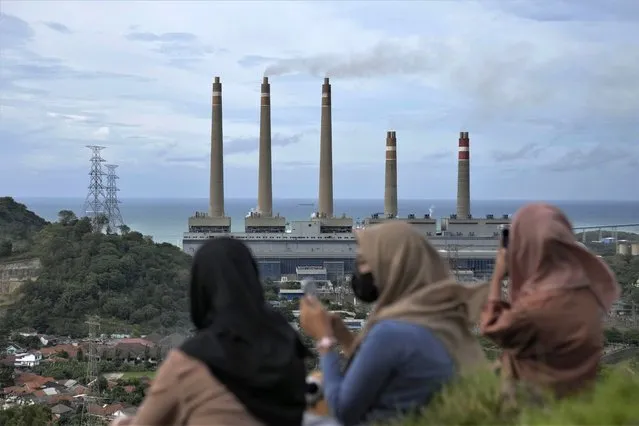
Indonesian women sit on a hill as the Suralaya coal power plant looms in the background in Cilegon, Indonesia, on January 8, 2023. A plan for how Indonesia will spend $20 billion to transition to cleaner energy was submitted Wednesday, Aug. 16, to the government and its financing partners, the planners said. (Photo by Dita Alangkara/AP Photo)

Indonesian women sit on a hill as the Suralaya coal power plant looms in the background in Cilegon, Indonesia, on January 8, 2023. A plan for how Indonesia will spend $20 billion to transition to cleaner energy was submitted Wednesday, Aug. 16, to the government and its financing partners, the planners said. (Photo by Dita Alangkara/AP Photo)
Details
15 Jan 2024 17:38:00
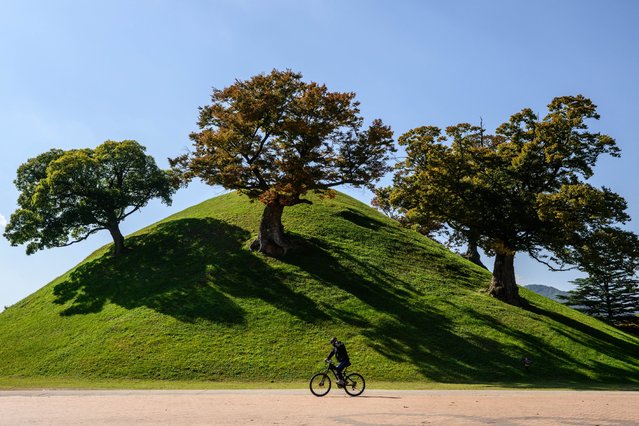
A cyclist rides past a tumulus tomb in Gyeongju, South Korea on November 1, 2025. (Photo by Anthony Wallace/AFP Photo)

A cyclist rides past a tumulus tomb in Gyeongju, South Korea on November 1, 2025. (Photo by Anthony Wallace/AFP Photo)
Details
04 Dec 2025 02:56:00
A general view of Hong Kong's business district is seen Thursday, August 1, 2013. (Photo by Vincent Yu/AP Photo)

A general view of Hong Kong's business district is seen Thursday, August 1, 2013. (Photo by Vincent Yu/AP Photo)
Details
21 Apr 2014 10:01:00
On August 31, 2012, a long filament of solar material that had been hovering in the sun's atmosphere, the corona, erupted out into space at 4:36 p.m. EDT. The coronal mass ejection, or CME, traveled at over 900 miles per second. The CME did not travel directly toward Earth, but did connect with Earth's magnetic environment, or magnetosphere, causing aurora to appear on the night of Monday, September 3. (Photo by NASA/GSFC/SDO)

On August 31, 2012, a long filament of solar material that had been hovering in the sun's atmosphere, the corona, erupted out into space at 4:36 p.m. EDT. The coronal mass ejection, or CME, traveled at over 900 miles per second. The CME did not travel directly toward Earth, but did connect with Earth's magnetic environment, or magnetosphere, causing aurora to appear on the night of Monday, September 3. (Photo by NASA/GSFC/SDO via The Atlantic)
Details
14 Sep 2012 09:01:00