Kyla Drumm, 5, waits after receiving the Pfizer-BioNTech coronavirus disease (COVID-19) vaccine in Skippack, Pennsylvania, U.S., November 3, 2021. (Photo by Hannah Beier/Reuters)
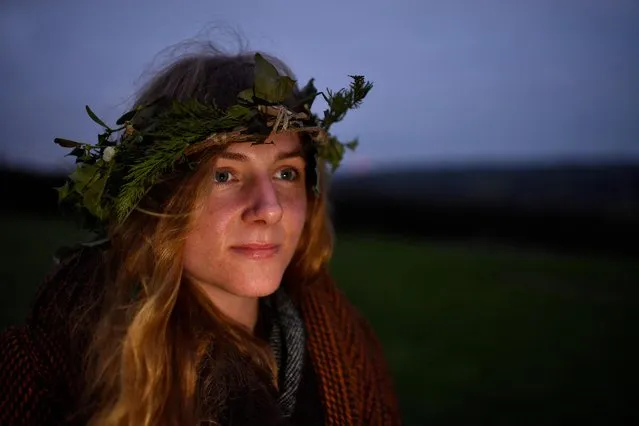
Aoife Ni Heochaidh enjoys the sunrise as she welcomes winter solstice at the 5000-year-old stone age passage tomb of Newgrange in the Boyne Valley, as entry inside the chamber is closed for the second year due to coronavirus disease (COVID-19) pandemic, in Newgrange, Ireland, December 21, 2021. (Photo by Clodagh Kilcoyne/Reuters)
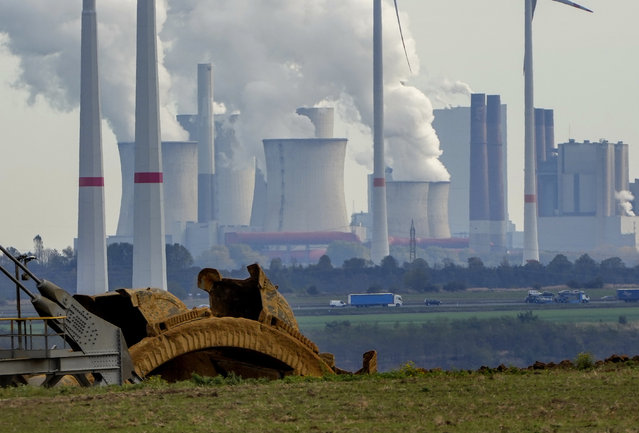
Steam comes out of the chimneys of the coal-fired power station Neurath near the Garzweiler open-cast coal mine in Luetzerath, Germany, Monday, October 25, 2021. The climate change conference COP26 will start next Sunday in Glasgow, Scotland. (Photo by Michael Probst/AP Photo)
A Saudi trader wears a mask as he monitors stock information at the Saudi stock market in Riyadh, Saudi Arabia on August 25, 2020. (Photo by Ahmed Yosri/Reuters)
A drone image shows decommissioned cruise ships being dismantled for scrap metal sales after the COVID-19 pandemic all but destroyed the industryat Aliaga ship-breaking yard in the Aegean port city of Izmir, western Turkey, October 2, 2020. (Photo by Umit Bektas/Reuters)
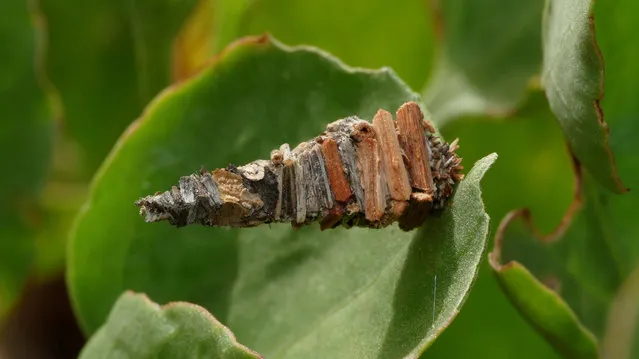
An undated handout photo made available by the Zerynthia Association shows the pupa of an amicta moneiba, a recently discovered species of moth endemic to La Gomera and El Hierro islands in the Canary Islands, Spain (issued 01 July 2020), as those two islands pulled apart from the rest of the Canary Islands 2.5 million years ago. The Institute of Evolutionary Biology of the Spanish National Research Council (CSIC) and the Zerynthia Association have recently discovered two new moth species in El Hierro and La Gomera. (Photo by Yeray Monasterio/Zerynthia/EPA/EFE)