Loading...
Done
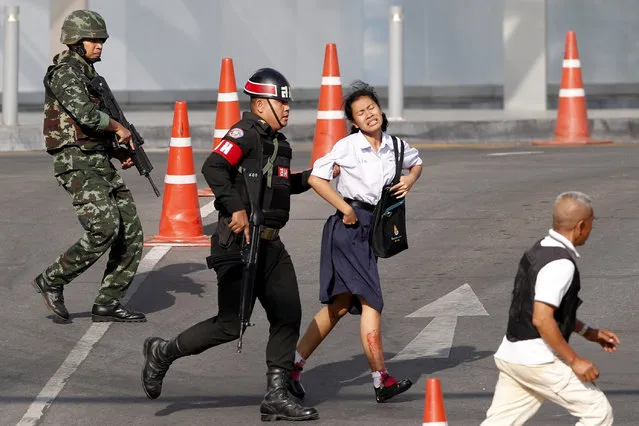
Soldiers evacuate a hostage from a mass shooting scene at the Terminal 21 shopping mall in Nakhon Ratchasima, Thailand, 09 February 2020. According to media reports, at least 21 people were killed, and as many as 30 wounded after a Thai soldier, identified as 32-year-old Jakraphanth Thomma, went on a shooting rampage with a M60 machine gun in the city of Nakhon Ratchasima, also known as Korat. Thomma held an unknown number of people hostage within the Terminal 21 shopping mall for around 17 hours before being shot and killed in a police operation. (Photo by Rungroj Yongrit/EPA/EFE)

Soldiers evacuate a hostage from a mass shooting scene at the Terminal 21 shopping mall in Nakhon Ratchasima, Thailand, 09 February 2020. According to media reports, at least 21 people were killed, and as many as 30 wounded after a Thai soldier, identified as 32-year-old Jakraphanth Thomma, went on a shooting rampage with a M60 machine gun in the city of Nakhon Ratchasima, also known as Korat. Thomma held an unknown number of people hostage within the Terminal 21 shopping mall for around 17 hours before being shot and killed in a police operation. (Photo by Rungroj Yongrit/EPA/EFE)
Details
10 Feb 2020 10:30:00
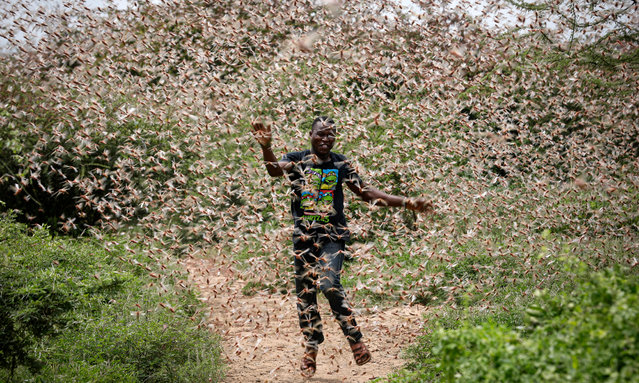
A local farmer Theophilus Mwendwa runs through a swarm of desert locusts to chase them away in the bush near Enziu, Kitui County, some 200km east of the capital Nairobi, Kenya, 24 January 2020. Large swarms of desert locusts have been invading Kenya for weeks, after having infested some 70 thousand hectares of land in Somalia which the United Nations Food and Agriculture Organisation (FAO) has termed the “worst situation in 25 years” in the Horn of Africa. FAO cautioned that it poses an “unprecedented threat” to food security and livelihoods in the region. (Photo by Dai Kurokawa/EPA/EFE)

A local farmer Theophilus Mwendwa runs through a swarm of desert locusts to chase them away in the bush near Enziu, Kitui County, some 200km east of the capital Nairobi, Kenya, 24 January 2020. Large swarms of desert locusts have been invading Kenya for weeks, after having infested some 70 thousand hectares of land in Somalia which the United Nations Food and Agriculture Organisation (FAO) has termed the “worst situation in 25 years” in the Horn of Africa. FAO cautioned that it poses an “unprecedented threat” to food security and livelihoods in the region. (Photo by Dai Kurokawa/EPA/EFE)
Details
22 Feb 2020 00:01:00
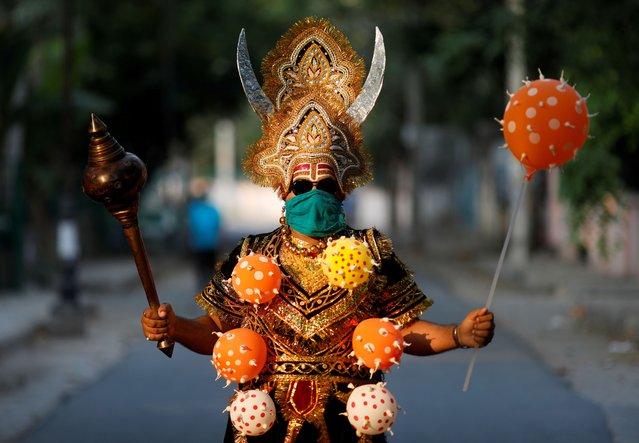
A local resident dressed as Yamraj or Hindu god of death, wearing a novel coronavirus-themed balloon necklace, gestures as he poses during an awareness about social distancing and staying at home organised by Delhi police during a nationwide lockdown to slow the spreading of the coronavirus disease (COVID-19), in New Delhi, India, April 28, 2020. (Photo by Adnan Abidi/Reuters)

A local resident dressed as Yamraj or Hindu god of death, wearing a novel coronavirus-themed balloon necklace, gestures as he poses during an awareness about social distancing and staying at home organised by Delhi police during a nationwide lockdown to slow the spreading of the coronavirus disease (COVID-19), in New Delhi, India, April 28, 2020. (Photo by Adnan Abidi/Reuters)
Details
04 May 2020 00:01:00
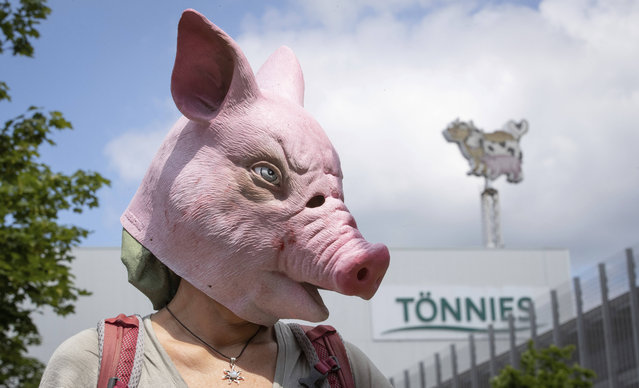
Animal rights activists protest in front of the Toennies meatpacking plant and slaughterhouse in Rheda-Wiedenbrueck, Germany, Saturday, June 20, 2020. Hundreds of new coronavirus cases are linked to the large meatpacking plant, officials ordered the closure of the slaughterhouse, as well as isolation and tests for everyone else who had worked at the Toennies site – putting about 7,000 people under quarantiner. (Photo by Friso Gentsch/dpa via AP Photo)

Animal rights activists protest in front of the Toennies meatpacking plant and slaughterhouse in Rheda-Wiedenbrueck, Germany, Saturday, June 20, 2020. Hundreds of new coronavirus cases are linked to the large meatpacking plant, officials ordered the closure of the slaughterhouse, as well as isolation and tests for everyone else who had worked at the Toennies site – putting about 7,000 people under quarantiner. (Photo by Friso Gentsch/dpa via AP Photo)
Details
22 Jun 2020 00:03:00
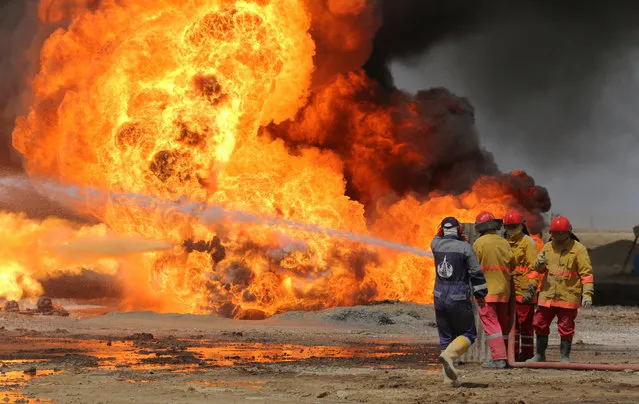
Iraqi firefighters try to stop the fire of burning oil wells in Kirkuk, northern Iraq, 02 June 2016. Two Khabbaz oil field wells in Kirkuk Province, northern Iraq, exploded by suspected insurgents, a security official said. (Photo by EPA/Stringer)

Iraqi firefighters try to stop the fire of burning oil wells in Kirkuk, northern Iraq, 02 June 2016. Two Khabbaz oil field wells in Kirkuk Province, northern Iraq, exploded by suspected insurgents, a security official said. (Photo by EPA/Stringer)
Details
24 May 2018 00:01:00
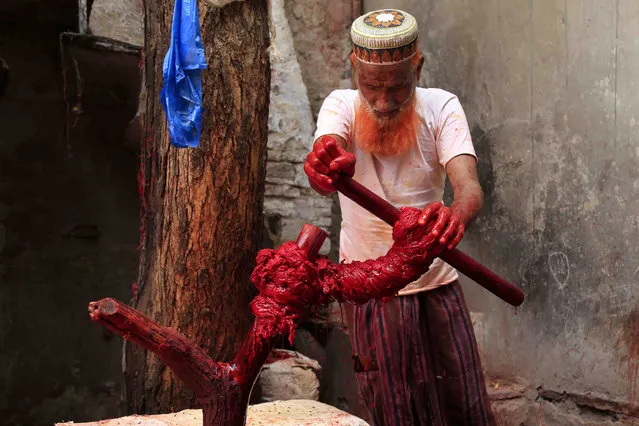
An Indian Muslim worker applies colors on Kalavas (sacred threads) in Ajmer in the Indian state of Rajasthan on May 24, 2018. (Photo by Himanshu Sharma/AFP Photo)

An Indian Muslim worker applies colors on Kalavas (sacred threads) in Ajmer in the Indian state of Rajasthan on May 24, 2018. (Photo by Himanshu Sharma/AFP Photo)
Details
30 May 2018 00:01:00
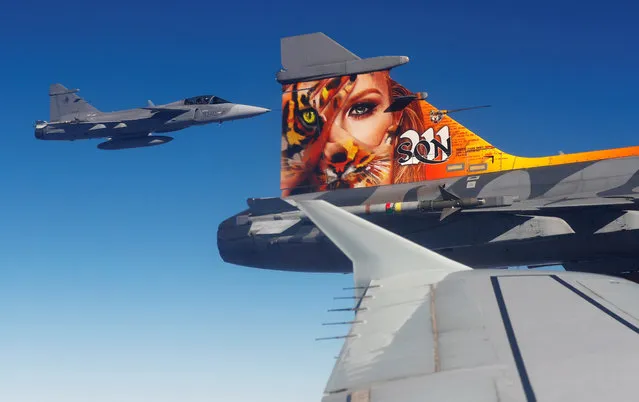
Two Czech Gripen fighter planes demonstrate a flight interception of a Belgian air force transport plane over the Czech Republic, as part of NATO drills on September 12, 2018. (Photo by Francois Lenoir/Reuters)

Two Czech Gripen fighter planes demonstrate a flight interception of a Belgian air force transport plane over the Czech Republic, as part of NATO drills on September 12, 2018. (Photo by Francois Lenoir/Reuters)
Details
28 Sep 2018 00:01:00
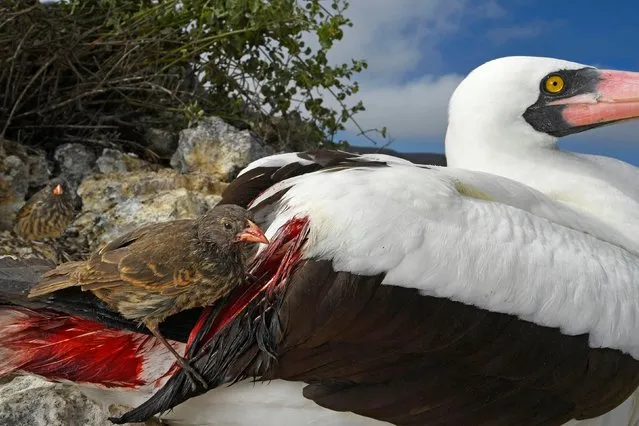
Bloodthirsty by Thomas P Peschak, Germany/South Africa — winner, Behaviour: birds. When rations run short on Wolf Island, in the remote northern Galápagos, the sharp-beaked ground finches become vampires. Their sitting targets are Nazca boobies and other large birds. The finches rely on a scant diet of seeds and insects, which regularly dries up, so they drink blood to survive. ‘I’ve seen more than half a dozen finches drinking from a single Nazca booby,’ says Tom. Rather than leave their nests the boobies tolerate the vampires, and the blood loss doesn’t seem to cause permanent harm. (Photo by Thomas P Peschak/2018 Wildlife Photographer of the Year)

Bloodthirsty by Thomas P. Peschak, Germany/South Africa — winner, Behaviour: birds. When rations run short on Wolf Island, in the remote northern Galápagos, the sharp-beaked ground finches become vampires. Their sitting targets are Nazca boobies and other large birds. The finches rely on a scant diet of seeds and insects, which regularly dries up, so they drink blood to survive. ‘I’ve seen more than half a dozen finches drinking from a single Nazca booby,’ says Tom. Rather than leave their nests the boobies tolerate the vampires, and the blood loss doesn’t seem to cause permanent harm. (Photo by Thomas P. Peschak/2018 Wildlife Photographer of the Year)
Details
19 Oct 2018 00:05:00