Loading...
Done
Lola is seen at left in everyday clothes – and then at right in her work clothes. She works as a clown in Paris. (Photo by Bruno Fert/Picturetank)

“The series of photos called Workwears, by French photographer Bruno Fert, visually juxtaposes people’s private lives with their lives at work. A firefighter, a fisherman, a nurse, a diver, a judge. One by one, Fert’s photos show people in their homes wearing everyday clothing – followed by another photo showing them dressed in the clothing of their chosen professions. Our reaction, Fert said, reminds us how tightly humans hold on to certain stereotypes about some professions. “I like to break those stereotypes”, he said”. – Thom Patterson via CNN. Here: Lola is seen at left in everyday clothes – and then at right in her work clothes. She works as a clown in Paris. (Photo by Bruno Fert/Picturetank)
Details
29 Oct 2014 12:40:00
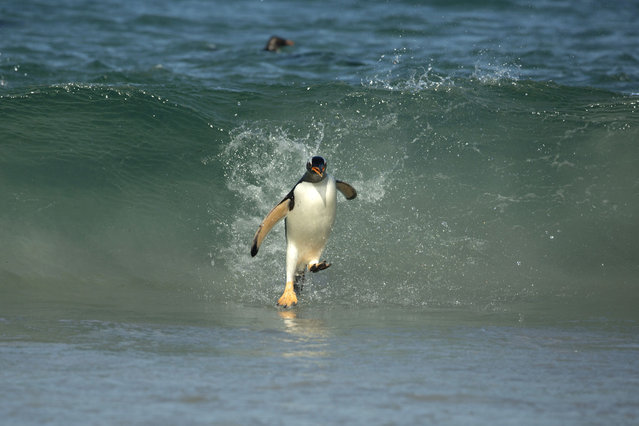
These surfing penguins are making waves as they glide gracefully across the ocean.They are showcasing their talent as they arrive on the East Coast beach of New Island in the Falklands.The penguins are of the gentoo species, characterised by their bright orange bills and the distinctive white stripes on their heads. Here: a lone penguin balancing cooly on a single foot as it catches a wave. (Photo by Shanu Subra/Solent News/SIPA Press)

These surfing penguins are making waves as they glide gracefully across the ocean.They are showcasing their talent as they arrive on the East Coast beach of New Island in the Falklands.The penguins are of the gentoo species, characterised by their bright orange bills and the distinctive white stripes on their heads. The dazzling images were captured by amateur photographer Shanu Subra, during a 26 day ecology expedition. Here: a lone penguin balancing cooly on a single foot as it catches a wave. (Photo by Shanu Subra/Solent News/SIPA Press)
Details
25 Nov 2014 10:55:00
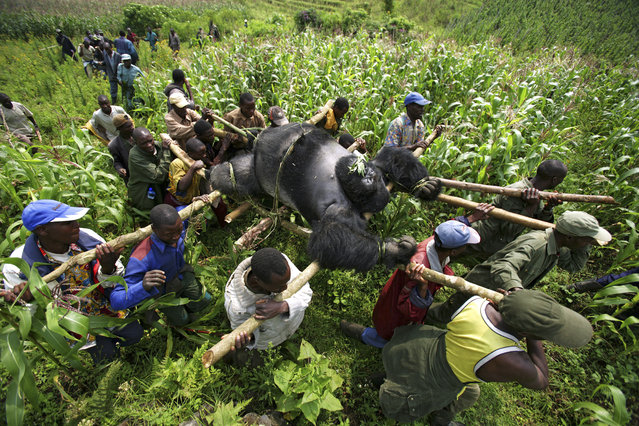
2008 Visa d'or Feature: Brent Stirton. Conservation Rangers from an Anti-Poaching unit work with locals to evacuate the bodies of four Mountain Gorrillas killed in mysterious circumstances in the park,  July 24, 2007, Virunga National Park, Eastern Congo. (Photo by Brent Stirton/Exclusive by Getty Images)

Jean-François Leroy launched Visa Pour l’Image, the international photojournalism festival, in Perpignan in 1989. Before heading up the festival, Leroy was shooting reportage for the agency Sipa Press and also working for Photo-Reporter, Le Photographe, Photo-Revue and Photo Magazine. He is the chairman of the company Images Evidence. Photo: 2008 Visa d'or Feature: Brent Stirton. Conservation Rangers from an Anti-Poaching unit work with locals to evacuate the bodies of four Mountain Gorrillas killed in mysterious circumstances in the park, July 24, 2007, Virunga National Park, Eastern Congo. (Photo by Brent Stirton/Exclusive by Getty Images)
Details
27 Aug 2013 10:42:00
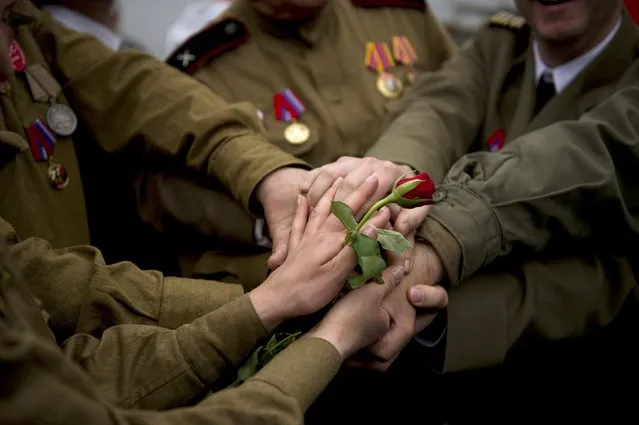
Members of a historical re-enactment group dressed as U.S. and Soviet Army soldiers take part in Elbe Day celebrations, in eastern German city of Torgau at the river Elbe, April 25, 2015. (Photo by Stefanie Loos/Reuters)

Members of a historical re-enactment group dressed as U.S. and Soviet Army soldiers take part in Elbe Day celebrations, in eastern German city of Torgau at the river Elbe, April 25, 2015. Elbe Day commemorates the encounter of the Allies 70 years ago, on the 25th of April 1945 when American and Soviet army units joined together on the destroyed bridge over the river Elbe. The photograph of the meaningful handshake made its way around the world and became a symbol of the near end of World War II in Europe. (Photo by Stefanie Loos/Reuters)
Details
26 Apr 2015 08:58:00
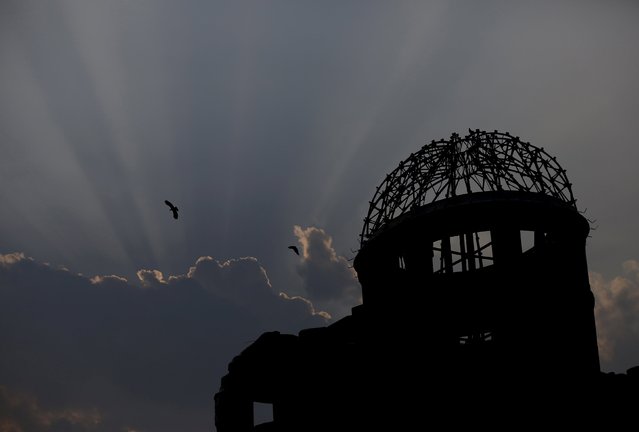
Birds fly over the Atomic Bomb Dome in Hiroshima, western Japan July 29, 2015. On August 6, 1945, the U.S. dropped the atomic bomb on Hiroshima, killing about 140,000 by the end of the year in a city of 350,000 residents, in the world's first nuclear attack. (Photo by Issei Kato/Reuters)

Birds fly over the Atomic Bomb Dome in Hiroshima, western Japan July 29, 2015. On August 6, 1945, the U.S. dropped the atomic bomb on Hiroshima, killing about 140,000 by the end of the year in a city of 350,000 residents, in the world's first nuclear attack. Three days later, a second atomic bomb was dropped on Nagasaki. Influenced by the shadows scorched into outdoor surfaces by the heat of the blasts 70 years ago, Reuters photographer Issei Kato pays homage to survivors, residents and historic buildings in both cities in a personal project that captures the shadows of today. (Photo by Issei Kato/Reuters)
Details
04 Aug 2015 12:01:00
Alexei Gruk, 45, mechanic and supporter of presidential candidate Pavel Grudinin, poses for a picture in St. Petersburg, Russia, January 31, 2018. “The most important thing for me is that our foreign policy stays the same”, said Gruk. “To hell with the sanctions… So what if they don’t bring foreign stuff here anymore? As if that means we have to give up. I don't care”. (Photo by Anton Vaganov/Reuters)

Most Russians intending to vote for Vladimir Putin in Sunday's election say stability is at the root of their faith in their candidate – though many young voters believe it's time for a change of leader. Putin, 65, is expected to win a fourth term in office with 69 percent of the vote, according to the latest survey by a state-run pollster. Reuters correspondents and photographers who travelled around the country talking to voters ahead of the March 18 election found nothing to contradict expectation of an emphatic Putin victory. (Photo by Anton Vaganov/Reuters)
Details
15 Mar 2018 00:01:00
A combination picture shows a voter, casting a ballot at a polling station number 216 (L) and walking with a ballot at a polling station number 217, during the presidential election in Ust-Djeguta, Russia March 18, 2018. The voter, asked by a Reuters reporter to explain why she was voting multiple times, ignored the question and walked away. (Photo by Reuters/Staff)

17 people were photographed by Reuters apparently casting ballots at more than one polling station Sunday during Russia’s presidential election in the town of Ust-Djeguta, southern Russia. Many appeared to be state employees, and some showed up in groups and in mini buses bearing the names of state-provided services. Voting twice is a misdemeanour under Russian law and those caught are heavily fined. But when shown these pictures, election commission member Leila Koichuyeva said: “They could be twins”. Here are a few. (Photo by Reuters/Staff)
Details
22 Mar 2018 06:22:00
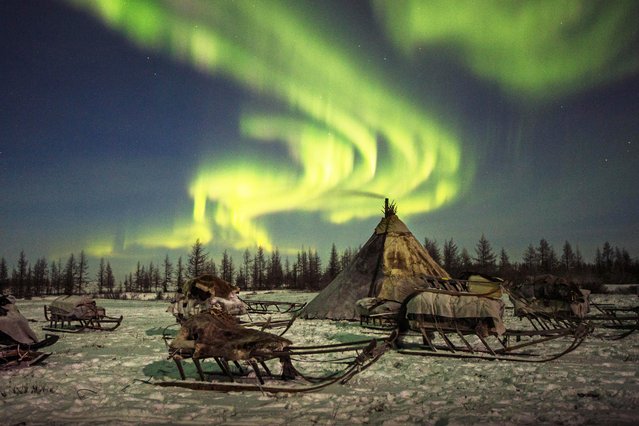
An empty camp is shown beneath a colourful sky in Siberia, December 2016. (Photo by Timothy Allen/Barcroft Productions)

A British photographer has captured life at the “edge of the world”. Timothy Allen, best known for his work on BBC's Human Planet, trekked through the freezing Siberian wilderness for 16 days as he joined part of an 800km migration of reindeer in the Yamal-Nenets region – a name that roughly translates to “edge of the world”. The stunning pictures feature the nomadic Nenets tribe, who drink blood to survive in -45°C temperatures. Timothy's epic journey, which will be revealed in an eight-minute documentary on Animal Planet USA, saw him travel across the bleak terrain of the frozen Ob River with the Nenets people in December last year. Here: An empty camp is shown beneath a colourful sky in Siberia, December 2016. (Photo by Timothy Allen/Barcroft Productions)
Details
19 Sep 2017 07:48:00