Loading...
Done
A girl salutes to visitors before a show at the Mangyongdae Children's Palace in central Pyongyang, North Korea May 5, 2016. Foreign journalists invited to cover North Korea's first ruling party congress in 36 years were treated on Thursday to song and dance performances by schoolchildren professing their love for leader Kim Jong Un. Kim is expected to use the congress starting on Friday to declare North Korea a nuclear weapons state and formally adopt his “Byongjin” policy to pursue economic development and nuclear capability at the same time. (Photo by Damir Sagolj/Reuters)

A girl salutes to visitors before a show at the Mangyongdae Children's Palace in central Pyongyang, North Korea May 5, 2016. Pyongyang held a gala of song and dance performances by local school children on May 5 for visiting delegations of foreign journalists and tourists at the Mangyongdae Children's Palace. The event included orchestral, choir, and acrobatic performances, many of them with political undertones. The Seventh Worker's Party Congress commences on May 6, 2016. (Photo by Damir Sagolj/Reuters)
Details
06 May 2016 13:37:00
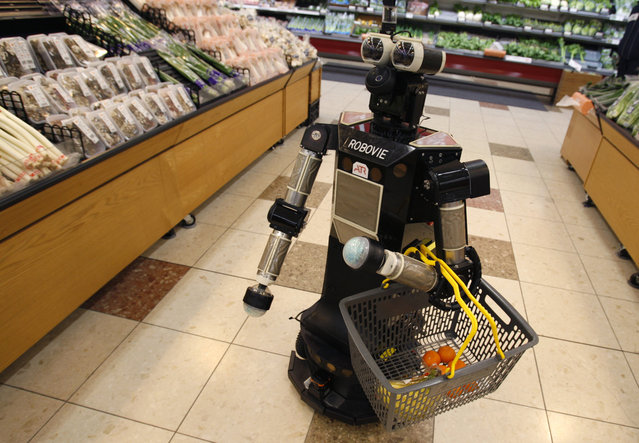
A robot named “Robovie-II”, developed by Japanese robotics research institution ATR, moves around at a grocery store during a shopping assisting experiment by utilizing the robot in an ubiquitous network technology platform in Kyoto, western Japan January 6, 2010. The robot greets the shopper at the entrance of the store, follows him to the shelves while holding a grocery basket and reminds him of the items on a shopping list, which the shopper would have entered beforehand in a specialized mobile device. The experiment is aimed to gather data in order to provide livelihood support for the elderly by using robots and network technologies, ATR's researcher Satoshi Koizumi said. (Photo by Yuriko Nakao/Reuters)

A robot named “Robovie-II”, developed by Japanese robotics research institution ATR, moves around at a grocery store during a shopping assisting experiment by utilizing the robot in an ubiquitous network technology platform in Kyoto, western Japan January 6, 2010. (Photo by Yuriko Nakao/Reuters)
Details
02 Feb 2018 06:54:00
A SpaceX Falcon Heavy rocket lifts off from historic launch pad 39-A at the Kennedy Space Center in Cape Canaveral, Florida, February 6, 2018. (Photo by Thom Baur/Reuters)

A SpaceX Falcon Heavy rocket lifts off from historic launch pad 39-A at the Kennedy Space Center in Cape Canaveral, Florida, February 6, 2018. The world' s most powerful rocket, SpaceX' s Falcon Heavy, blasted off Tuesday on its highly anticipated maiden test flight, carrying CEO Elon Musk' s cherry red Tesla roadster to an orbit near Mars. Screams and cheers erupted at Cape Canaveral, Florida as the massive rocket fired its 27 engines and rumbled into the blue sky over the same NASA launchpad that served as a base for the US missions to Moon four decades ago. (Photo by Thom Baur/Reuters)
Details
07 Feb 2018 08:40:00
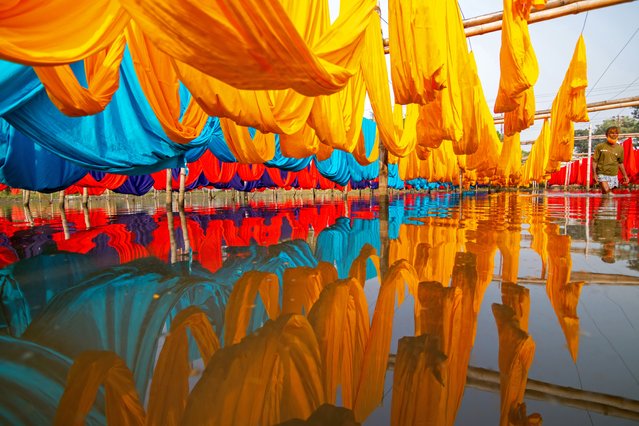
Workers hang thousands of different colorful fabrics on iron wires tied between a bamboo framework and constantly turn them so that they dry perfectly in a flooded field in Narayanganj, Bangladesh on March 16, 2022. Iron wires are used between a bamboo framework to create giant washing lines for the final part of the dying process as the fabrics are dried in the sun. Bright strands of blue, pink, orange and green-dyed cloths hang above the grassy field in a dazzling network of interlocking colors. This is the final part of the dying process after which the cloth is made into t-shirts and vests at the garment factory. (Photo by Joy Saha/ZUMA Press Wire/Rex Features/Shutterstock)

Workers hang thousands of different colorful fabrics on iron wires tied between a bamboo framework and constantly turn them so that they dry perfectly in a flooded field in Narayanganj, Bangladesh on March 16, 2022. (Photo by Joy Saha/ZUMA Press Wire/Rex Features/Shutterstock)
Details
25 Mar 2022 05:47:00
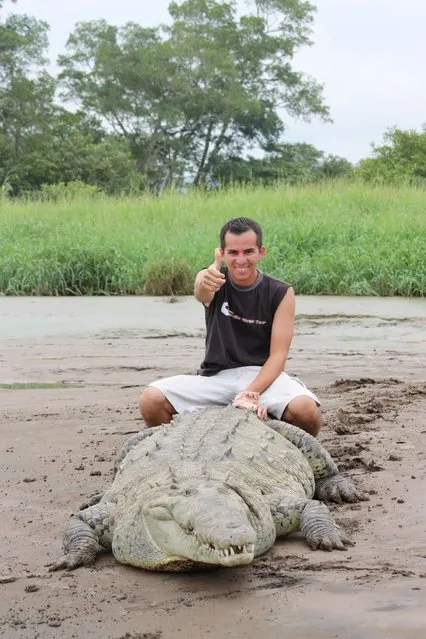
A tour guide shows a thumbs up as he sits on top of a crocodile on the Tarcoles river in Tarcoles, Costa Rica. (Photo and caption by Barcroft Media)

To most of us, hand-feeding crocodiles might sound like a one-way ticket to a watery grave. But for Jose Eduardo Chaves Salas, 32, coming within inches of the fearsome creatures’ razor-sharp teeth is all in a day’s work. He runs Jose's Crocodile River Tour on the Tarcoles River in Costa Rica, where tourists can watch him feed crocs up to 17 feet long. Photo: A tour guide shows a thumbs up as he sits on top of a crocodile on the Tarcoles river in Tarcoles, Costa Rica. (Photo and caption by Barcroft Media)
Details
20 Oct 2013 09:06:00
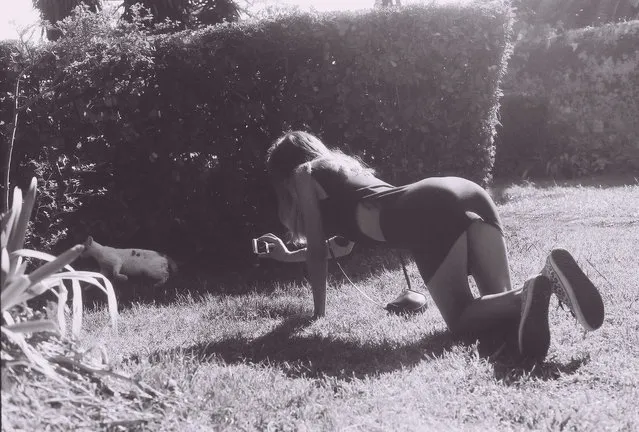
Untitled. (Photo by Artem Nadyozhin)

Untitled. (Photo by Artem Nadyozhin)


P.S. Need more? Please use tag Simply Some Photos!

P.S.S. All pictures are presented in high resolution. To see Hi-Res images – just TWICE click on any picture. In other words, click small picture – opens the BIG picture. Click BIG picture – opens VERY BIG picture (if available; this principle works anywhere on the site AvaxNews).
Details
17 Nov 2013 15:03:00
Drawings By Jennifer Healy

“I was born in the United States in 1985. As early as I can remember I’ve been a “doodler”. From even the early days I’ve always loved strange, offbeat, beautiful, and slightly melancholy things. Something about the mixed grabbed me. My love for sketching carried on throughout my high school days. Which is when I took a small class on watercolor. Watercolor is what birthed my passion for mixing colors and how a color can tell a story. In year 2009 I discovered digital painting and my new found passion for the medium. It’s been the favored medium for the past years since. I’ve used online tutorials and videos to help me learn along the way and then in late 2011 I took a workshop called Becoming a Better Artist. The beginning of 2013 I won a class from The Art Department which will start this spring.”
Jennifer Healy
Details
05 Dec 2013 12:04:00
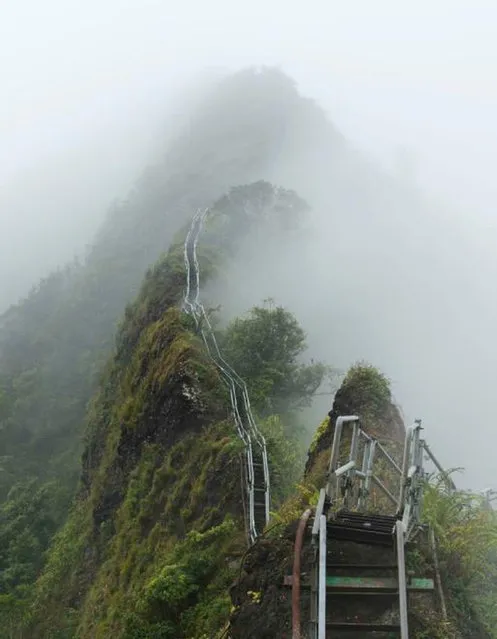
Stairway To Heaven In Hawaii

The Haʻikū Stairs, also known as the Stairway to Heaven or Haʻikū Ladder, is a steep hiking trail on the island of Oʻahu. The trail began as a wooden ladder spiked to the cliff on the south side of the Haʻikū Valley. It was installed in 1942 to enable antenna cables to be strung from one side of the cliffs above Haʻikū Valley to the other. A building to provide a continuous communication link between Wahiawā and Haʻikū Valley Naval Radio Station was constructed at the peak of Puʻukeahiakahoe, elevation about 2,800 feet (850 m). The antennae transmitted very low frequency radio signals from a 200,000-watt Alexanderson alternator in the center of Haʻikū valley. The signals could reach US Navy submarines as far away as Tokyo Bay while the submarines were submerged.
Details
30 Nov 2013 12:47:00