Loading...
Done
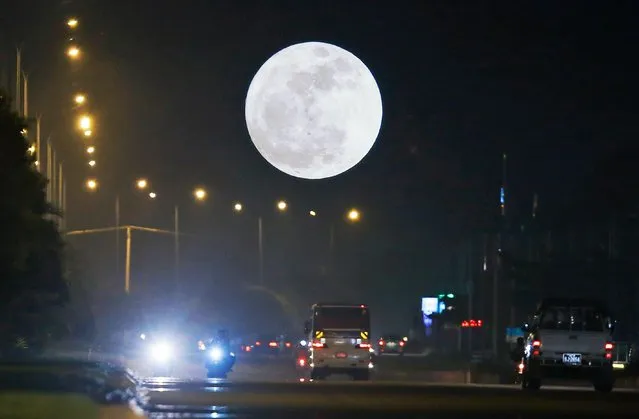
A so-called “Supermoon” dominates the sky while traffic rolls in the streets in Naypyitaw, Myanmar, 03 December 2017. According to the National Aeronautics and Space Administration (NASA) a series of three “Supermoons” – dubbed the “Supermoon trilogy” – will appear in the sky on 03 December 2017, on 01 January 2018 and and 31 January 2018. A 'Supermoon' commonly is a full moon at its closest distance to the earth with the moon appearing larger than usual. (Photo by Hein Htet/EPA/EFE)

A so-called “Supermoon” dominates the sky while traffic rolls in the streets in Naypyitaw, Myanmar, 03 December 2017. According to the National Aeronautics and Space Administration (NASA) a series of three “Supermoons” – dubbed the “Supermoon trilogy” – will appear in the sky on 03 December 2017, on 01 January 2018 and and 31 January 2018. A “Supermoon” commonly is a full moon at its closest distance to the earth with the moon appearing larger than usual. (Photo by Hein Htet/EPA/EFE)
Details
05 Dec 2017 07:45:00
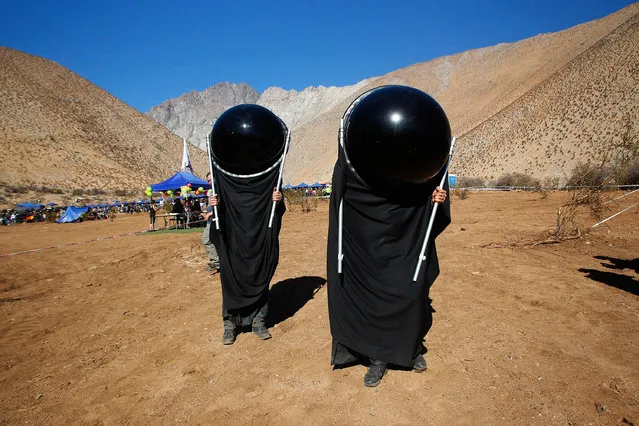
Chileans watch the sky with special suits prior to a total solar eclipse on July 2, 2019 in Paiguano, Chile. Around 25,0000 tourists arrived to Paiguano, a small town of around 1,000 inhabitants in the Elqui Valley, 650 km away Santiago. This is the only Earth's total solar eclipse of 2019 and the first one since 2017. From this point, the sun will fully disappear for around two minutes. It is best visible from a stripe in the South Pacific, Chile and Argentina. (Photo by Marcelo Hernandez/Getty Images)

Chileans watch the sky with special suits prior to a total solar eclipse on July 2, 2019 in Paiguano, Chile. Around 25,0000 tourists arrived to Paiguano, a small town of around 1,000 inhabitants in the Elqui Valley, 650 km away Santiago. This is the only Earth's total solar eclipse of 2019 and the first one since 2017. From this point, the sun will fully disappear for around two minutes. It is best visible from a stripe in the South Pacific, Chile and Argentina. (Photo by Marcelo Hernandez/Getty Images)
Details
04 Jul 2019 00:05:00
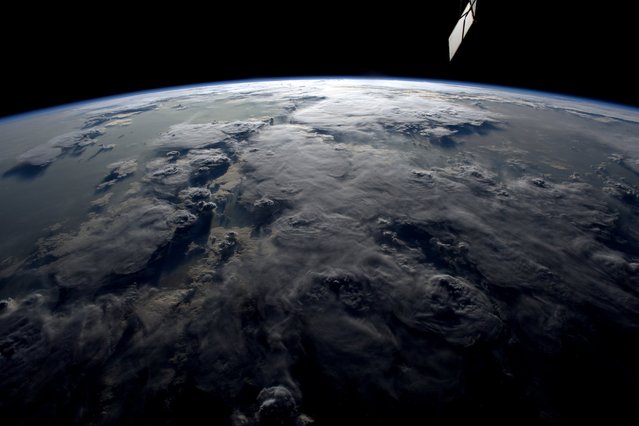
European Space Agency astronaut Tim Peake will return home after a six-month long mission on the International Space Station,on June 18, 2016. Peake was the first British ESA astronaut to visit the ISS and captured hundreds of photographs of the Earth during his mission. Here: “Lots of sun-glint right now during our whole orbit – we haven't seen a sunset for over 3 days”, he wrote. (Photo by Tim Peake/ESA/NASA)

European Space Agency astronaut Tim Peake will return home after a six-month long mission on the International Space Station,on June 18, 2016. Peake was the first British ESA astronaut to visit the ISS and captured hundreds of photographs of the Earth during his mission. Here: “Lots of sun-glint right now during our whole orbit – we haven't seen a sunset for over 3 days”, he wrote. (Photo by Tim Peake/ESA/NASA)
Details
18 Jun 2016 13:08:00
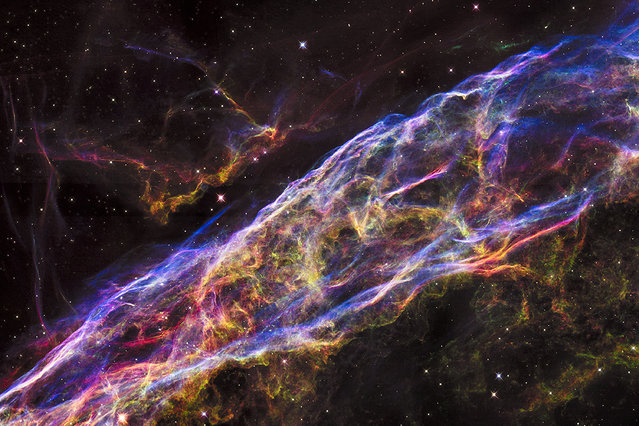
A small section of the expanding remains of the Veil Nebula, a massive star that exploded about 8,000 years ago. The entire nebula is 110 light-years across, covering six full moons on the sky as seen from Earth, and resides about 2,100 light-years away in the constellation Cygnus, the Swan. Image taken by NASA's Hubble Space Telescope. Released September 24, 2015. (Photo by Reuters/NASA/ESA/Hubble Heritage Team)

A small section of the expanding remains of the Veil Nebula, a massive star that exploded about 8,000 years ago. The entire nebula is 110 light-years across, covering six full moons on the sky as seen from Earth, and resides about 2,100 light-years away in the constellation Cygnus, the Swan. Image taken by NASA's Hubble Space Telescope. Released September 24, 2015. (Photo by Reuters/NASA/ESA/Hubble Heritage Team)
Details
10 Dec 2015 08:01:00


(L-R) Natalie Burns and Taunia Arave battle as referee Nick Stevens (R) looks on during the US National Sumo Championships at the Riviera Hotel & Casino June 24, 2011 in Las Vegas, Nevada. (Photo by Ethan Miller/Getty Images)
Details
26 Jun 2011 10:13:00
North West Of England Battered By High Winds

A pedestrian battles against gale force winds in Adelaide Street West next to the promenade in Blackpool on December 28, 2011 in Blackpool, England. (Photo by Christopher Furlong/Getty Images)
Details
29 Dec 2011 11:25:00
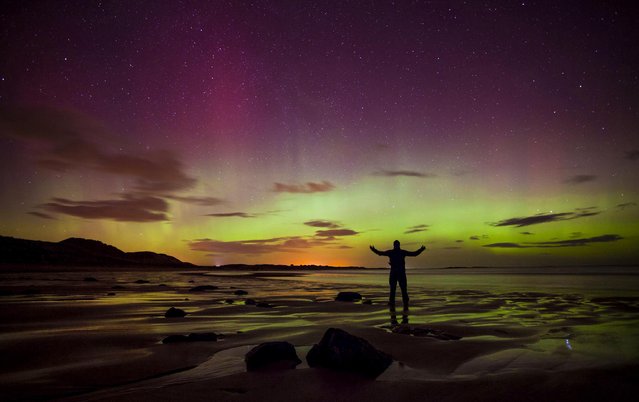
A man poses standing on a rock looking at the aurora borealis, or northern lights, illuminating the night sky at Embleton Bay in Northumberland, England, on February 27, 2014. The northern lights is a fantastical natural light display with fast moving light effects caused by particles charged by the sun colliding with particles in Earth's upper atmosphere. (Photo by Tom White/PA Wire)

A man poses standing on a rock looking at the aurora borealis, or northern lights, illuminating the night sky at Embleton Bay in Northumberland, England, on February 27, 2014. The northern lights is a fantastical natural light display with fast moving light effects caused by particles charged by the sun colliding with particles in Earth's upper atmosphere. (Photo by Tom White/PA Wire)
Details
02 Mar 2014 10:12:00
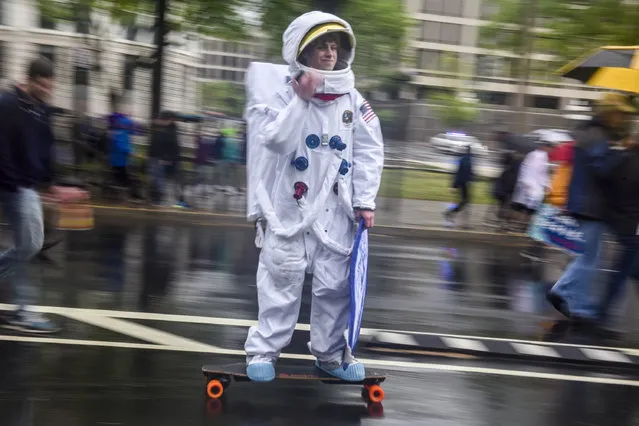
Max Gold, 20, of NYC, cruises on his skateboard as thousands gather on the National Mall for the March for Science on Saturday, April 22, 2017, in Washington, DC.  Activists and scientists descend on the nation's capital to rally for environmental causes and government policies rooted in scientific research as part of the Earth Day and March for Science rallies. (Photo by Jahi Chikwendiu/The Washington Post)

Max Gold, 20, of NYC, cruises on his skateboard as thousands gather on the National Mall for the March for Science on Saturday, April 22, 2017, in Washington, DC. Activists and scientists descend on the nation's capital to rally for environmental causes and government policies rooted in scientific research as part of the Earth Day and March for Science rallies. (Photo by Jahi Chikwendiu/The Washington Post)
Details
22 May 2017 07:38:00