Loading...
Done
Vardzia Cave Monastery

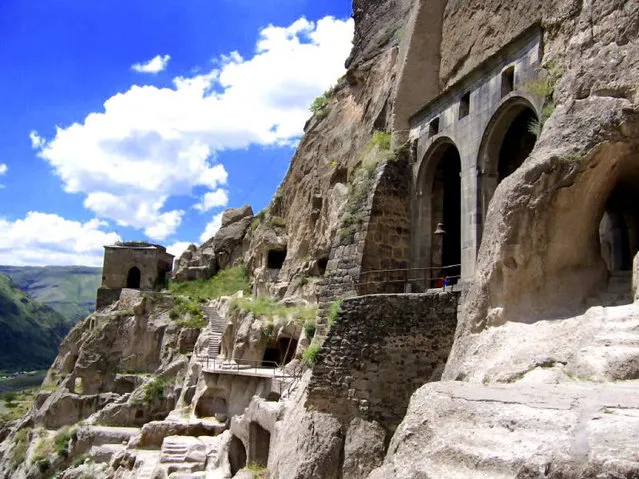
Vardzia is a cave monastery site in southern Georgia, excavated from the slopes of the Erusheti Mountain on the left bank of the Mtkvari River, thirty kilometres from Aspindza. The main period of construction was the second half of the twelfth century. The caves stretch along the cliff for some five hundred metres and in up to nineteen tiers. The Church of the Dormition, dating to the 1180s during the golden age of Tamar and Rustaveli, has an important series of wall paintings. The site was largely abandoned after the Ottoman takeover in the sixteenth century. Now part of a state heritage reserve, the extended area of Vardzia-Khertvisi has been submitted for future inscription on the UNESCO World Heritage List
Details
04 Sep 2013 10:53:00
Activists and supporters of Ukrainian nationalist groups light flares during a rally to mark the third anniversary of the Euromaidan Revolution in downtown Kiev, Ukraine, 21 November 2016. (Photo by Roman Pilipey/EPA)

Activists and supporters of Ukrainian nationalist groups light flares during a rally to mark the third anniversary of the Euromaidan Revolution in downtown Kiev, Ukraine, 21 November 2016. About one thousand activists took park in the rally during which they burned tires on the Independence Square, destroyed the Russian bank Sberbank and broke windows in the office of a Ukrainian politician Viktor Medvedchuk, according to Ukrainian media. (Photo by Roman Pilipey/EPA)
Details
22 Nov 2016 10:23:00
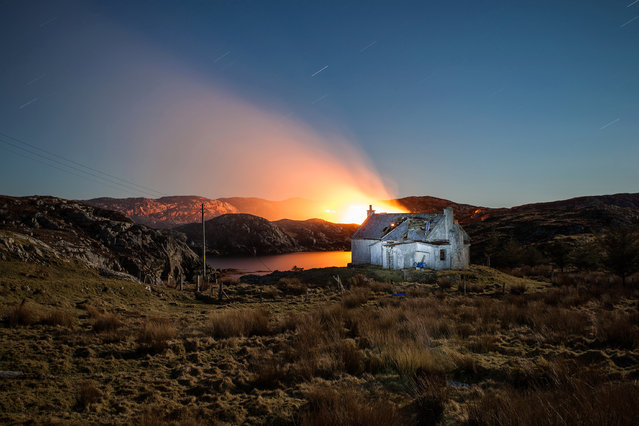
“Peat Fire”. Taken in March 2013 on the east coast of Harris. The fire is from muir-burning, when farmers burn off grasses and heather to improve grazing for their sheep. (Photo by John Maher/The Guardian)

Photographer John Maher, once the drummer with punk bank Buzzcocks, travelled to the Outer Hebrides to photograph abandoned crofters’ cottages – many of which, like this one, have seemingly been untouched since. Here: “Peat Fire”. Taken in March 2013 on the east coast of Harris. The fire is from muir-burning, when farmers burn off grasses and heather to improve grazing for their sheep. (Photo by John Maher/The Guardian)
Details
19 Aug 2016 11:39:00
A priest comforts one of the relatives of the victims, before a mass in their memory, as Lebanon marks one-year anniversary of Beirut port explosion, at the port in Beirut, Lebanon on August 4, 2021. (Photo by Aziz Taher/Reuters)

A priest comforts one of the relatives of the victims, before a mass in their memory, as Lebanon marks one-year anniversary of Beirut port explosion, at the port in Beirut, Lebanon on August 4, 2021. United in grief and anger, families of the victims and other Lebanese came out into the streets of Beirut on Wednesday to demand accountability as banks, businesses and government offices shuttered to mark one year since the horrific explosion. (Photo by Aziz Taher/Reuters)
Details
05 Aug 2021 08:47:00
stone art by Hirotoshi Itoh

Hirotoshi Itoh graduated from Tokyo National Fine Arts University in 1982 and later went into his family business as a stonemason. He spent several years working with metal before turning his attention to stones. He utilizes stones found in a river bank near his home, and he creates sculptures that juxtapose the original shape and hardness of the material with surprising humor and texture. You can find more of his work on his Deviant Art page.
Details
17 May 2012 10:58:00
Performers take part in a rain soaked Notting Hill Carnival on August 25th, 2014 in London, England.  (Photo by Mary Turner/Getty Images)

Performers take part in a rain soaked Notting Hill Carnival on August 25th, 2014 in London, England. Despite the bad weather over 1 million visitors are expected to attend the two-day event which is the largest of its kind in Europe. The event has taken place on the West London streets every August Bank Holiday weekend since 1964. (Photo by Mary Turner/Getty Images)
Details
26 Aug 2014 10:57:00
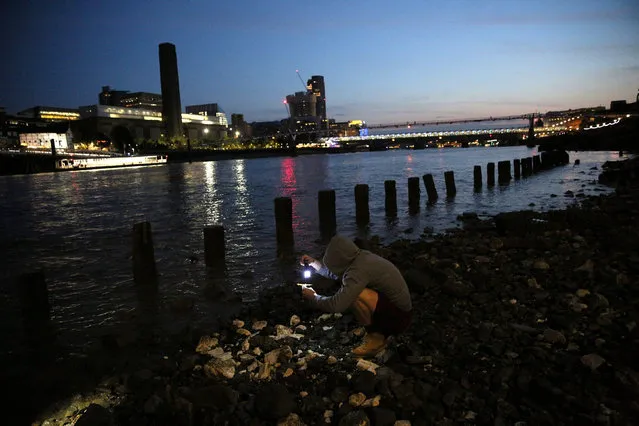
A mudlark uses a torch to look for items on the bank of the River Thames in London, Britain June 06, 2016. Mudlarking is believed to trace its origins to the 18th and 19th century, when scavengers searched the Thames' shores for items to sell. These days, history and archaeology fans are the ones hoping to find old relics such as coins, ceramics, artifacts or everyday items from across centuries. They wait for the low tide and then scour specific areas of exposed shores. "If you're in a field you could be out all day long, with the river you're restricted to about two or three hours," mudlark Nick Stevens said. While many just use the naked eye for their searches, others rely on metal detectors for which a permit from the Port of London Authority is needed. Digging also requires consent. (Photo by Neil Hall/Reuters)

A mudlark uses a torch to look for items on the bank of the River Thames in London, Britain June 06, 2016. Mudlarking is believed to trace its origins to the 18th and 19th century, when scavengers searched the Thames' shores for items to sell. These days, history and archaeology fans are the ones hoping to find old relics such as coins, ceramics, artifacts or everyday items from across centuries. their finds with the Portable Antiquities Scheme. Any item over 300 years old must be recorded. (Photo by Neil Hall/Reuters)
Details
27 Aug 2016 10:43:00
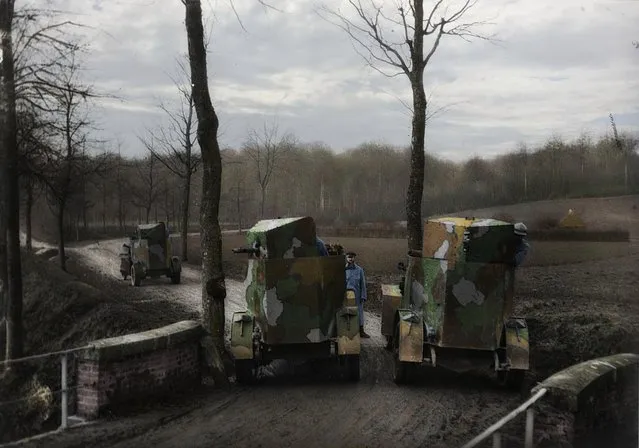
The expertly colourised shots were brought to life by French bank technician, Frédéric Duriez (51). The images were provided by the Valois collection which belongs to the BDIC. “By colourising these photos, I reduce the time that separates us today from this conflict”, said Frédéric. “A black and white photo does not attract the attention of young people, if you colour it, then people will look at it with curiosity. After this, we see the greater the misery and distress of these French fighters”. The total number of casualties in WW1 was more that 38 million. By the end of the war, over eight-million men had been called up to fight in the French army. France suffered 4.2 million casualties during the war with 1.3 million people dead. Here: Car cannon sections in firing position, Auxi-le-Château. (Photo by Frédéric Duriez/BDIC/Mediadrumworld.com)

The expertly colourised shots were brought to life by French bank technician, Frédéric Duriez (51). The images were provided by the Valois collection which belongs to the BDIC. “By colourising these photos, I reduce the time that separates us today from this conflict”, said Frédéric. Here: Car cannon sections in firing position, Auxi-le-Château. (Photo by Frédéric Duriez/BDIC/Mediadrumworld.com)
Details
03 May 2017 08:41:00