Loading...
Done
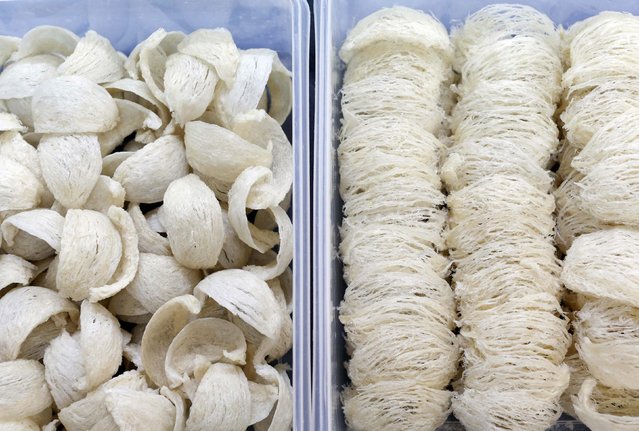
Two styles of cleaned bird's nest, Yan Zhan (L) and Su Zhan (R) await repacking at a processing plant in Kuala Lumpur, February 17, 2015. Prized in China for is alleged health benefits for hundreds of years, nests made from swiftlets' saliva are being mixed into coffee and cereal as the Southeast Asian producers of the delicacy seek to broaden its appeal, and their profit margins. (Photo by Olivia Harris/Reuters)

Two styles of cleaned bird's nest, Yan Zhan (L) and Su Zhan (R) await repacking at a processing plant in Kuala Lumpur, February 17, 2015. Prized in China for is alleged health benefits for hundreds of years, nests made from swiftlets' saliva are being mixed into coffee and cereal as the Southeast Asian producers of the delicacy seek to broaden its appeal, and their profit margins. The nests are among the world's most expensive foods, selling for up to $2,500 a kg and the swiftlets that weave them are indigenous to Indonesia, Malaysia, Thailand and Vietnam. (Photo by Olivia Harris/Reuters)
Details
24 Feb 2015 13:57:00
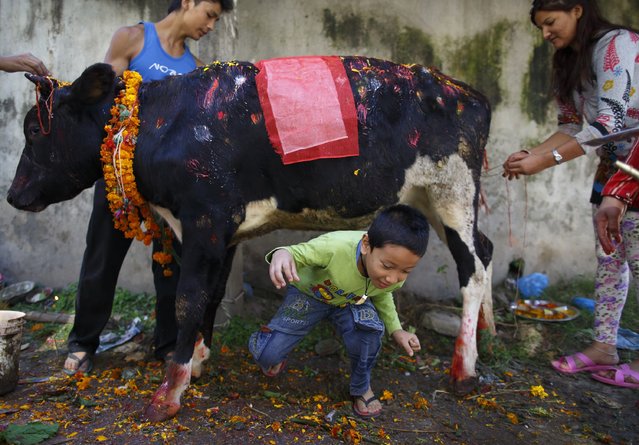
A boy crawls under a cow during a religious ceremony celebrating the Tihar festival, also called Diwali, in Kathmandu, October 23, 2014. Hindus all over Nepal are celebrating the festival during which they worship cows, which are considered a maternal figure, and other animals. Also known as the festival of lights, devotees worship the goddess of wealth Laxmi by illuminating and decorating their homes using garlands, oil lamps, candles and colourful light bulbs. (Photo by Navesh Chitrakar/Reuters)

A boy crawls under a cow during a religious ceremony celebrating the Tihar festival, also called Diwali, in Kathmandu, October 23, 2014. Hindus all over Nepal are celebrating the festival during which they worship cows, which are considered a maternal figure, and other animals. Also known as the festival of lights, devotees worship the goddess of wealth Laxmi by illuminating and decorating their homes using garlands, oil lamps, candles and colourful light bulbs. (Photo by Navesh Chitrakar/Reuters)
Details
25 Oct 2014 13:23:00
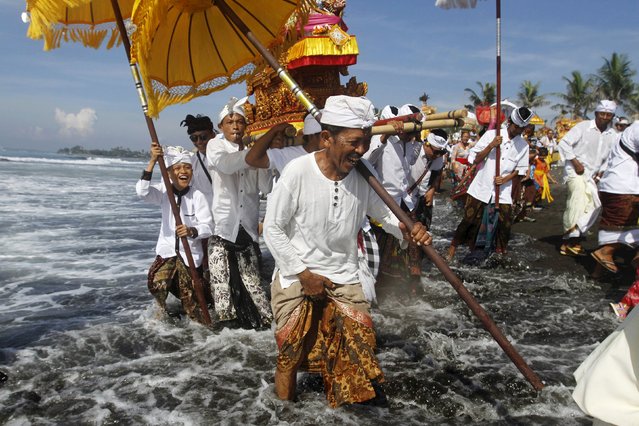
Balinese Hindus carry Pratimas, or symbols of God, on the beach during Melasti, a purification ceremony, ahead of the holy day of Nyepi, in Gianyar on the Indonesian resort island of Bali, March 6, 2016. Nyepi is a day of silence to celebrate the Balinese new year, reserved for self-reflection, where people are not allowed to use lights, light fires, work, travel or enjoy entertainment. (Photo by Roni Bintang/Reuters)

Balinese Hindus carry Pratimas, or symbols of God, on the beach during Melasti, a purification ceremony, ahead of the holy day of Nyepi, in Gianyar on the Indonesian resort island of Bali, March 6, 2016. Nyepi is a day of silence to celebrate the Balinese new year, reserved for self-reflection, where people are not allowed to use lights, light fires, work, travel or enjoy entertainment. (Photo by Roni Bintang/Reuters)
Details
07 Mar 2016 11:19:00
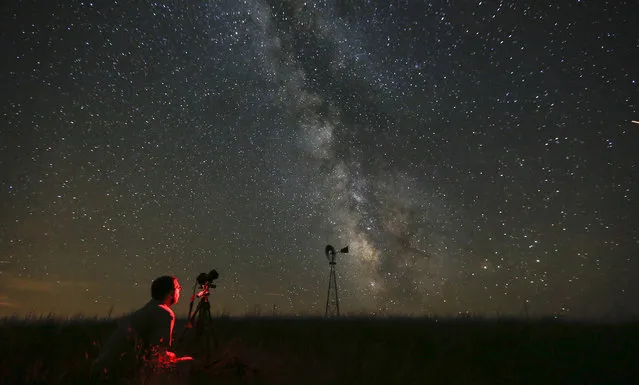
In this Wednesday, July 23, 2014 file photo, Omaha photographer Lane Hickenbottom photographs the night sky in a pasture near Callaway, Neb. With no moon in the sky, the Milky Way was visible to the naked eye. More than one-third of the world’s population can no longer see the Milky Way because of man-made lights, according to a scientific paper by Light Pollution Science and Technology Institute's Fabio Falchi and his team members, published on Friday, June 10, 2016. (Photo by Travis Heying/The Wichita Eagle via AP Photo)

In this Wednesday, July 23, 2014 file photo, Omaha photographer Lane Hickenbottom photographs the night sky in a pasture near Callaway, Neb. With no moon in the sky, the Milky Way was visible to the naked eye. More than one-third of the world’s population can no longer see the Milky Way because of man-made lights, according to a scientific paper by Light Pollution Science and Technology Institute's Fabio Falchi and his team members, published on Friday, June 10, 2016. (Photo by Travis Heying/The Wichita Eagle via AP Photo)
Details
11 Jun 2016 12:37:00
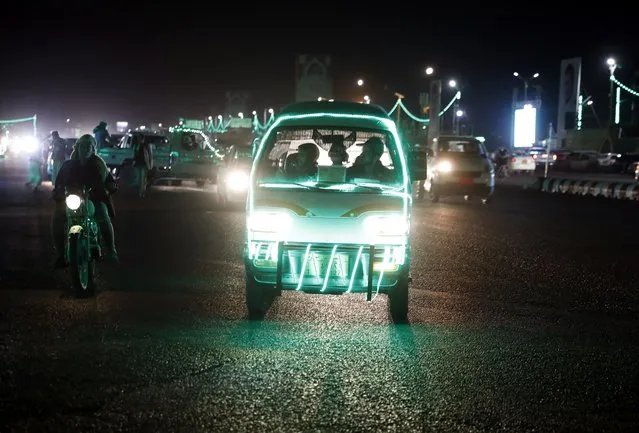
People ride a minibus illuminated with green colorful lights at a street in preparation for celebrations of the birthday of the prophet Muhammad, in Sana'a, Yemen, 04 October 2022. Mawlid is annually celebrated by many Muslim countries on the 12th day of Rabi al-Awwal (the third month of the Islamic calendar), marking the birthday of the prophet Muhammad, which is expected to be marked on 08 October 2022. In Yemen, it is celebrated by illuminating buildings and streets with green colorful lights and decorating vehicles in green. (Photo by Yahya Arhab/EPA/EFE)

People ride a minibus illuminated with green colorful lights at a street in preparation for celebrations of the birthday of the prophet Muhammad, in Sana'a, Yemen, 04 October 2022. Mawlid is annually celebrated by many Muslim countries on the 12th day of Rabi al-Awwal (the third month of the Islamic calendar), marking the birthday of the prophet Muhammad, which is expected to be marked on 08 October 2022. In Yemen, it is celebrated by illuminating buildings and streets with green colorful lights and decorating vehicles in green. (Photo by Yahya Arhab/EPA/EFE)
Details
19 Oct 2022 04:17:00
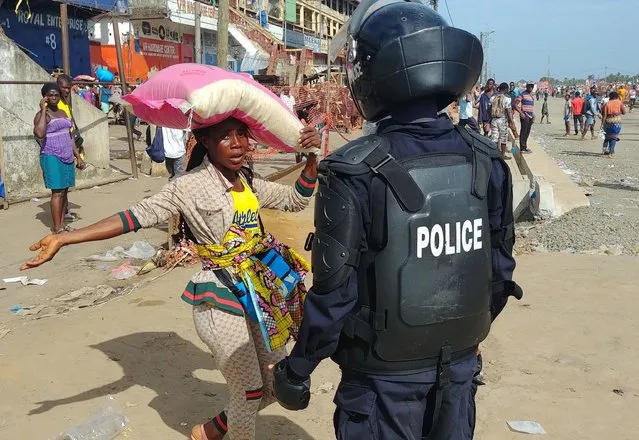
A police officer chases shoppers to clear the streets of the Red Light market on the first day of lockdown to stop the spread of the coronavirus disease (COVID-19) in Monrovia, Liberia on April 11, 2020. (Photo by Derick Snyder/Reuters)

A police officer chases shoppers to clear the streets of the Red Light market on the first day of lockdown to stop the spread of the coronavirus disease (COVID-19) in Monrovia, Liberia on April 11, 2020. (Photo by Derick Snyder/Reuters)
Details
15 Apr 2020 00:01:00
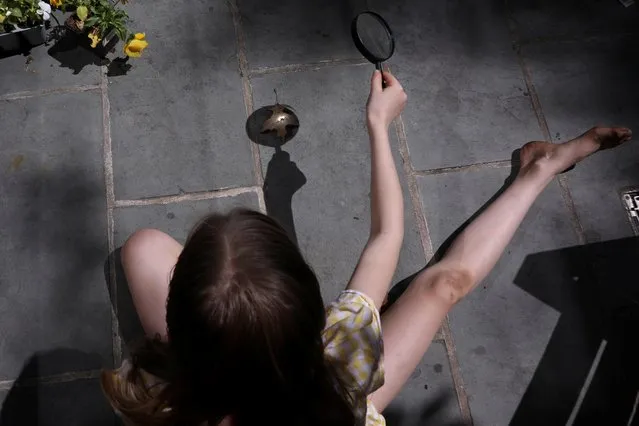
Lydia Hassebroek, 10, uses a magnifying glass to light a leaf on fire in her backyard during the outbreak of the coronavirus disease (COVID-19) in Brooklyn, New York, U.S., May 17, 2020. (Photo by Caitlin Ochs/Reuters)

Lydia Hassebroek, 10, uses a magnifying glass to light a leaf on fire in her backyard during the outbreak of the coronavirus disease (COVID-19) in Brooklyn, New York, U.S., May 17, 2020. (Photo by Caitlin Ochs/Reuters)
Details
19 Jun 2020 00:05:00
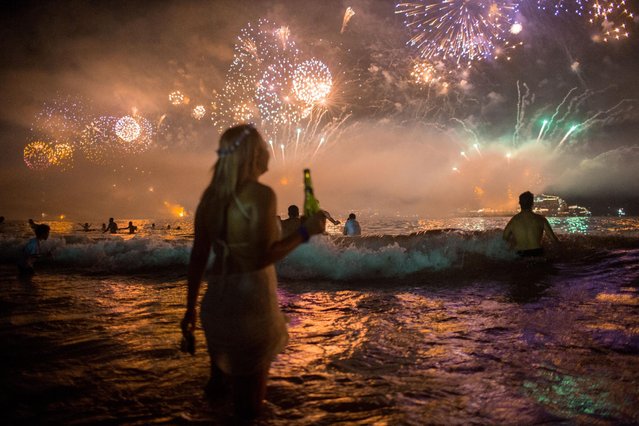
Fireworks light the sky over Copacabana beach during New Year's Eve celebrations in Rio de Janeiro, Brazil, Thursday, January 1, 2016. (Photo by Mauro Pimentel/AP Photo)

Fireworks light the sky over Copacabana beach during New Year's Eve celebrations in Rio de Janeiro, Brazil, Thursday, January 1, 2016. (Photo by Mauro Pimentel/AP Photo)
Details
02 Jan 2016 08:02:00