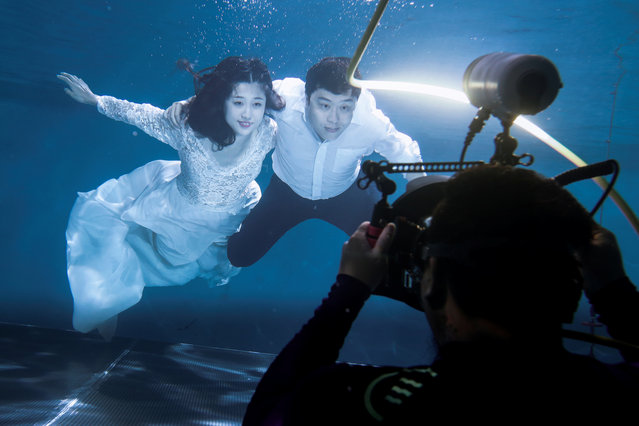
Cao Ri and Xu Jiaqian have a wedding photograph taken in a pool at the Qianyishi Underwater Photography Studio in Beijing, China on September 7, 2017. (Photo by Thomas Peter/Reuters)
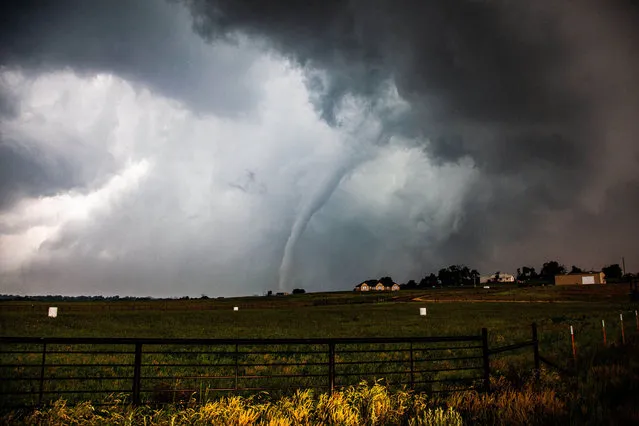
An EF-2 tornado begins to rope out on the outskirts of Mangum, Oklahoma, U.S. on May 20, 2019. Multiple tornadoes touched down and heavy rain flooded areas across Oklahoma. (Photo by Brett Conner/ZUMA Wire)
Los Angeles Rams cheerleaders including the first two male cheerleaders in Super Bowl history (C) perform in the third quarter of Super Bowl LIII between the New England Patriots and the Los Angeles Rams at Mercedes-Benz Stadium in Atlanta, Georgia, USA, 03 February 2019. (Photo by Mike Zarrilli/EPA/EFE)
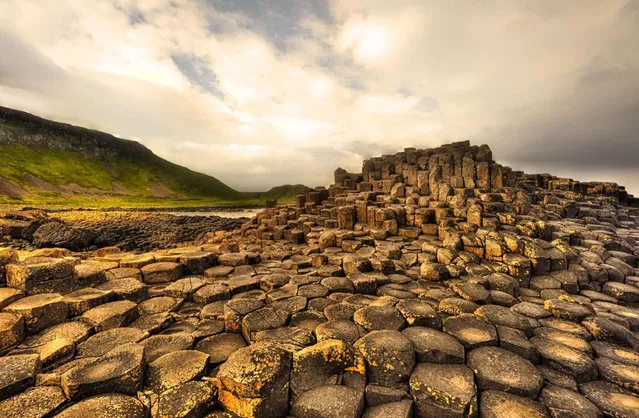
Legend has it that the Irish warrior Fionn mac Cumhaill (Finn McCool) built the causeway to walk to Scotland to fight his Scottish counterpart Benandonner. One version of the legend tells that Fionn fell asleep before he got to Scotland. When he did not arrive, the much larger Benandonner crossed the bridge looking for him. To protect Fionn, his wife Oonagh laid a blanket over him so he could pretend that he was actually their baby son. In a variation, Fionn fled after seeing Benandonner's great bulk, and asked his wife to disguise him as the baby. In both versions, when Benandonner saw the size of the 'infant', he assumed the alleged father, Fionn, must be gigantic indeed. Therefore, Benandonner fled home in terror, ripping up the Causeway in case he was followed by Fionn.
Zdzisław Beksiński, 24 February 1929 – 21 February 2005) was a renowned Polish painter, photographer, and sculptor. Beksiński executed his paintings and drawings either in what he called a 'Baroque' or a 'Gothic' manner. The first style is dominated by representation, with the best-known examples coming from his fantastic realism period when he painted disturbing images of a surrealistic, nightmarish environment. The second style is more abstract, being dominated by form, and is typified by Beksiński's later paintings.
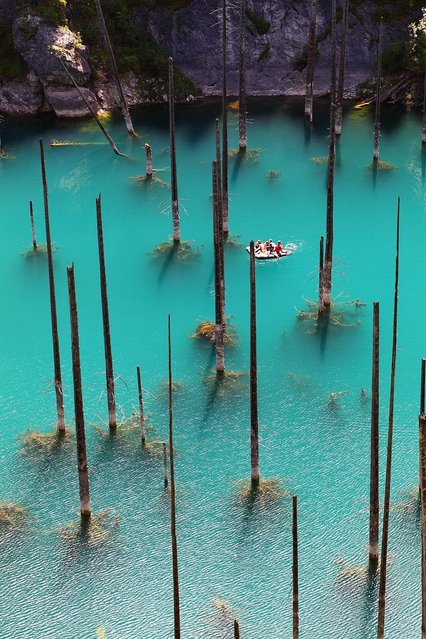
Kaindy Lake (Kazakh: Қайыңды көлі, Qayındı köli) is a 400 metre long lake in Kazakhstan that reaches depths near 30 metres in some areas. It is located 129 km ESE of the city of Almaty and is 2,000 metres above sea level. It was created by the result of an enormous limestone landslide, triggered by the 1911 Kebin earthquake. The track to Kaindy lake has many scenic views to the Saty Gorge, the Chilik River valley and the Kaindy Gorge. Dried-out trunks of submerged Picea schrenkiana trees rise above the surface.
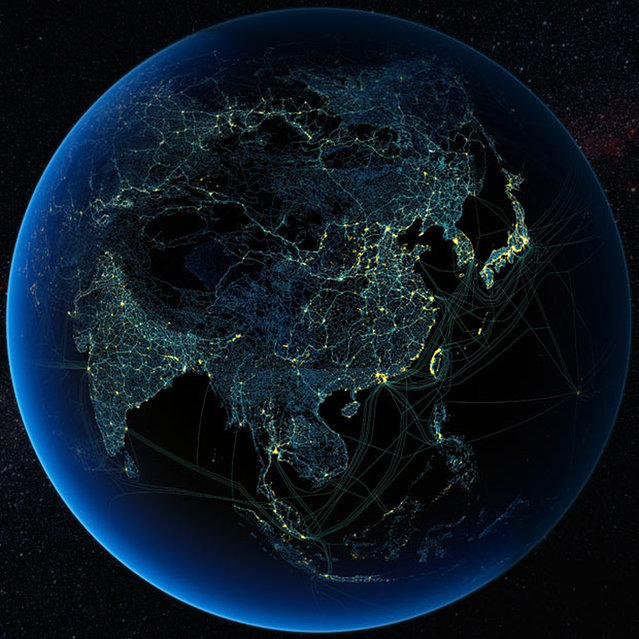
Defined according to wikipedia it is “a recent and informal geologic chronological term that serves to mark the evidence and extent of human activities that have had a significant global impact on the Earth’s ecosystems. The term was coined by ecologist Eugene Stoermer but has been widely popularized by the Nobel Prize-winning atmospheric chemist Paul Crutzen.”
The images here where created by Felix Pharand-Deschenes depicting how various human influences, from road and rail, to internet cables and airlines create significant patterns covering the Earth. What can we learn from these patterns in how they are influencing the environment
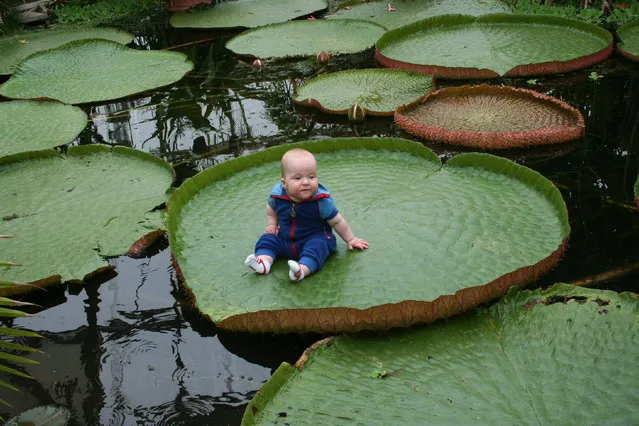
The species has very large leaves, up to 3 m in diameter, that float on the water's surface on a submerged stalk, 7–8 m in length. The species was once called Victoria regia after Queen Victoria, but the name was superseded. V. amazonica is native to the shallow waters of the Amazon River basin, such as oxbow lakes and bayous. It is depicted in the Guyanese coat of arms. The flowers are white the first night they are open and become pink the second night. They are up to 40 cm in diameter, and are pollinated by beetles.