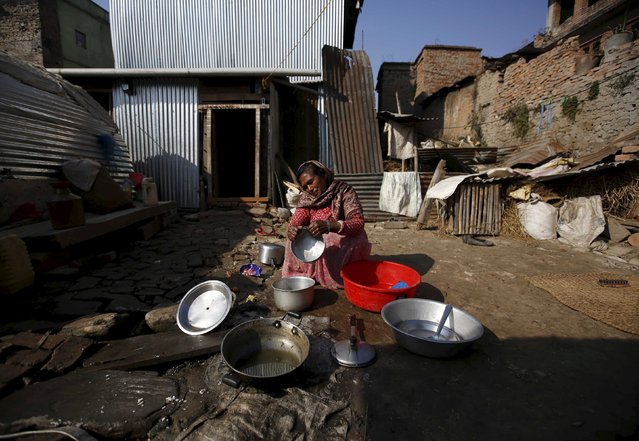
A woman washes her dishes outside the temporary shelter built near the houses damaged during an earthquake earlier this year, in Bhaktapur, Nepal December 28, 2015. (Photo by Navesh Chitrakar/Reuters)
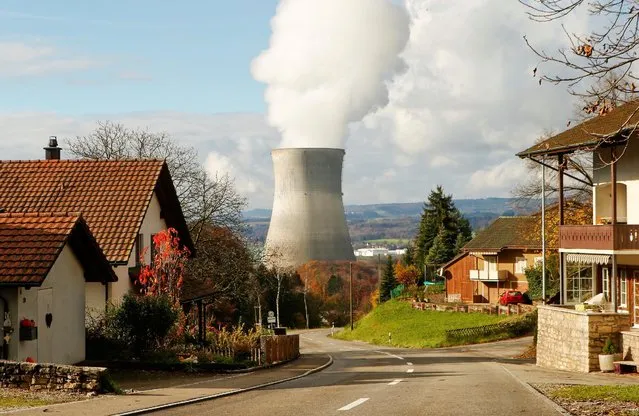
Steam emerges from a cooling tower of the nuclear power plant Leibstadt near Leibstadt, Switzerland, November 18, 2014. (Photo by Arnd Wiegmann/Reuters)
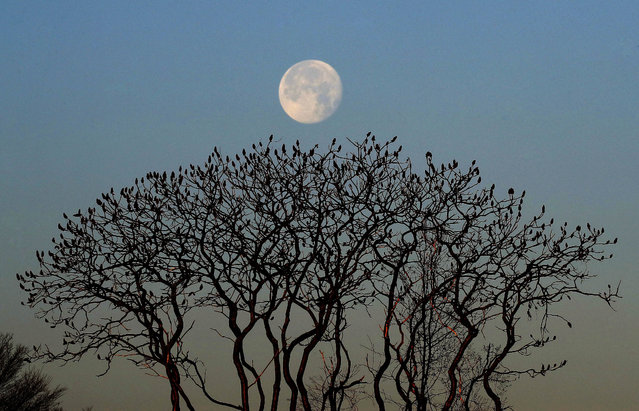
The waning moon sets behind leafless sumac trees on a crisp, clear morning, Thursday, December 15, 2016, in Portland, Maine. Much of the northern Mid-Atlantic and Northeast will stay cold for the next couple of days as the arctic air remains stuck over the northern Appalachians, the National Weather Service said. (Photo by Robert F. Bukaty/AP Photo)
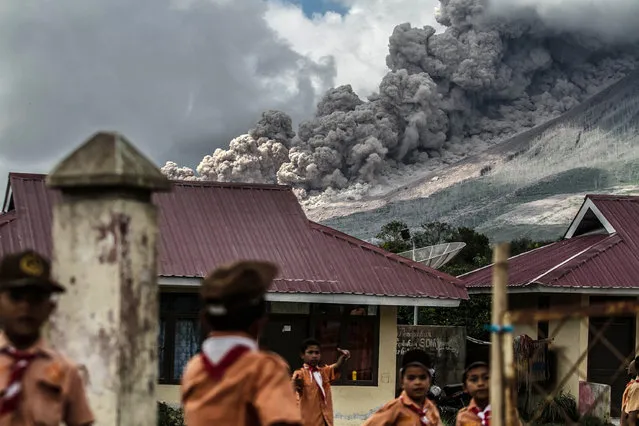
Elementary school children play outside their classrooms as mount Sinabung volcano spews thick volcanic ash in the background on February 10, 2017 in Karo, Indonesia. Mount Sinabung is one of the most active volcanoes in Indonesia and last erupted in May 2016, killing seven people. (Photo by Albert Damanik/Barcroft Images)
Cheerleaders let their hair fly as they perform prior to a German first division Bundesliga soccer match between 1. FC Cologne and Bayern Munich in Cologne, Germany, March 4, 2017. (Photo by Michael Probst/AP Photo)
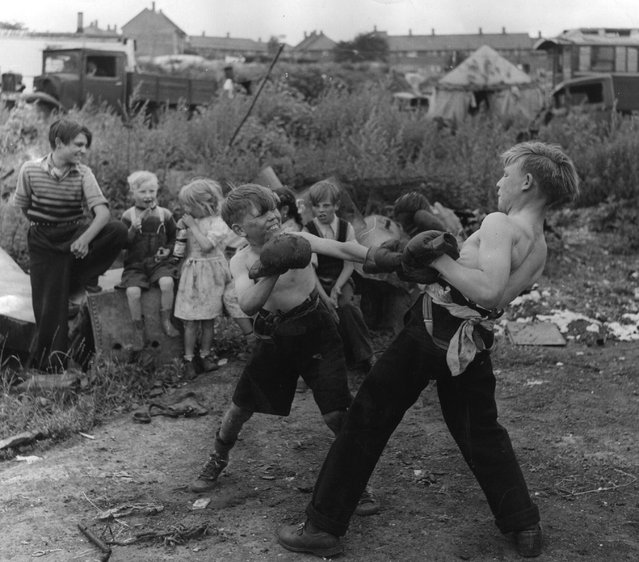
The unromantic gypsies. Children boxing in a gypsy camp in Kent, England on July 1, 1951. Like all boys these gypsy lads like to try their hand at boxing. Encouraged by their friends they fight it out on Corke's Meadow. Few Romanies now live a life of wandering romance. Most are like the three hundred squatters of Corke's Meadow, Kent, which is part of a “gypsy problem” that involves about 100,000 today. Of those about 25,000 can be rightly called gypsies, the rest are Mumpers and Posh-rats and Hobos. Corke's Meadow has both kinds. “Picture Post” cameraman Bert Hardy photographs the Corke's Meadow gypsies in their encampment. (Photo by Hulton-Deutsch Collection/Corbis via Getty Images)
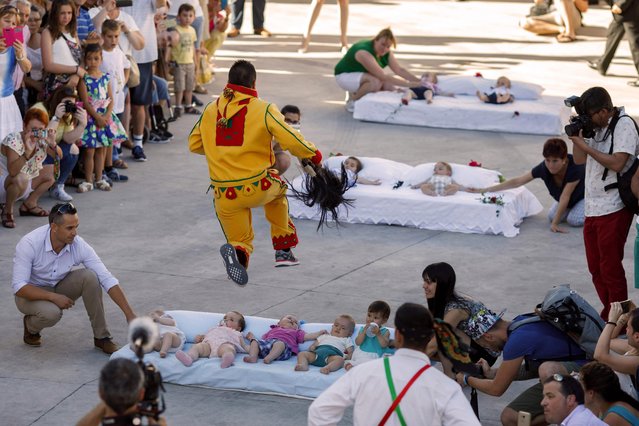
A man dressed up as the devil jumps over babies lying on a mattress in the street during “El Colacho”, the “baby jumping festival” in the village of Castrillo de Murcia, near Burgos on June 18, 2017. Baby jumping (El Colacho) is a traditional Spanish practice dating back to 1620 that takes place annually to celebrate the Catholic feast of Corpus Christi. During the act – known as El Salto del Colacho (the devil's jump) or simply El Colacho – men dressed as the Devil jump over babies born in the last twelve months of the year who lie on mattresses in the street. (Photo by Cesar Manso/AFP Photo)