Loading...
Done
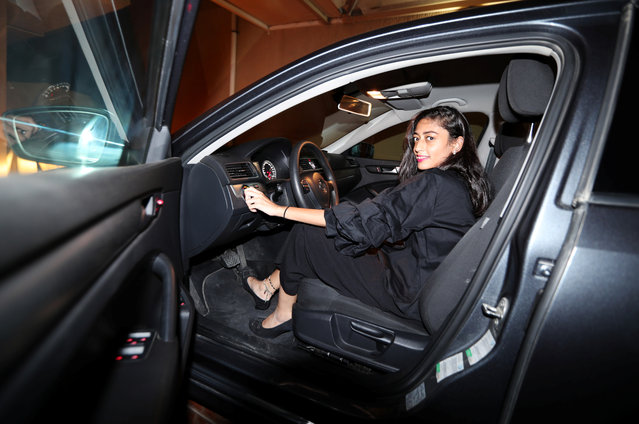
Hannan Iskandar gets ready before she starts to drive her car in her neighborhood, in Al Khobar, Saudi Arabia on June 24, 2018. Saudi Arabia ended its longstanding ban on women driving on June 24, 2018 – and the second the clock struck midnight, women across the country started their engines. (Photo by Hamad I Mohammed/Reuters)

Hannan Iskandar gets ready before she starts to drive her car in her neighborhood, in Al Khobar, Saudi Arabia on June 24, 2018. Saudi Arabia ended its longstanding ban on women driving on June 24, 2018 – and the second the clock struck midnight, women across the country started their engines. (Photo by Hamad I Mohammed/Reuters)
Details
25 Jun 2018 09:50:00
A shop assistant creates a window display in a Next store in central London December 30, 2014.  British clothing retailer Next's sales rose 2.9 percent in the run up to Christmas mostly due to online and catalogue purchases, hitting the upper end of its predictions and it said full-year profit would rise by about 11.5 percent. (Photo by Neil Hall/Reuters)

A shop assistant creates a window display in a Next store in central London December 30, 2014. British clothing retailer Next's sales rose 2.9 percent in the run up to Christmas mostly due to online and catalogue purchases, hitting the upper end of its predictions and it said full-year profit would rise by about 11.5 percent. (Photo by Neil Hall/Reuters)
Details
03 Jan 2015 12:38:00


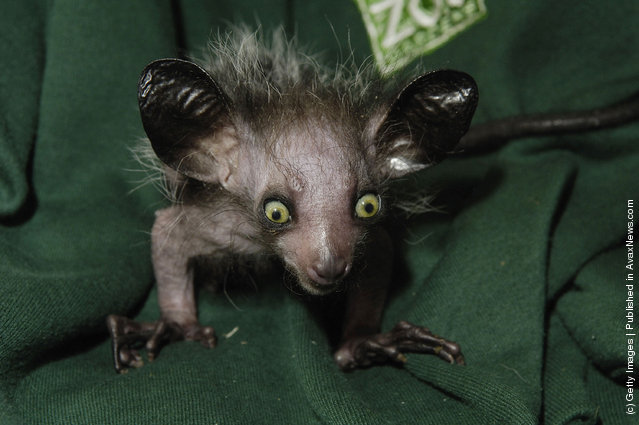
“The aye-aye (Daubentonia madagascariensis) is a lemur, a strepsirrhine primate native to Madagascar that combines rodent-like teeth and a special thin middle finger to fill the same ecological niche as a woodpecker. It is the world's largest nocturnal primate, and is characterized by its unusual method of finding food; it taps on trees to find grubs, then gnaws holes in the wood and inserts its narrow middle finger to pull the grubs out. The only other animal species known to find food in this way is the striped possum. From an ecological point of view the aye-aye fills the niche of a woodpecker as it is capable of penetrating wood to extract the invertebrates within”. – Wikipedia

Photo: In this handout image from Bristol Zoo is seen the first captive bred aye-aye in the UK named “Kintana” (meaning star in Malagasy) April 15, 2005 at Bristol Zoo Gardens, England. The zoo announced today only the second baby aye-aye to be hand-reared in the world (the first was in Jersey Zoo) and has now made his first public appearance since his birth on 11 February 2005. (Photo by Rob Cousins/Bristol Zoo via Getty Images)
Details
13 Apr 2011 13:33:00


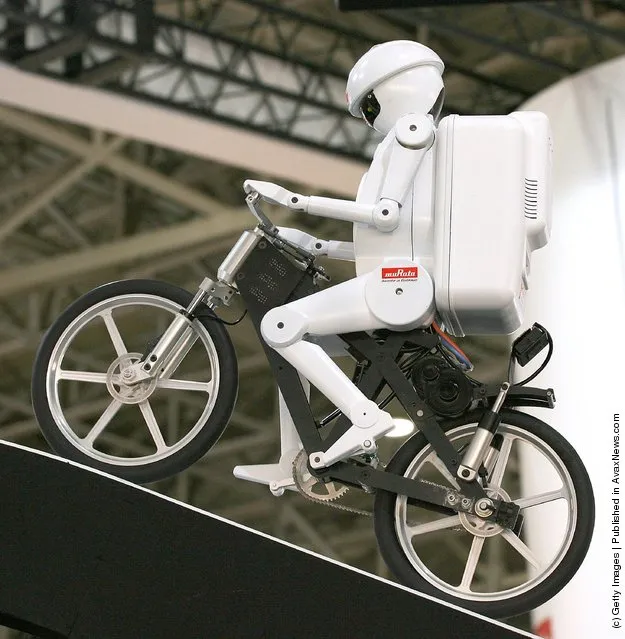
Japan's electronics equipment maker MuRata Manufacturing Co., Ltd's showcased their bicycle-riding robot “MuRata Boy” during the CEATEC Japan 2006 exhibition on October 3, 2006 in Chiba, Japan. The “MuRata Boy” robot can ride up a 25-degree slope, stop without losing its balance and make an S-curve without falling. (Photo by Koichi Kamoshida/Getty Images)
Details
14 May 2011 13:41:00
Hook, an indigenous Moken man, holds a three-pronged throwing spear and searches for fish in the waters of Ko Surin National Park. March 1, 2013 – Ko Surin, Thailand. (Photo by Taylor Weidman/zReportage via ZUMA Press)

“For centuries, the Moken sea nomads have traveled the islands between Thailand and Myanmar fishing and foraging for food on the sea floor. Throughout the Mergui Archipelago, Moken migrate in flotillas of Kabangs (traditional boat of the Moken people), stopping at different islands and beaches. Expert freedivers, the Moken have adapted physically to an aquatic life, developing unique characteristics that let them see better and hold their breath longer while underwater”. – Taylor Weidman. Photo: Hook, an indigenous Moken man, holds a three-pronged throwing spear and searches for fish in the waters of Ko Surin National Park. March 1, 2013 – Ko Surin, Thailand. (Photo by Taylor Weidman/zReportage via ZUMA Press)
Details
24 Mar 2014 06:45:00
A woman takes part in a global March for marijuana in Medellin, Colombia, May 7, 2016. The Global Marijuana March (GMM) is an annual rally held at different locations across the planet. It refers to cannabis-related events that occur on the first Saturday in May, or thereabouts, and may include marches, meetings, rallies, raves, concerts, festivals and information tables. The Global Marijuana March also goes by the name of the Million Marijuana March (MMM). It began in 1999. (Photo by Fredy Builes/Reuters)

A woman takes part in a global March for marijuana in Medellin, Colombia, May 7, 2016. The Global Marijuana March (GMM) is an annual rally held at different locations across the planet. It refers to cannabis-related events that occur on the first Saturday in May, or thereabouts, and may include marches, meetings, rallies, raves, concerts, festivals and information tables. (Photo by Fredy Builes/Reuters)
Details
09 May 2016 09:05:00
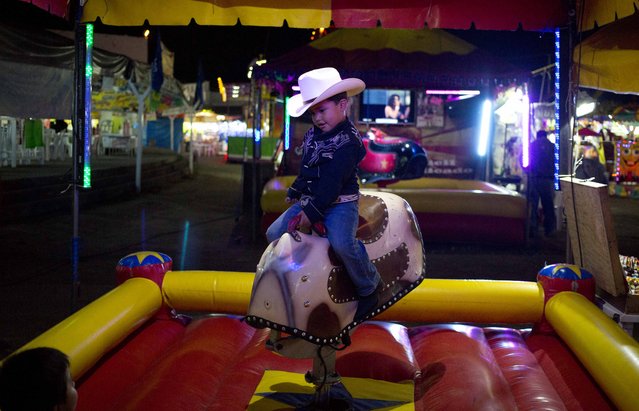
In this March 18, 2015 photo, a boy rides a mechanical bull for children at the Texcoco Fair on the outskirts of Mexico City. In Mexico, these types of fairs date back to Spanish colonial times, and in some smaller communities they are organized around the feast days of Roman Catholic saints. (Photo by Eduardo Verdugo/AP Photo)

In this March 18, 2015 photo, a boy rides a mechanical bull for children at the Texcoco Fair on the outskirts of Mexico City. In Mexico, these types of fairs date back to Spanish colonial times, and in some smaller communities they are organized around the feast days of Roman Catholic saints. (Photo by Eduardo Verdugo/AP Photo)
Details
28 Apr 2015 13:45:00
A woman hands flowers to a member of the Wisconsin National Guard standing by as people gather for a vigil, following the police shooting of Jacob Blake, a Black man, in Kenosha, Wisconsin, U.S., August 28, 2020. (Photo by Brendan McDermid/Reuters)

A woman hands flowers to a member of the Wisconsin National Guard standing by as people gather for a vigil, following the police shooting of Jacob Blake, a Black man, in Kenosha, Wisconsin, U.S., August 28, 2020. (Photo by Brendan McDermid/Reuters)
Details
08 Sep 2020 00:01:00