Loading...
Done
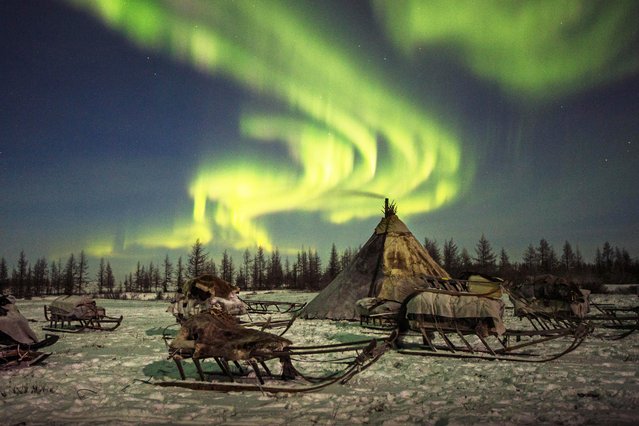
An empty camp is shown beneath a colourful sky in Siberia, December 2016. (Photo by Timothy Allen/Barcroft Productions)

A British photographer has captured life at the “edge of the world”. Timothy Allen, best known for his work on BBC's Human Planet, trekked through the freezing Siberian wilderness for 16 days as he joined part of an 800km migration of reindeer in the Yamal-Nenets region – a name that roughly translates to “edge of the world”. The stunning pictures feature the nomadic Nenets tribe, who drink blood to survive in -45°C temperatures. Timothy's epic journey, which will be revealed in an eight-minute documentary on Animal Planet USA, saw him travel across the bleak terrain of the frozen Ob River with the Nenets people in December last year. Here: An empty camp is shown beneath a colourful sky in Siberia, December 2016. (Photo by Timothy Allen/Barcroft Productions)
Details
19 Sep 2017 07:48:00
Yang Juan, an employee at Goopal Group, takes a nap in her seat after lunch, in Beijing, China, April 21, 2016. (Photo by Jason Lee/Reuters)

Yang Juan, an employee at Goopal Group, takes a nap in her seat after lunch, in Beijing, China, April 21, 2016. Office workers sleeping on the job is a common sight in China, where a surplus of cheap labour can lead to downtime at work. But in China's technology sector, where business is growing faster than many start-up firms can hire new staff, workers burn the midnight oil to meet deadlines and compete with their rivals. Some companies provide sleeping areas and beds for workers to rest during late nights. (Photo by Jason Lee/Reuters)
Details
12 May 2016 14:53:00
Co-hosts Kat Dennings (L) and Beth Behrs onstage at The 40th Annual People's Choice Awards show at Nokia Theatre LA Live on January 8, 2014 in Los Angeles, California. (Photo by Allen Berezovsky/WireImage)

Co-hosts Kat Dennings (L) and Beth Behrs onstage at The 40th Annual People's Choice Awards show at Nokia Theatre LA Live on January 8, 2014 in Los Angeles, California. (Photo by Allen Berezovsky/WireImage)
Details
10 Jan 2014 11:17:00
Farmer holding a freshly cut cocoa bean pod, revealing the pulp and seed inside on a rainforest farm. (Photo by Doug McKinlay/Getty Images)

Chocolate is the greatest gift the Earth has given us. The dessert table would be a sad sight without it. It’s so beloved, so appreciated, that the Swedish scientist who named the cocoa plant that gives us chocolate called it Theobroma cacao, which means “food of the gods”. Here: Farmer holding a freshly cut cocoa bean pod, revealing the pulp and seed inside on a rainforest farm. (Photo by Doug McKinlay/Getty Images)
Details
10 Aug 2016 10:20:00
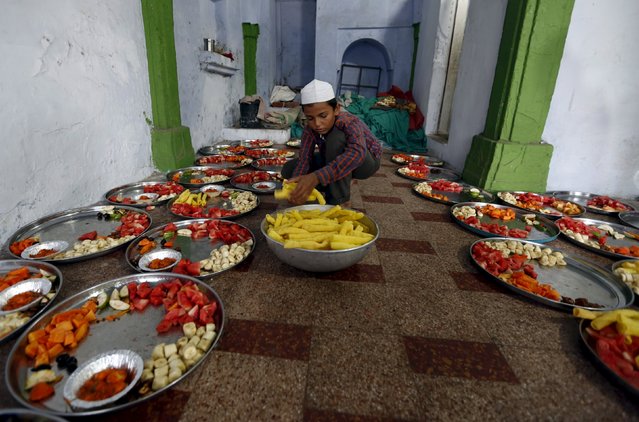
A Muslim boy prepares plates of food for an Iftar (breaking of fast) meal inside a mosque during the holy month of Ramadan in Ahmedabad, India, June 28, 2015. (Photo by Amit Dave/Reuters)

A Muslim boy prepares plates of food for an Iftar (breaking of fast) meal inside a mosque during the holy month of Ramadan in Ahmedabad, India, June 28, 2015. (Photo by Amit Dave/Reuters)
Details
29 Jun 2015 12:20:00
A timber truck driver (L) dressed as Father Frost is saluted by a soldier at the Kremlin's Spasskiye (Saviour) Gate in Moscow, Russian Federation, on December 24, 2013. (Photo by Vyacheslav Prokofyev/ITAR-TASS/ZUMA Press)

A timber truck driver (L) dressed as Father Frost is saluted by a soldier at the Kremlin's Spasskiye (Saviour) Gate in Moscow, Russian Federation, on December 24, 2013. (Photo by Vyacheslav Prokofyev/ITAR-TASS/ZUMA Press)
Details
25 Dec 2013 09:51:00
A mobile phone showing the time at noon, is displayed for a photo in front of an almost empty road with low traffic, during the coronavirus disease (COVID-19) outbreak, in Wuhan, Hubei province, China, March 31, 2020. (Photo by Aly Song/Reuters)

A mobile phone showing the time at noon, is displayed for a photo in front of an almost empty road with low traffic, during the coronavirus disease (COVID-19) outbreak, in Wuhan, Hubei province, China, March 31, 2020. (Photo by Aly Song/Reuters)
Details
07 Apr 2020 00:01:00
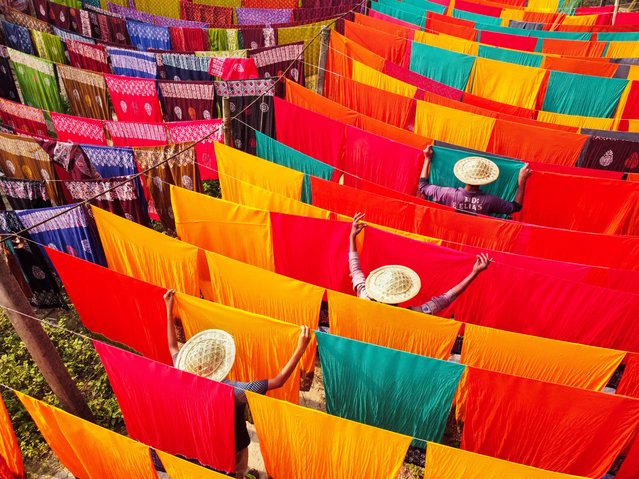
Workers hang hundreds of color-dyed sheets of cloth on a bamboo framework to dry in a dyeing factory in Narayanganj, Bangladesh on May 23, 2023. The drying process usually takes 4 hours, with each set of 200 pieces at a time to dry in temperatures over 42 degrees Celsius. Workers use hats for protection from the scorching heat because they have to constantly turn the colorful fabrics so that they dry perfectly in the sunlight. (Photo by Joy Saha/ZUMA Press Wire/Rex Features/Shutterstock)

Workers hang hundreds of color-dyed sheets of cloth on a bamboo framework to dry in a dyeing factory in Narayanganj, Bangladesh on May 23, 2023. The drying process usually takes 4 hours, with each set of 200 pieces at a time to dry in temperatures over 42 degrees Celsius. Workers use hats for protection from the scorching heat because they have to constantly turn the colorful fabrics so that they dry perfectly in the sunlight. (Photo by Joy Saha/ZUMA Press Wire/Rex Features/Shutterstock)
Details
14 Jun 2023 02:39:00