This aerial photograph taken on January 27, 2024 shows a camel in the desert of Samawa in Iraq's southern province of al-Muthanna. (Photo by Hussein Faleh/AFP Photo)
Someone struggles with an umbrella on Mudeford Quay seafront in Dorset, UK during storm Nelson on March 28, 2024. (Photo by Steve Hogan/Picture Exclusive)
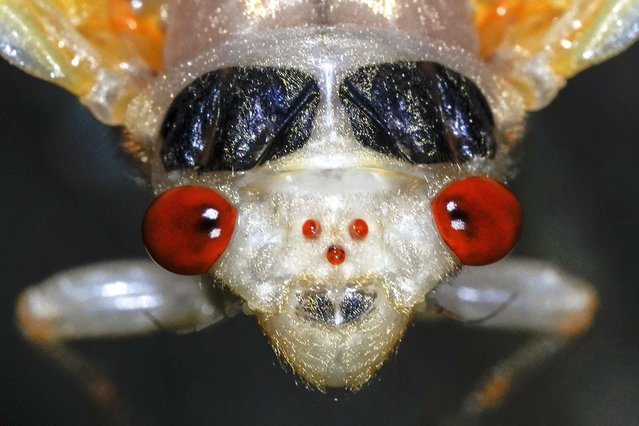
An adult periodical cicada, in the process of shedding its nymphal skin, is visible on Saturday, May 11, 2024, in Cincinnati. There are two large compound eyes, which are used to visually perceive the world around them, and three small, jewel-like, simple eyes called ocelli at center. (Photo by Carolyn Kaster/AP Photo)
Swimmers in the Sky Pool, a transparent swimming pool suspended 35 meters above ground between two apartment buildings, during hot weather in Nine Elms, central London on Monday, August 12, 2024. (Photo by James Manning/PA Images via Getty Images)
The strength of a weaver ant carrying fruit in Indonesia in the last decade of August 2024 is equivalent to the average man or woman picking up a minibus. (Photo by Ridho Arifuddin/Solent News)
Lake Baikal is the world's oldest lake, at 25 million years (possibly older), and deepest, averaging 744.4 metres (2,442 ft).
Located in the south of the Russian region of Siberia, between Irkutsk Oblast to the northwest and the Buryat Republic to the southeast, it is the most voluminous freshwater lake in the world, containing roughly 20% of the world's unfrozen surface fresh water.
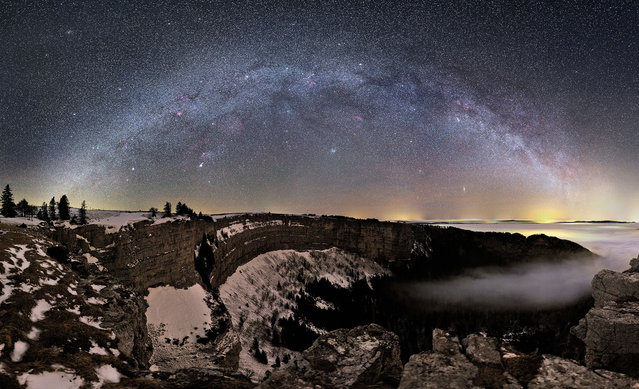
The Milky Way is the galaxy in which Earth is contained. This name derives from its appearance as a dim “milky” glowing band arching across the night sky, in which the naked eye cannot distinguish individual stars. The term “Milky Way” is a translation of the Classical Latin via lactea, from the Hellenistic Greek γαλαξίας κύκλος (pr. galaxías kýklos, “milky circle”). The Milky Way appears like a band because it is a disk-shaped structure being viewed from inside. The fact that this faint band of light is made up of stars was proven in 1610 when Galileo Galilei used his telescope to resolve it into individual stars. In the 1920s, observations by astronomer Edwin Hubble showed that the Milky Way is just one of many galaxies.