Loading...
Done
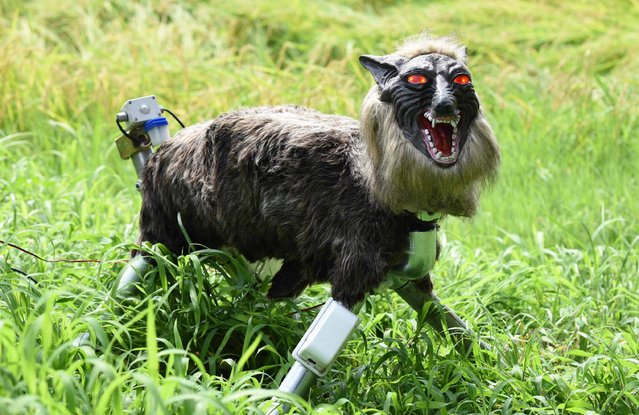
A wolf-like robot “Super Monster Wolf” stands beside a rice field to drive away wild animals that cause damages to crops in Kisarazu, Chiba prefecture, on August 25, 2017. The agricultural coopetative association JA Kisarazu-shi introduced the 65cm-long and 50cm-high robot recently on a trial basis which can detect wild animals such as boars and deers with an infrared ray sensor when they approach and intimidates them, flashing the red LED eyes and blaring 48 types of sounds including a wolf growl and human voice. (Photo by Toru Yamanaka/AFP Photo)

A wolf-like robot “Super Monster Wolf” stands beside a rice field to drive away wild animals that cause damages to crops in Kisarazu, Chiba prefecture, on August 25, 2017. The agricultural coopetative association JA Kisarazu-shi introduced the 65cm-long and 50cm-high robot recently on a trial basis which can detect wild animals such as boars and deers with an infrared ray sensor when they approach and intimidates them, flashing the red LED eyes and blaring 48 types of sounds including a wolf growl and human voice. (Photo by Toru Yamanaka/AFP Photo)
Details
27 Aug 2017 07:17:00
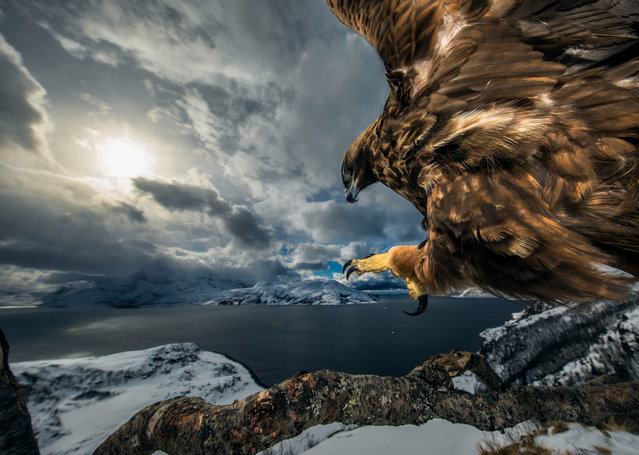
Birds behaviour winner: Land of the Eagle by Audun Rikardsen, Norway. High on a ledge, on the coast near his home in northern Norway, Rikardsen carefully positioned an old tree branch that he hoped would make a perfect golden eagle lookout. To this, he bolted a tripod head with a camera, flashes and motion sensor attached, and built himself a hide a short distance away. From time to time, he left road‑kill carrion nearby. Very gradually – over the next three years – a golden eagle got used to the camera and started to use the branch regularly to survey the coast below. (Photo by Audun Rikardsen/2019 Wildlife Photographer of the Year)

Birds behaviour winner: Land of the Eagle by Audun Rikardsen, Norway. High on a ledge, on the coast near his home in northern Norway, Rikardsen carefully positioned an old tree branch that he hoped would make a perfect golden eagle lookout. To this, he bolted a tripod head with a camera, flashes and motion sensor attached, and built himself a hide a short distance away. From time to time, he left road‑kill carrion nearby. Very gradually – over the next three years – a golden eagle got used to the camera and started to use the branch regularly to survey the coast below. (Photo by Audun Rikardsen/2019 Wildlife Photographer of the Year)
Details
17 Oct 2019 00:03:00
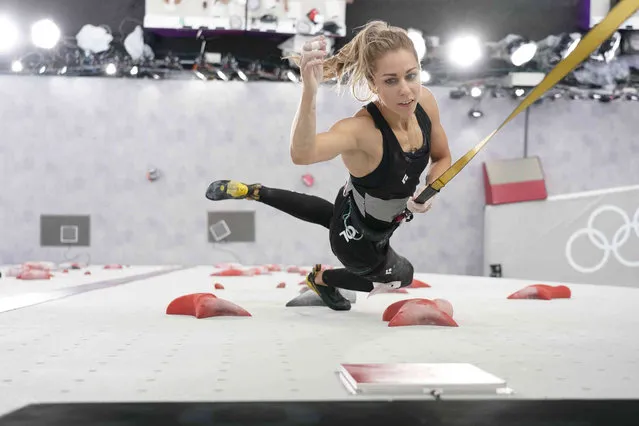
Aleksandra Miroslaw, of Poland, competes during the speed portion of the women's sport climbing final at the 2020 Summer Olympics, Friday, August 6, 2021, in Tokyo, Japan. (Photo by Tsuyoshi Ueda/Pool Photo via AP Photo)

Aleksandra Miroslaw, of Poland, competes during the speed portion of the women's sport climbing final at the 2020 Summer Olympics, Friday, August 6, 2021, in Tokyo, Japan. (Photo by Tsuyoshi Ueda/Pool Photo via AP Photo)
Details
22 Apr 2022 06:18:00
In this image taken with a slow shutter speed, Spain's tennis player Rafael Nadal gestures during a training session at the Martin Carpena Sports Hall, in Malaga, southern Spain, on Friday, November 15, 2024. (Photo by Manu Fernandez/AP Photo)

In this image taken with a slow shutter speed, Spain's tennis player Rafael Nadal gestures during a training session at the Martin Carpena Sports Hall, in Malaga, southern Spain, on Friday, November 15, 2024. (Photo by Manu Fernandez/AP Photo)
Details
23 Nov 2024 05:08:00
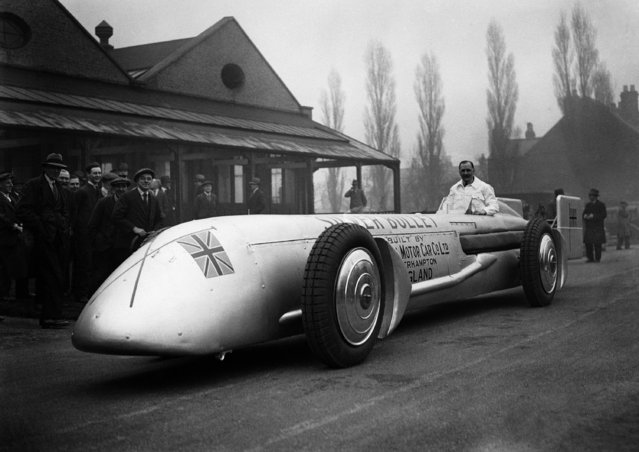
Kaye Don seated in the cockpit of his new racing car the “Silver Bullet” at Wolverhampton, England on February 21, 1930, in which he will attempt to beat world land speed record at Daytona. It has two 12-cylinder V shaped engines and each develops 2,000-h.p. The theoretical speed of the car is 275 m.p.h. but the designer estimated that will be able to reach 250 m.p.h. allowing for wind pressures. (Photo by AP Photo/Staff/Puttnam)

Kaye Don seated in the cockpit of his new racing car the “Silver Bullet” at Wolverhampton, England on February 21, 1930, in which he will attempt to beat world land speed record at Daytona. It has two 12-cylinder V shaped engines and each develops 2,000-h.p. The theoretical speed of the car is 275 m.p.h. but the designer estimated that will be able to reach 250 m.p.h. allowing for wind pressures. (Photo by AP Photo/Staff/Puttnam)
Details
03 Mar 2018 00:03:00
Humanoid robots fight during a kickboxing match on day two of the 2025 World Humanoid Robot Games at National Speed Skating Oval on August 16, 2025 in Beijing, China. The 2025 World Humanoid Robot Games (WHRG) will be held from August 14 to 17 in Beijing's National Speed Skating Oval, bringing together 280 teams from 16 countries across five continents. (Photo by Lintao Zhang/Getty Images)

Humanoid robots fight during a kickboxing match on day two of the 2025 World Humanoid Robot Games at National Speed Skating Oval on August 16, 2025 in Beijing, China. The 2025 World Humanoid Robot Games (WHRG) will be held from August 14 to 17 in Beijing's National Speed Skating Oval, bringing together 280 teams from 16 countries across five continents. (Photo by Lintao Zhang/Getty Images)
Details
06 Sep 2025 03:50:00


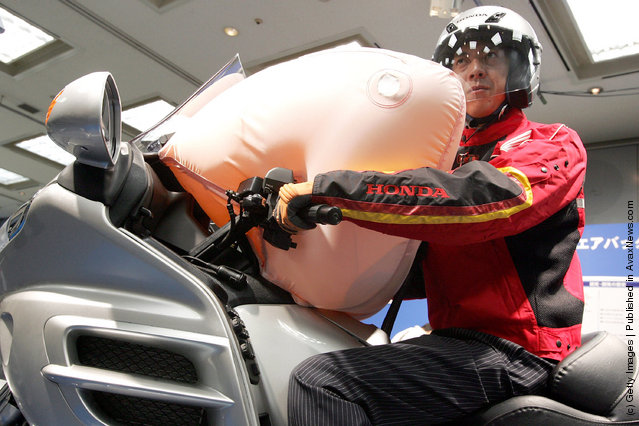
“The technology was designed to address the risk associated with head-on or nearly head-on motorcycle collisions, which account for a large percentage of motorcycle crashes. The airbag was designed to deploy during a severe frontal collision in which a rider could be thrown forward from the motorcycle. Once deployed, the airbag stands upright in front of the rider to help absorb the rider’s kinetic energy prior to leaving the motorcycle”. – Ohio.Honda.com

Photo: Honda Motor Co., Ltd.'s world's first production motorcycle airbag system is introduced at a press conference at Honda's HQ on September 8, 2005 in Tokyo, Japan. The motorcycle airbag system to be installed to lessen the injuries of the rider is comprised of the airbag module that include the airbag and the inflator, crash sensors that monitor acceleration changes and an ECU that performs calculation to determine when a collision is occuring. (Photo by Junko Kimura/Getty Images)
Details
20 Jun 2011 14:29:00
Hundreds of gannets dive for mackerel off the coast of Shetland, Northern Isles of Scotland on July 2020, where they plunge into the water from heights of up to 100ft at speeds of 60mph. (Photo by David Keep/The Times)

Hundreds of gannets dive for mackerel off the coast of Shetland, Northern Isles of Scotland on July 2020, where they plunge into the water from heights of up to 100ft at speeds of 60mph. (Photo by David Keep/The Times)
Details
09 Aug 2020 00:03:00