Loading...
Done
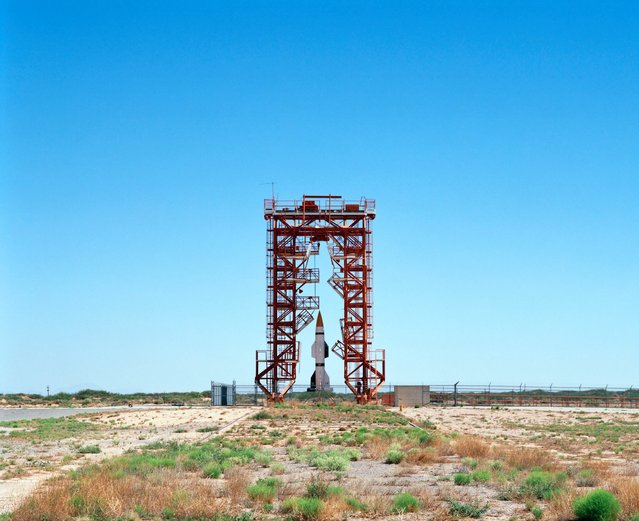
Launch Pad and Gantry with Hermes A-1 Rocket – V2 Launch Complex 33, White Sands missile range, New Mexico in 2006. (Photo by Roland Miller)

Roland Miller is on a mission to document the deserted sites of America’s space race. He has photographed launch pads, bunkhouses and research facilities across the country, some of which no longer exist or are closed to the public on secure military bases. His book, “Abandoned in Place”, is published by the University of New Mexico Press in March. Here: Launch Pad and Gantry with Hermes A-1 Rocket – V2 Launch Complex 33, White Sands missile range, New Mexico in 2006. (Photo by Roland Miller)
Details
25 Feb 2016 11:38:00
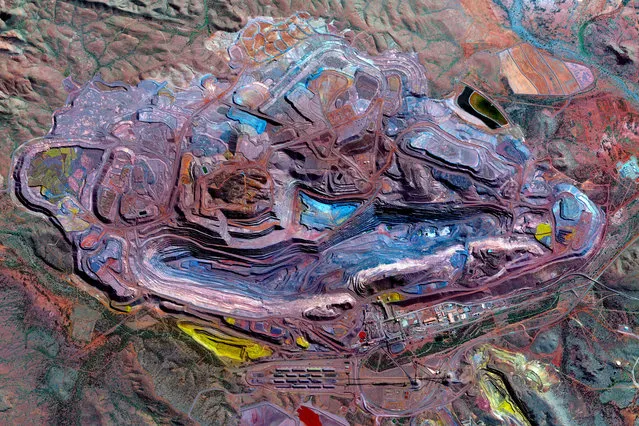
Mount Whaleback iron ore mine 23°21’32.3”S, 119°40’40.1”E. The Mount Whaleback Iron Ore Mine in the Pilbara region of Western Australia. Roughly 98% of the world’s mined iron ore is used to make steel and is thus a significant component in the construction of buildings, automobiles, and appliances such as refrigerators. (Photo by Daily Overview/DigitalGlobe, a Maxar Company)

Mount Whaleback iron ore mine 23°21’32.3”S, 119°40’40.1”E. The Mount Whaleback Iron Ore Mine in the Pilbara region of Western Australia. Roughly 98% of the world’s mined iron ore is used to make steel and is thus a significant component in the construction of buildings, automobiles, and appliances such as refrigerators. (Photo by Daily Overview/DigitalGlobe, a Maxar Company)
Details
16 Nov 2018 00:03:00
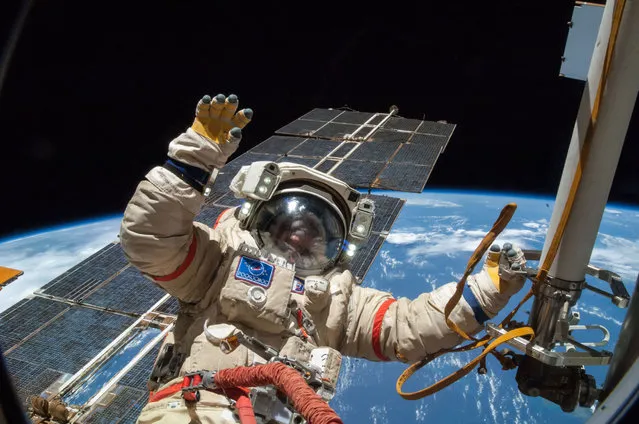
Russian cosmonaut Alexander Skvortsov, Expedition 40 flight engineer, attired in a Russian Orlan spacesuit, participates in a session of extravehicular activity (EVA) in support of science and maintenance on the International Space Station on August 18, 2014. During the five-hour, 11-minute spacewalk, Skvortsov and cosmonaut Oleg Artemyev (out of frame) deployed a small science satellite, retrieved and installed experiment packages and inspected components on the exterior of the orbital laboratory. (Photo by NASA)

Russian cosmonaut Alexander Skvortsov, Expedition 40 flight engineer, attired in a Russian Orlan spacesuit, participates in a session of extravehicular activity (EVA) in support of science and maintenance on the International Space Station on August 18, 2014. During the five-hour, 11-minute spacewalk, Skvortsov and cosmonaut Oleg Artemyev (out of frame) deployed a small science satellite, retrieved and installed experiment packages and inspected components on the exterior of the orbital laboratory. (Photo by NASA)
Details
13 Apr 2022 06:53:00
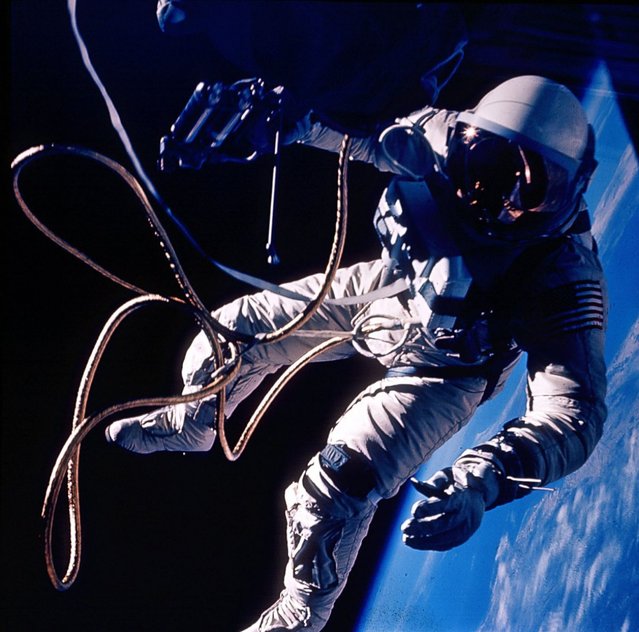
The First U.S. Spacewalk – Gemini 4 Ed White made the United States' first spacewalk on June 3, 1965 during the Gemini 4 mission. The extra-vehicular activity (EVA) started at 19:45 UT (3:45 p.m. EDT) on the third orbit when White opened his hatch and used the hand-held manuevering oxygen-jet gun to push himself out of the capsule. (Photo by NASA)

The First U.S. Spacewalk – Gemini 4 Ed White made the United States' first spacewalk on June 3, 1965 during the Gemini 4 mission. The extra-vehicular activity (EVA) started at 19:45 UT (3:45 p.m. EDT) on the third orbit when White opened his hatch and used the hand-held manuevering oxygen-jet gun to push himself out of the capsule. (Photo by NASA)
Details
11 Apr 2014 08:40:00
National Diving School director Jerome Vincent, wearing a Gandolfi space suit, executes training procedures in a swimming pool in Marseille October 22, 2014. (Photo by Jean-Paul Pelissier/Reuters)

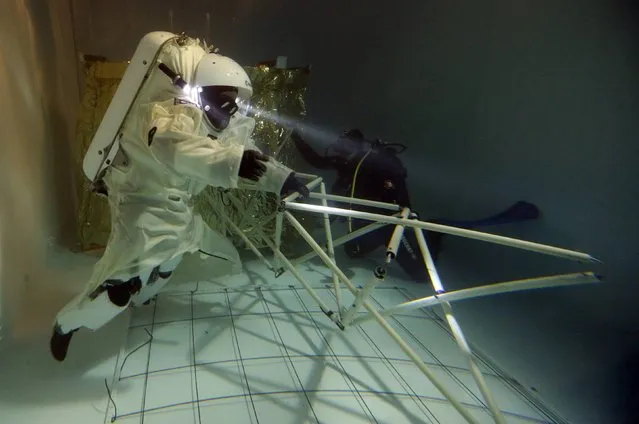
National Diving School director Jerome Vincent, wearing a Gandolfi space suit, executes training procedures in a swimming pool in Marseille October 22, 2014. The underwater test session develops European expertise in spacewalk simulations under partial gravity for exploring the Moon, asteroids and Mars.The training is organised by Comex, a French company specializing in engineering and deep sea diving operations, in collaboration with the European Space Agency (ESA) and with Apollo XI “Under the sea”. (Photo by Jean-Paul Pelissier/Reuters)
Details
26 Oct 2014 12:47:00
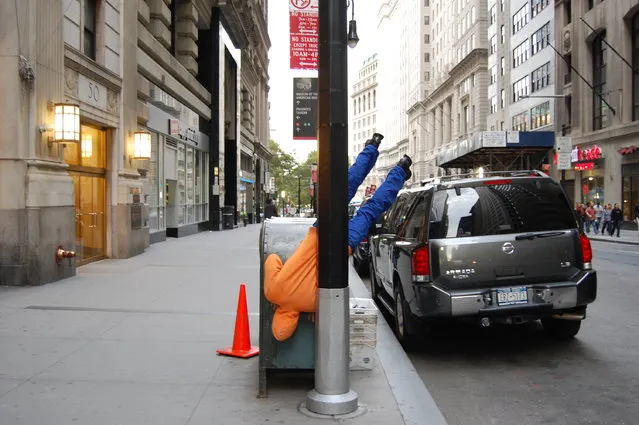
Willi Dorner, Bodies in Urban Spaces, September 26, 2010

“Bodies in urban spaces” is a temporarily intervention in diversified urban architectonical environment. The intention of “bodies in urban spaces” is to point out the urban functional structure and to uncover the restricted movement possibilities and behavior as well as rules and limitations. Photo: “Bodies in Urban Spaces”, September 26, 2010. (Photos by Andrew Russeth)
Details
16 Sep 2013 09:32:00
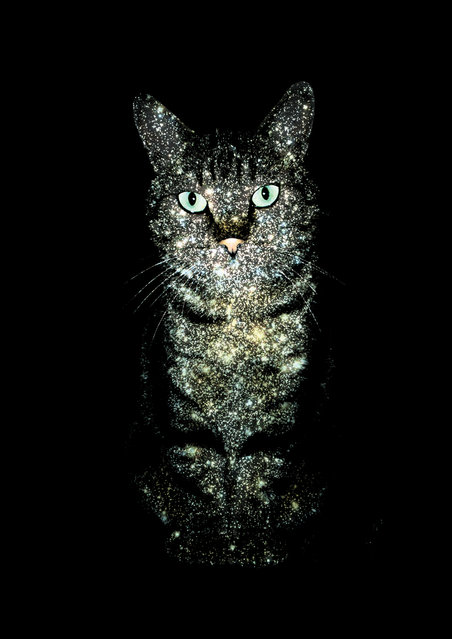
Space Cats By Zippora Lux

Boya Latumahina, alter ego, Zippora Lux is a Design student studying at Central St Martins in London. She has created these space age cats by combining two of her favourite things, cats and telescopic photographs.
Details
01 Dec 2013 10:34:00
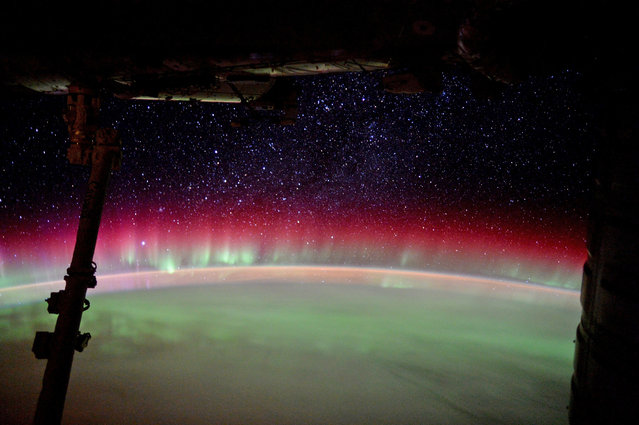
ESA astronaut Tim Peake posted this stunning image on his social media channels, commenting: “Station passed through magnificent aurora Australis last night”. Tim is set to return to Earth on 18 June 2016, bringing his six-month Principia mission to the ISS to an end. During his stay he performed more than 30 scientific experiments for ESA and taking part in numerous others from ESA's international partners. ESA and the UK Space Agency have partnered to develop many exciting educational activities around the Principia mission, aimed at sparking the interest of young children in science and space. (Photo by Tim Peake/ESA/NASA)

ESA astronaut Tim Peake posted this stunning image on his social media channels, commenting: “Station passed through magnificent aurora Australis last night”. Tim is set to return to Earth on 18 June 2016, bringing his six-month Principia mission to the ISS to an end. During his stay he performed more than 30 scientific experiments for ESA and taking part in numerous others from ESA's international partners. ESA and the UK Space Agency have partnered to develop many exciting educational activities around the Principia mission, aimed at sparking the interest of young children in science and space. (Photo by Tim Peake/ESA/NASA)
Details
31 Dec 2016 10:21:00