Loading...
Done
Mahmoud El Komy, a 26-year-old Egyptian mechatronics engineer, stands beside Cira 3, a remote-controlled robot that runs tests on suspected coronavirus disease (COVID-19) patients, to limit the human exposure to the virus, amid a second wave of infections in Tanta, Egypt, November 18, 2020. (Photo by Mohamed Abd El Ghany/Reuters)

Mahmoud El Komy, a 26-year-old Egyptian mechatronics engineer, stands beside Cira 3, a remote-controlled robot that runs tests on suspected coronavirus disease (COVID-19) patients, to limit the human exposure to the virus, amid a second wave of infections in Tanta, Egypt, November 18, 2020. (Photo by Mohamed Abd El Ghany/Reuters)
Details
20 Dec 2020 00:01:00
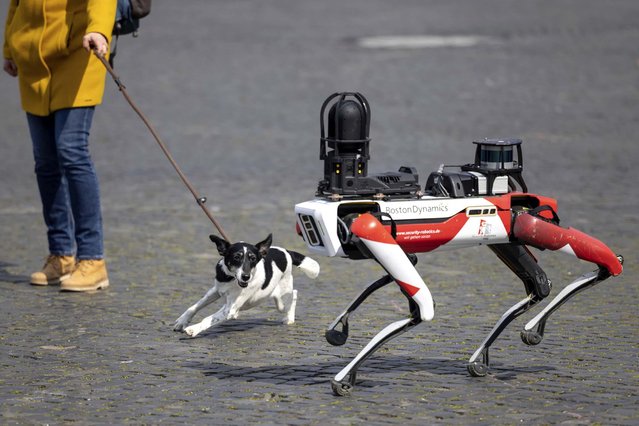
Spot, a robot with dog-like movements, walks past a dog in Cathedral Square in Erfurt, Germany on April 20, 2021. Security service provider Ciborius, a provider of robotic security solutions with artificial intelligence, presented its artificial employee with high-resolution 360-degree all-round camera, ultra-bright LED light and a light detection system on Domplatz. (Photo by Michael Reichel/dpa)

Spot, a robot with dog-like movements, walks past a dog in Cathedral Square in Erfurt, Germany on April 20, 2021. Security service provider Ciborius, a provider of robotic security solutions with artificial intelligence, presented its artificial employee with high-resolution 360-degree all-round camera, ultra-bright LED light and a light detection system on Domplatz. (Photo by Michael Reichel/dpa)
Details
02 May 2021 08:30:00
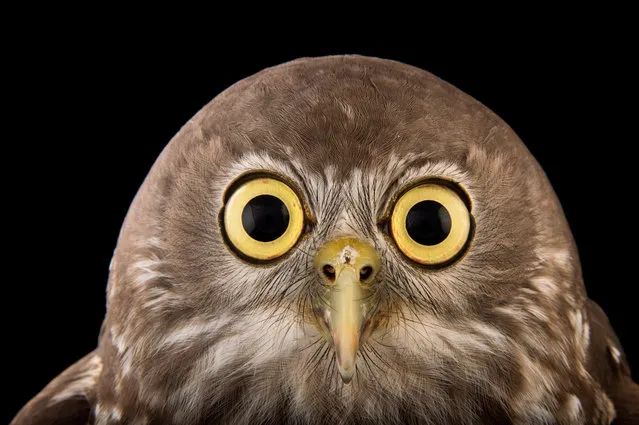
The National Geographic Photo Ark is a travelling exhibition of photographer Joel Sartore’s quest to create a photo archive of biodiversity around the world. So far, Sartore has captured studio portraits of more than 6,000 species – a number that he hopes to double. On 1 July, the ark will open at Melbourne zoo – the first time it has been exhibited in the southern hemisphere. More than 50 portraits will be on display, including many of Australian endangered animals being protected by programs at the zoo itself. These captions have been edited from text supplied by Melbourne zoo. Here: Barking owl. So-named because its call sounds like a barking dog, these birds are native to Australia, Indonesia and Papua New Guinea. In Victoria they are listed as an endangered species, and in 2003 there were estimated to be fewer than 50 breeding pairs. The main threat to the species in Victoria is loss of habitat, especially large trees with hollows in which they can nest and on which many of their prey depend. Apart from a bark, they may utter a chilling scream when they feel threatened. (Photo by Joel Sartore/National Geographic Photo Ark/The Guardian)

The National Geographic Photo Ark is a travelling exhibition of photographer Joel Sartore’s quest to create a photo archive of biodiversity around the world. So far, Sartore has captured studio portraits of more than 6,000 species – a number that he hopes to double. On 1 July, the ark will open at Melbourne zoo – the first time it has been exhibited in the southern hemisphere. More than 50 portraits will be on display, including many of Australian endangered animals being protected by programs at the zoo itself. These captions have been edited from text supplied by Melbourne zoo. Here: Barking owl. (Photo by Joel Sartore/National Geographic Photo Ark/The Guardian)
Details
01 Jul 2017 07:45:00
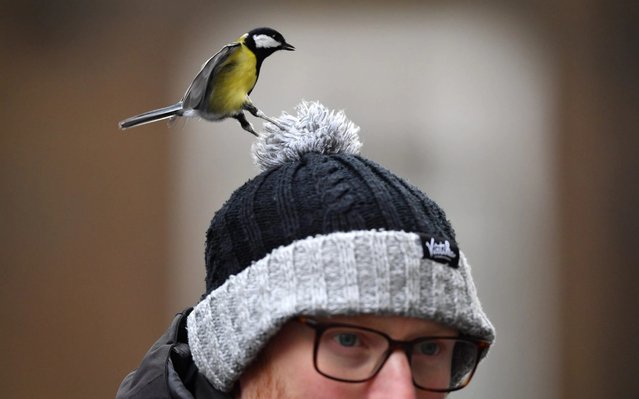
A great tit eats food from the top of a photographer's hat as the press wait for politicians on Downing Street on December 16, 2019 in London, England. The UK's Prime Minister is set to hold a mini Cabinet reshuffle to replace outgoing ministers following last week's general election victory. (Photo by Leon Neal/Getty Images)

A great tit eats food from the top of a photographer's hat as the press wait for politicians on Downing Street on December 16, 2019 in London, England. The UK's Prime Minister is set to hold a mini Cabinet reshuffle to replace outgoing ministers following last week's general election victory. (Photo by Leon Neal/Getty Images)
Details
29 Dec 2019 00:03:00
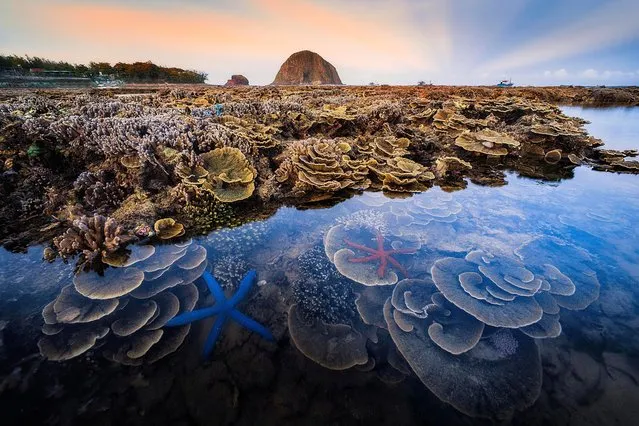
Runner-up; Hon Yen marine ecosystem. Phu Yen, Vietnam. Every year between May and August, the coral of this rich and diverse ecosystem becomes exposed at low tide. (Photo by Truong Hoai Vu/Royal Society of Biology Photography Competition)

Runner-up; Hon Yen marine ecosystem. Phu Yen, Vietnam. Every year between May and August, the coral of this rich and diverse ecosystem becomes exposed at low tide. (Photo by Truong Hoai Vu/Royal Society of Biology Photography Competition)
Details
31 Oct 2021 05:12:00


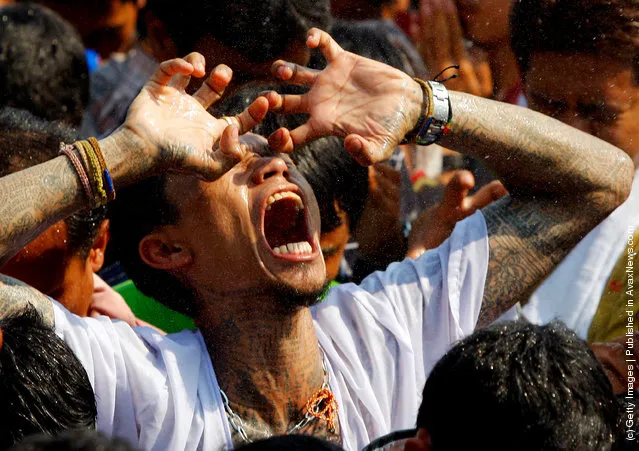
A Thai devotee in a state of trance screams while holy water is sprayed as thousands race towards the edifice of the founder monk during the annual Tattoo fesitval at Wat Bang Phra on March 7, 2009 in Nakhom Pathom, Thailand. Some men take on the characteristics of sacred animals that have been carved onto their skin. Thousands of believers from all over Thailand come to take part in one of the country's most bizarre festivals about 50 miles outside Bangkok to pay respect to the temple's monks who are master tattooist. In Thai culture the tattoo or Thai word sak yant is worn as a symbol of spiritual and physical protection, many believe that the tattoo have mystical powers. Many tattoo fanatics choose to have monkeys and tigers as well as the Khmer/Cambodia ancient script on their bodies. (Photo Paula Bronstein/Getty Images)
Details
27 Jun 2011 10:43:00
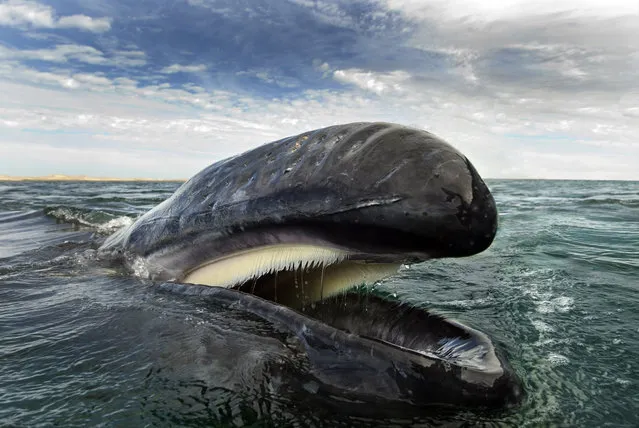
Gray whale feeding at the surface and showing it's baleen. (Photo by Christopher Swann/Biosphoto)

Gray whale feeding at the surface and showing it's baleen. (Photo by Christopher Swann/Biosphoto)
Details
11 Jun 2017 07:23:00
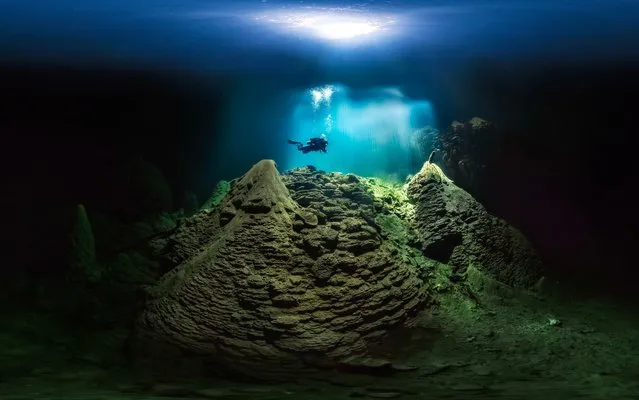
Cave Diver, Anhumas Abyss, Bonito, Brazil: The Anhumas Abyss is an underground cavern with a crystal-clear lake below, more than 260 feet (79 m) deep. A visitor must enter through a narrow opening at the top of the chamber and rappel into the cave. Snorkeling and scuba diving in the lake reveal amazing scenery. Distinctive, conical limestone stalagmites and stalactites occupy the lake and the surrounding area, some reaching 65 feet (20 m) high. “One must rappel about 235 feet (72 m) to get down into this deep lake. The photo was taken at a depth of 50 feet (15 m). It was a challenge to create the image because of the high contrast, plus the diver could not see into the darkness, making communication impossible”. (Photo by Marcio Cabral/Nature’s Best Photography Awards 2017)

Cave Diver, Anhumas Abyss, Bonito, Brazil: The Anhumas Abyss is an underground cavern with a crystal-clear lake below, more than 260 feet (79 m) deep. A visitor must enter through a narrow opening at the top of the chamber and rappel into the cave. Snorkeling and scuba diving in the lake reveal amazing scenery. Distinctive, conical limestone stalagmites and stalactites occupy the lake and the surrounding area, some reaching 65 feet (20 m) high. (Photo by Marcio Cabral/Nature’s Best Photography Awards 2017)
Details
26 Oct 2017 08:10:00