Loading...
Done
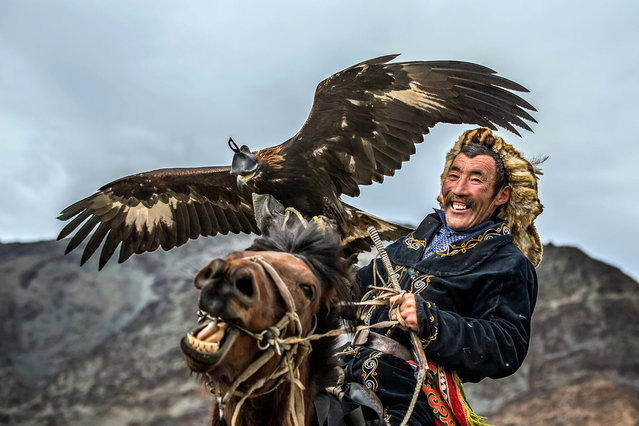
He said: "The photos were taken during the 17th Golden Eagle Festival in the Bayan-Ulgii province in Altai Mountains of Western Mongolia and the festival is just amazing”. (Photo by Batzaya Choijiljav/Caters News)

With their wings at full length, these beautiful golden eagles soar through the skies in a glorious training session to hunt their prey. Others sit on the arms of their owners and trainers. Batzaya Choijiljav, 41, from Mongolia has taken these magnificent pictures at the annual traditional Kazakhs festival, October 2015. (Photo by Batzaya Choijiljav/Caters News)
Details
06 Nov 2015 08:04:00
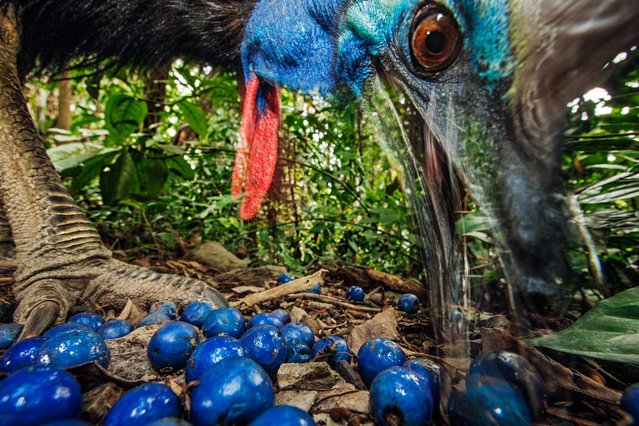
“Cassowaries are large, flightless birds related to emus and (more distantly) to ostriches, rheas, and kiwis”, writes Olivia Judson in the September issue of National Geographic magazine. (Photo by Christian Ziegler/National Geographic)

“Cassowaries are large, flightless birds related to emus and (more distantly) to ostriches, rheas, and kiwis”, writes Olivia Judson in the September issue of National Geographic magazine. How large? People-size: Adult males stand well over five foot five and top 110 pounds. Females are even taller, and can weigh more than 160 pounds. Dangerous when roused, they’re shy and peaceable when left alone. But even birds this big and tough are prey to habitat loss. The dense New Guinea and Australia rain forests where they live have dwindled. Today cassowaries might number 1,500 to 2,000. And because they help shape those same forests – by moving seeds from one place to another – “if they vanish”, Judson writes, “the structure of the forest would gradually change” too. (Photo by Christian Ziegler/National Geographic)
Details
06 Jan 2014 12:21:00
Baby Fennec Fox

“The fennec fox is a small nocturnal fox found in the Sahara of North Africa. Its most distinctive feature is unusually large ears. The name “fennec” comes from the Arabic word for fox, and the species name zerda has a Greek origin that refers to its habitat. The fennec is the smallest species of canid in the world; coat, ears and kidney functions have adapted to a high-temperature, low-water, desert environment. In addition, its hearing is sensitive enough to hear prey moving underground”. – Wikipedia

Photo: A Baby Fennec is seen at Sunshine International Aquarium on June 24, 2009 in Tokyo, Japan. The small nocturnal fox babies were born on May 17 2009. (Photo by Junko Kimura/Getty Images)
Details
16 Sep 2011 12:02:00
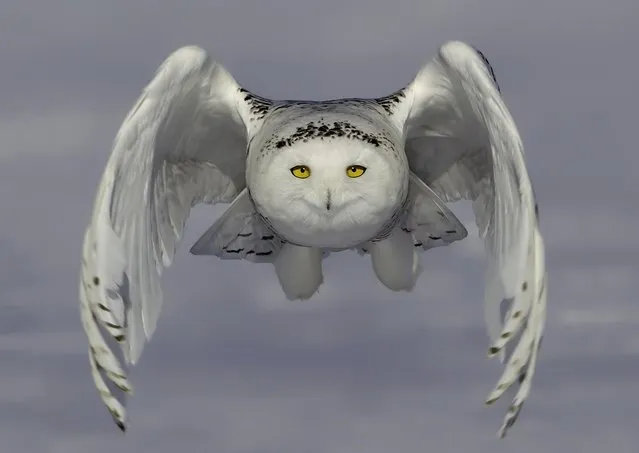
A beautiful snowy owl looks like she is flying above a cloud, but in fact she is gliding inches above a snowplain in a hunt for food. The owls fit in perfectly with their surroundings as both the male and female, which has darker markings on her feathers referred to as barres, hunt for voles. (Photo by Rick Dobson/Solent News/SIPA Press)

A beautiful snowy owl looks like she is flying above a cloud, but in fact she is gliding inches above a snowplain in a hunt for food. The owls fit in perfectly with their surroundings as both the male and female, which has darker markings on her feathers referred to as barres, hunt for voles. The female is so low to the ground she is almost touching it as she spots her prey in the snow. Nature photographer Rick Dobson captured the two birds hunting in corn fields near his home, just outside of Ottawa, Ontario, Canada. (Photo by Rick Dobson/Solent News/SIPA Press)
Details
24 Mar 2015 10:00:00
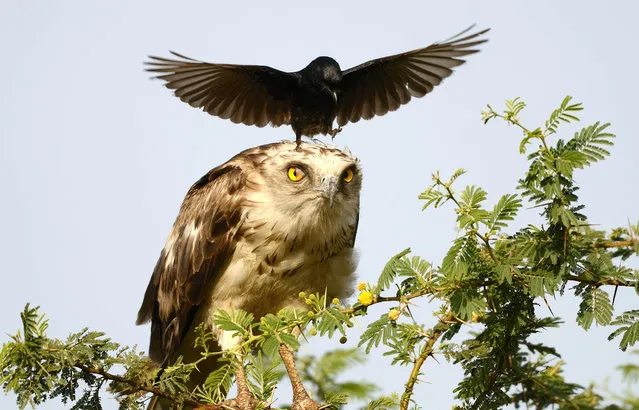
A crow lands on the eagles head much to the eagles displeasure. (Photo by Greaves B. Henriksen/Caters News Agency)

These pictures show a rather annoying crow irritating an eagle. The crow tirelessly circles the bird of prey and repeatedly lands on his head – much to the crows displeasure. The encounter was spotted by Greaves Henriksen in Tamilnadu, India. The 52-year-old amateur photographer believes the eagle was sitting close to a nest, which the crow was trying to defend. Here: A crow lands on the eagles head much to the eagles displeasure. (Photo by Greaves B. Henriksen/Caters News Agency)
Details
09 Feb 2017 00:03:00
This Thursday, January 22, 2015 photo made with a long exposure shows the glow from a Noctiluca scintillans algal bloom along the seashore in Hong Kong. The luminescence, also called Sea Sparkle, is triggered by farm pollution that can be devastating to marine life and local fisheries, according to University of Georgia oceanographer Samantha Joye. (Photo by Kin Cheung/AP Photo)

This Thursday, January 22, 2015 photo made with a long exposure shows the glow from a Noctiluca scintillans algal bloom along the seashore in Hong Kong. The luminescence, also called Sea Sparkle, is triggered by farm pollution that can be devastating to marine life and local fisheries, according to University of Georgia oceanographer Samantha Joye. Noctiluca itself does not produce neurotoxins like other similar organisms do. But its role as both prey and predator tends can eventually magnify the accumulation of toxins in the food chain, according to R. Eugene Turner at Louisiana State University. (Photo by Kin Cheung/AP Photo)
Details
23 Jan 2015 13:12:00
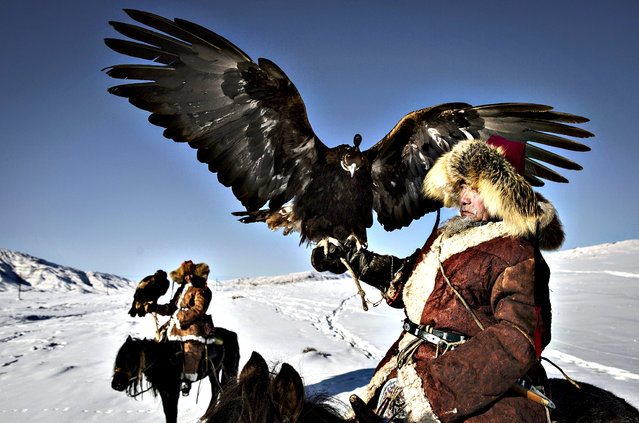
Chinese Kazakh eagle hunters sit on horseback as they travel to a local competition on January 29, 2015 in the mountains of Qinghe County, Xinjiang, northwestern China. The festival, organised by the local hunting community, is part of an effort to promote and grow traditional hunting practices for new generations in the mountainous region of western China that borders Kazakhstan, Russia and Mongolia. (Photo by Kevin Frayer/Getty Images)

Chinese Kazakh eagle hunters sit on horseback as they travel to a local competition on January 29, 2015 in the mountains of Qinghe County, Xinjiang, northwestern China. The festival, organised by the local hunting community, is part of an effort to promote and grow traditional hunting practices for new generations in the mountainous region of western China that borders Kazakhstan, Russia and Mongolia. The training and handling of the large birds of prey follows a strict set of ancient rules that Kazakh eagle hunters are preserving for future generations. (Photo by Kevin Frayer/Getty Images)
Details
07 Feb 2015 14:11:00
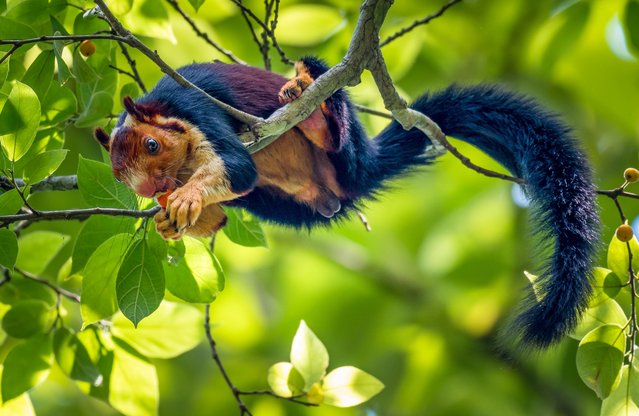
Its main predators are the birds of prey and the leopard. The Giant Squirrel is mostly active in the early hours of the morning and in the evening, resting in the midday. They are typically solitary animals that only come together for breeding. (Photo by Kaushik Vijayan/South West News Service)

The Malabar Giant squirrel – double the size of their grey relatives and measuring up to 36 inches (91.5 cm) from head to tail – lives deep in the forests of India. The athletic animals can leap an incredible 20 feet (6 m) between trees. Photographer Kaushik Vijayan, 39, snapped the animals in their native habit to produce these stunning images. Kaushik, from Kerala State, India, said: “Up until that point I had never heard about a squirrel like that or seen one. The sight was an absolute feast for my eyes. The squirrels fascinated me and I got excited to capture this beauty on my camera”. (Photo by Kaushik Vijayan/South West News Service)
Details
04 Apr 2019 00:03:00