Loading...
Done
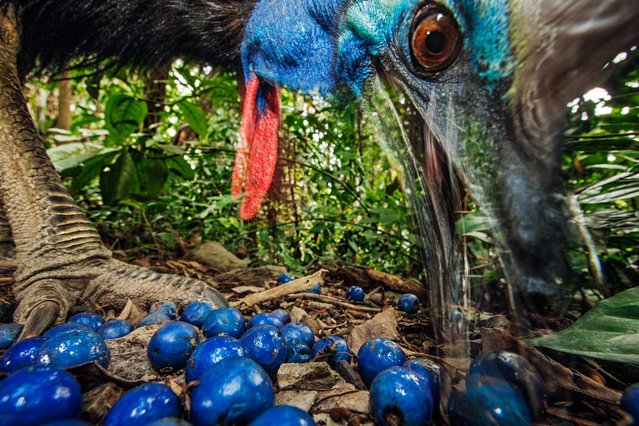
“Cassowaries are large, flightless birds related to emus and (more distantly) to ostriches, rheas, and kiwis”, writes Olivia Judson in the September issue of National Geographic magazine. (Photo by Christian Ziegler/National Geographic)

“Cassowaries are large, flightless birds related to emus and (more distantly) to ostriches, rheas, and kiwis”, writes Olivia Judson in the September issue of National Geographic magazine. How large? People-size: Adult males stand well over five foot five and top 110 pounds. Females are even taller, and can weigh more than 160 pounds. Dangerous when roused, they’re shy and peaceable when left alone. But even birds this big and tough are prey to habitat loss. The dense New Guinea and Australia rain forests where they live have dwindled. Today cassowaries might number 1,500 to 2,000. And because they help shape those same forests – by moving seeds from one place to another – “if they vanish”, Judson writes, “the structure of the forest would gradually change” too. (Photo by Christian Ziegler/National Geographic)
Details
06 Jan 2014 12:21:00
Tsukimi Ayano steps out of her house in the village of Nagoro on Shikoku Island in southern Japan February 24, 2015. (Photo by Thomas Peter/Reuters)

Tsukimi Ayano steps out of her house in the village of Nagoro on Shikoku Island in southern Japan February 24, 2015. Tsukimi Ayano made her first scarecrow 13 years ago to frighten off birds pecking at seeds in her garden. The life-sized straw doll resembled her father, so she made more. Today, the tiny village of Nagoro in southern Japan is teeming with Ayano's hand-sewn creations, frozen in time for a tableau that captures the motions of everyday life. (Photo by Thomas Peter/Reuters)
Details
17 Mar 2015 12:38:00
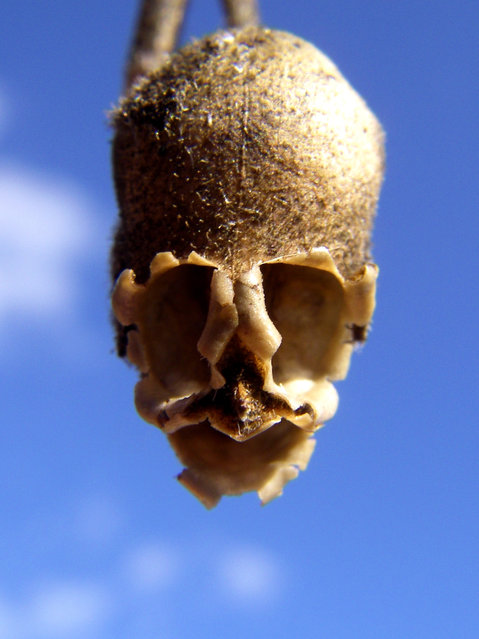
The Dragon’s Skull

Yes this is not a real dragon’s skull but it is still pretty creepy. This weird little plant is called a Snapdragon or Dragon flower or, if you want to sound even smarter, The Antirrhinum. Once the flower has died, the seed pod begins to look like the skulls you see here. Apart from being creepy as hell and alleged protectors of the garden, if you wore this about your body you would appear to be more “fascinating and gracious”. Though I imagine if anyone actually did find this on you, fascinating and gracious are not the only things they will think about you.
Details
22 Oct 2013 08:31:00
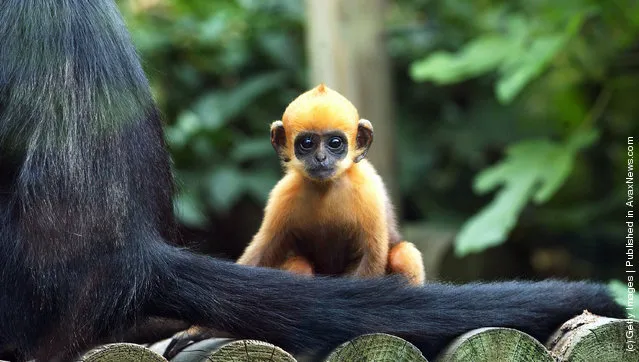
Baby Francois' Langur

“Francois' langur is one of several species of leaf monkeys. Over 50% of its diet is made up of young leaves. It will also consume fruits (17.2%), seeds, flowers, stems, roots, bark and occasionally minerals and insects off of rock surfaces and cliffs. This langur consumes its favorite food, young leaves, at the highest rate during the dry season, April through September, also known as the young leaf-lean period”. – Wikipedia

Photo: An endangered baby Francois' Langur monkey called Laa Laa settles in following her July 6 birth at London Zoo, Regent's Park on August 5, 2004 in London. The bright ginger youngster was born to glossy black parents Max and Shaneka and has the typical orange baby coat which is in stark contrast against the black of her parent's and older brother Grub's fur. (Photo by Steve Finn/Getty Images)
Details
22 Sep 2011 11:28:00
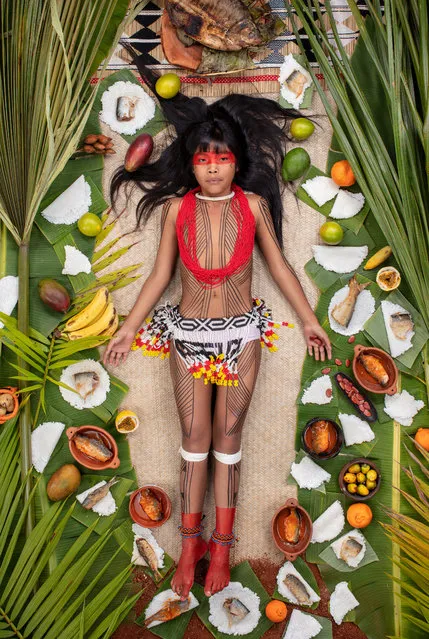
Kawakanih Yawalapiti, 9, Upper Xingu region of Mato Grosso, Brazil, 2018: Kawakanih lives with her tribe, the Yawalapiti, in Xingu national park, a preserve in the Amazon basin of Brazil. The Yawalapiti collect seeds to preserve species unique to their ecosystem, which lies between the rain forest and savannah. Kawakanih’s diet is simple, consisting mainly of fish, cassava, porridge, fruit and nuts. “It takes five minutes to catch dinner”, says Kawakanih. “When you’re hungry, you just go to the river with your net”. (Photo by Gregg Segal/The Guardian)

Photographer Gregg Segal travelled the world to document children and the food they eat in a week. Partly inspired by the increasing problems of childhood obesity, he tracked traditional regional diets as yet unaffected by globalisation, and ironically, found that the healthiest diets were often eaten by the least well off. (Photo by Gregg Segal/The Guardian)
Details
03 Jul 2019 00:03:00
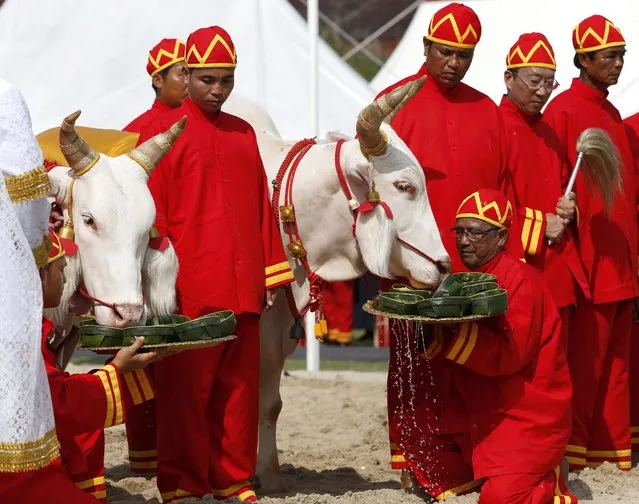
Royal sacred white oxen are offered food to consult the oracles during the Royal Ploughing Ceremony at the Royal Ground, Sanam Luang near the Grand Palace in Bangkok, Thailand, 09 May 2016. The ancient Brahmin rite is of great importance to the country's farmers. Thousands of farmers converge in Bangkok for the annual event, which is believed to assure a successful planting season and an abundance of crops. (Photo by Rungroj Yongrit/EPA)

Royal sacred white oxen are offered food to consult the oracles during the Royal Ploughing Ceremony at the Royal Ground, Sanam Luang near the Grand Palace in Bangkok, Thailand, 09 May 2016. The ancient Brahmin rite is of great importance to the country's farmers. Thousands of farmers converge in Bangkok for the annual event, which is believed to assure a successful planting season and an abundance of crops. This year the sacred oxen ate paddy, sesame seeds, water and liquor which according to traditional soothsayers predicts that the country will have abundant food, sufficient water for agriculture as well as communication and foreign trade will improve leading to the prosperous economy. (Photo by Rungroj Yongrit/EPA)
Details
10 May 2016 13:11:00
Drinkers celebrated on the last Friday before Christmas in York, United Kingdom on December 18, 2020. Black Eye Friday, affectionately named for its tendency to prompt drink-fuelled punch ups as the Christmas cheer spills over, has been dampened this year by the global coronavirus pandemic shutting bars and banning socialising. (Photo by Nb press ltd)

Drinkers celebrated on the last Friday before Christmas in York, United Kingdom on December 18, 2020. Black Eye Friday, affectionately named for its tendency to prompt drink-fuelled punch ups as the Christmas cheer spills over, has been dampened this year by the global coronavirus pandemic shutting bars and banning socialising. (Photo by Nb press ltd)
Details
20 Dec 2020 00:07:00
Jeff Byrd 500

David Reutimann, driver of the #00 Aaron's Dream Machine Toyota, Brian Vickers, driver of the #83 Red Bull Toyota, and Denny Hamlin, driver of the #11 FedEx Express Toyota, collide after an incident in the NASCAR Sprint Cup Series Jeff Byrd 500 Presented By Food City at Bristol Motor Speedway on March 20, 2011 in Bristol, Tennessee.
Details
20 Mar 2011 20:55:00