A partial Solar eclipse is seen just after sunrise over the Queens borough of New York across the East River on November 3, 2013 in New York. (Photo by Stan Honda/AFP Photo)
The second and final qualification motor (QM-2) test for the Space Launch System's booster, June 28, 2016, at Orbital ATK Propulsion Systems test facilities in Promontory, Utah. During the Space Launch System flight the boosters will provide more than 75 percent of the thrust needed to escape the gravitational pull of the Earth, the first step on NASA's Journey to Mars. (Photo by Bill Ingalls/NASA)
Commuters ride on the roof of a Jakarta state rail train at Cawang train station on January 27, 2012 in Jakarta, Indonesia. (Photo by Ulet Ifansasti/Getty Images)
A poster for the IMAX presentation of “The Hunger Games: Catching Fire” (left), and a teaser poster for “The Hunger Games: Mockingjay, Part I”, both created by the Los Angeles-based design firm IGNITION. Both are nominated for the 2014 Key Art Awards in the category of Theatrical Domestic One-Sheet. The Hollywood Reporter's annual competition for the best in film and TV advertising honors some of the most creative imagery used in movie posters. Here is a selection of some of this year's nominees. (Photo by Key Art Awards 2014)
CHIP is a prefab, net-zero solar-powered house designed and built by a student-run team from two Southern California schools: Southern California Institute of Architecture (SCI-Arc) and California Institute of Technology (Caltech). The house is the team's entry for the U.S. Department of Energy Solar Decathlon 2011 competition.
Selfie picture shows Swiss pioneer Bertrand Piccard during the last leg of the round the world trip with Solar Impulse 2 over the Arab peninsula July 25, 2016. (Photo by Jean Revillard/Bertrand Piccard/Reuters/SI2)
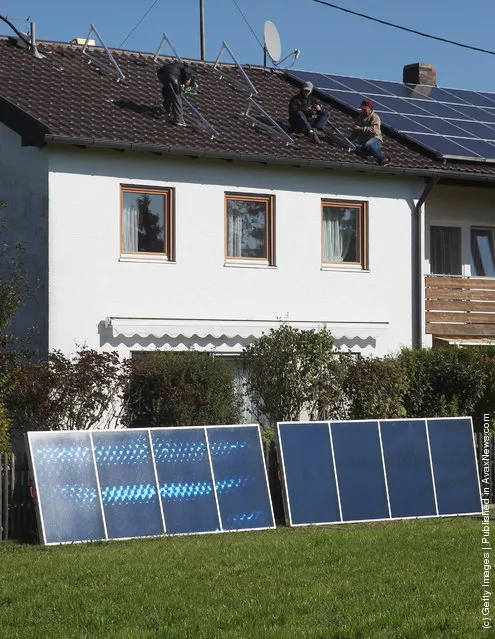
Workers prepare the roof of a house to get installed solar power modules for producing heat on October 15, 2011 in Wessling, Germany. Germany has and is continuing to invest heavily in solar energy, both in the public and private sectors. The German government introduced a feed-in tariff with its Renewable Energy Act in 2000 that guarantees homeowners a minimum rate for selling electricity from renewable energy sources into the nation's electricity grid. (Photo by Alexandra Beier/Getty Images)