Loading...
Done
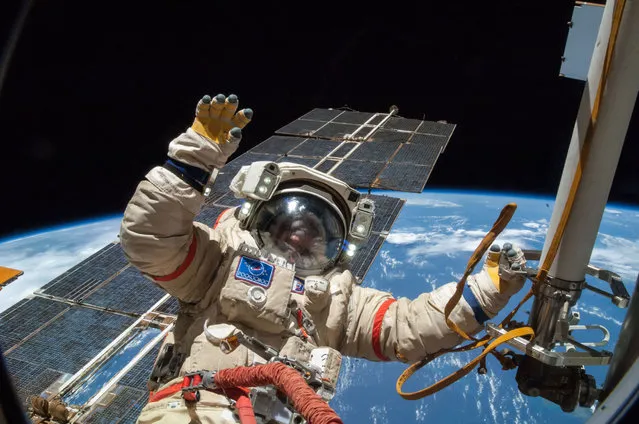
Russian cosmonaut Alexander Skvortsov, Expedition 40 flight engineer, attired in a Russian Orlan spacesuit, participates in a session of extravehicular activity (EVA) in support of science and maintenance on the International Space Station on August 18, 2014. During the five-hour, 11-minute spacewalk, Skvortsov and cosmonaut Oleg Artemyev (out of frame) deployed a small science satellite, retrieved and installed experiment packages and inspected components on the exterior of the orbital laboratory. (Photo by NASA)

Russian cosmonaut Alexander Skvortsov, Expedition 40 flight engineer, attired in a Russian Orlan spacesuit, participates in a session of extravehicular activity (EVA) in support of science and maintenance on the International Space Station on August 18, 2014. During the five-hour, 11-minute spacewalk, Skvortsov and cosmonaut Oleg Artemyev (out of frame) deployed a small science satellite, retrieved and installed experiment packages and inspected components on the exterior of the orbital laboratory. (Photo by NASA)
Details
13 Apr 2022 06:53:00
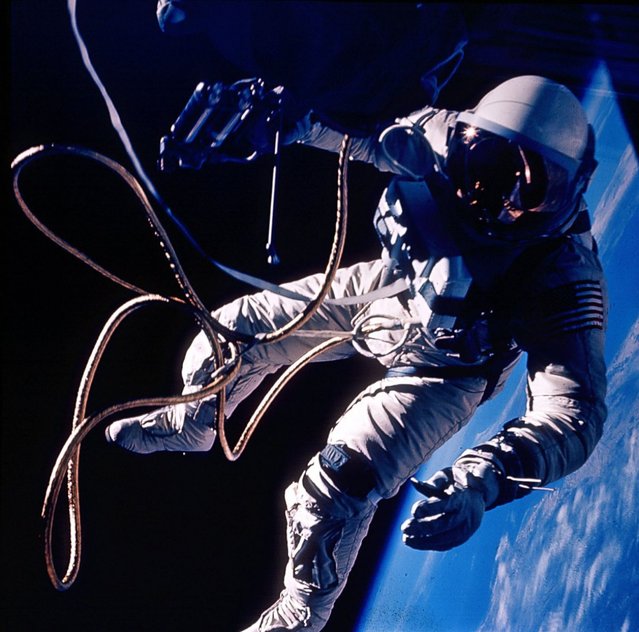
The First U.S. Spacewalk – Gemini 4 Ed White made the United States' first spacewalk on June 3, 1965 during the Gemini 4 mission. The extra-vehicular activity (EVA) started at 19:45 UT (3:45 p.m. EDT) on the third orbit when White opened his hatch and used the hand-held manuevering oxygen-jet gun to push himself out of the capsule. (Photo by NASA)

The First U.S. Spacewalk – Gemini 4 Ed White made the United States' first spacewalk on June 3, 1965 during the Gemini 4 mission. The extra-vehicular activity (EVA) started at 19:45 UT (3:45 p.m. EDT) on the third orbit when White opened his hatch and used the hand-held manuevering oxygen-jet gun to push himself out of the capsule. (Photo by NASA)
Details
11 Apr 2014 08:40:00
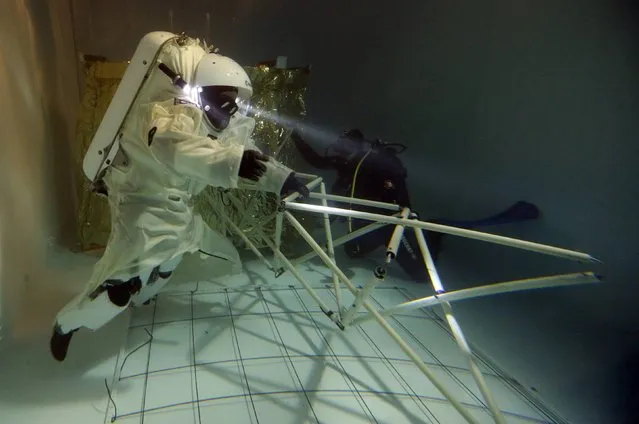
National Diving School director Jerome Vincent, wearing a Gandolfi space suit, executes training procedures in a swimming pool in Marseille October 22, 2014. (Photo by Jean-Paul Pelissier/Reuters)

National Diving School director Jerome Vincent, wearing a Gandolfi space suit, executes training procedures in a swimming pool in Marseille October 22, 2014. The underwater test session develops European expertise in spacewalk simulations under partial gravity for exploring the Moon, asteroids and Mars.The training is organised by Comex, a French company specializing in engineering and deep sea diving operations, in collaboration with the European Space Agency (ESA) and with Apollo XI “Under the sea”. (Photo by Jean-Paul Pelissier/Reuters)
Details
26 Oct 2014 12:47:00
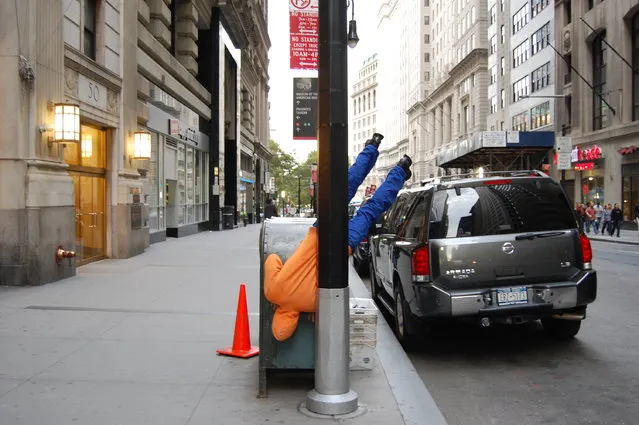
Willi Dorner, Bodies in Urban Spaces, September 26, 2010

“Bodies in urban spaces” is a temporarily intervention in diversified urban architectonical environment. The intention of “bodies in urban spaces” is to point out the urban functional structure and to uncover the restricted movement possibilities and behavior as well as rules and limitations. Photo: “Bodies in Urban Spaces”, September 26, 2010. (Photos by Andrew Russeth)
Details
16 Sep 2013 09:32:00
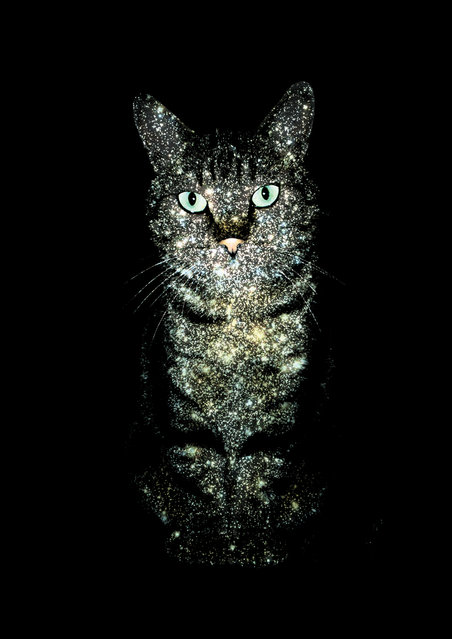
Space Cats By Zippora Lux

Boya Latumahina, alter ego, Zippora Lux is a Design student studying at Central St Martins in London. She has created these space age cats by combining two of her favourite things, cats and telescopic photographs.
Details
01 Dec 2013 10:34:00
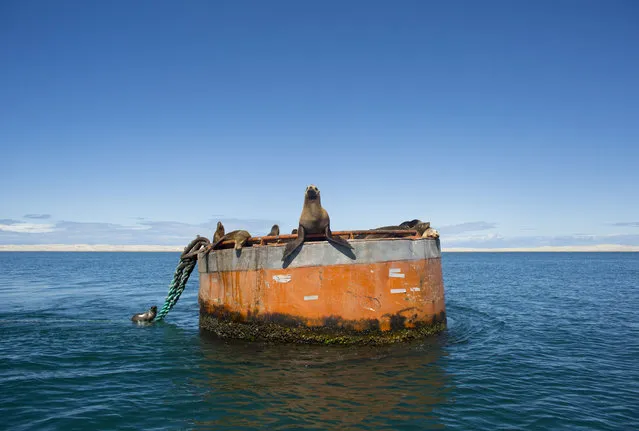
In this March 3, 2015 photo, a group of California sea lions rest on a large bouy in the San Ignacio lagoon, in the Pacific Ocean, near Guerrero Negro, in Mexico's Baja California peninsula. (Photo by Dario Lopez-Mills/AP Photo)

In this March 3, 2015 photo, a group of California sea lions rest on a large bouy in the San Ignacio lagoon, in the Pacific Ocean, near Guerrero Negro, in Mexico's Baja California peninsula. (Photo by Dario Lopez-Mills/AP Photo)
Details
20 Mar 2015 10:37:00
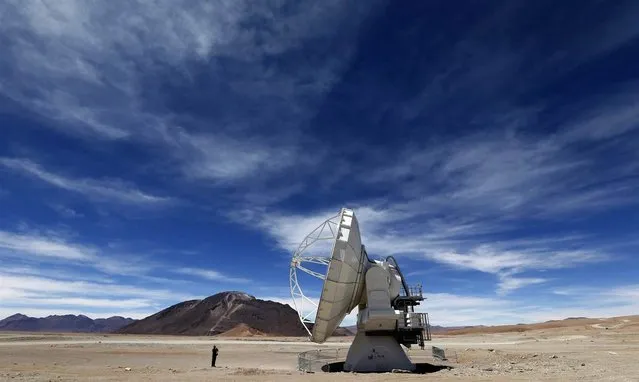
A man takes a photo of a radio antenna that's part of the Atacama Large Milimeter Array Observatory on March 12, 2013 at Llano de Chajnantor, about 43 miles (70 kilometers) from San Pedro de Atacama, Chile. The $1.5 billion ALMA facility, which had its official inauguration on March 13, is considered the world's most expensive ground-based observatory. (Photo by Felipe Trueba/EPA)

A man takes a photo of a radio antenna that's part of the Atacama Large Milimeter Array Observatory on March 12, 2013 at Llano de Chajnantor, about 43 miles (70 kilometers) from San Pedro de Atacama, Chile. The $1.5 billion ALMA facility, which had its official inauguration on March 13, is considered the world's most expensive ground-based observatory. (Photo by Felipe Trueba/EPA)
Details
03 Apr 2013 09:25:00
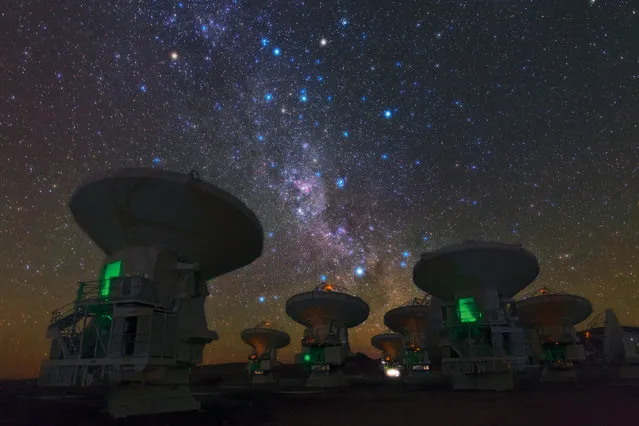
The antennas of the European Southern Observatory's Atacama Large Millimeter/Submillimeter Array, also known as ALMA, are set against the splendor of the Milky Way in this picture by Babak Tafreshi

The antennas of the European Southern Observatory's Atacama Large Millimeter/Submillimeter Array, also known as ALMA, are set against the splendor of the Milky Way in this picture by Babak Tafreshi. Construction of the full ALMA array is due to be completed in Chile's Atacama Desert in 2013, but the facility is already making scientific observations with a partial array of antennas. (Photo by ESO/B. Tafreshi/TWAN)
Details
03 Jun 2012 11:57:00