Loading...
Done
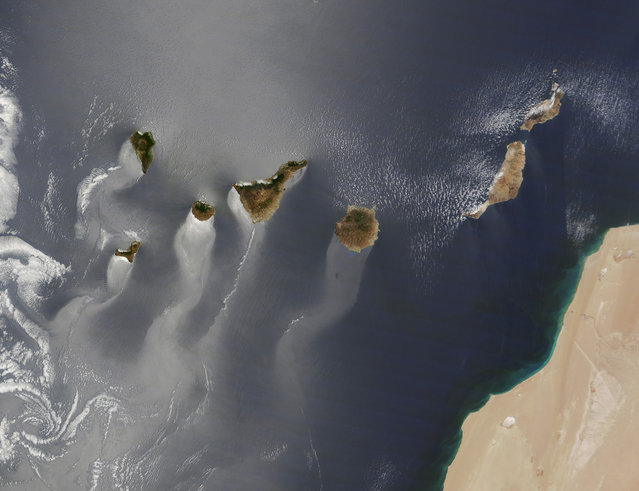
Canary Islands. (Photo by NASA)

Canary Islands. (Photo by NASA)
Details
29 Dec 2013 08:23:00


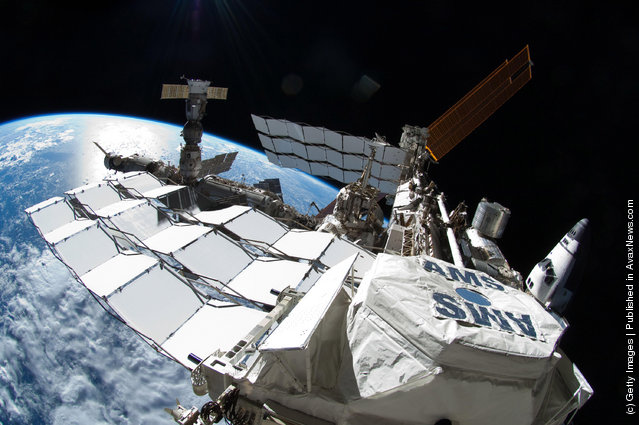
Space shuttle Atlantis (R) remains docked to the International Space Station photographed by NASA astronaut Ronald Garan during a planned six-and-a-half-hour spacewalk July 12, 2011 in space. Space shuttle Atlantis has embarked on a 12-day mission to the International Space Station where it will deliver the Raffaello multi-purpose logistics module packed with supplies and spare parts. This was the final mission of the space shuttle program, which began on April 12, 1981 with the launch of Colombia. (Photo by NASA via Getty Images)
Details
20 Jul 2011 12:23:00
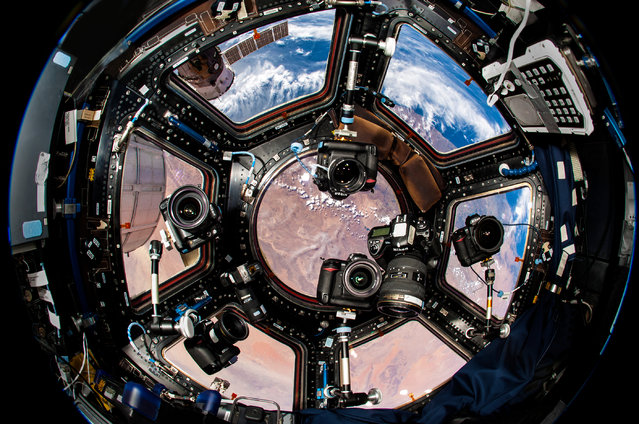
Astronaut Donald R. Pettit would often rig an array of as many as six cameras in the cupola windows and set them all to fire continuously for events such as sunsets, which only last around seven seconds on the ISS. (Photo by Donald R. Pettit)

Astronaut Donald R. Pettit would often rig an array of as many as six cameras in the cupola windows and set them all to fire continuously for events such as sunsets, which only last around seven seconds on the ISS. (Photo by Donald R. Pettit)
Details
05 Sep 2016 11:34:00
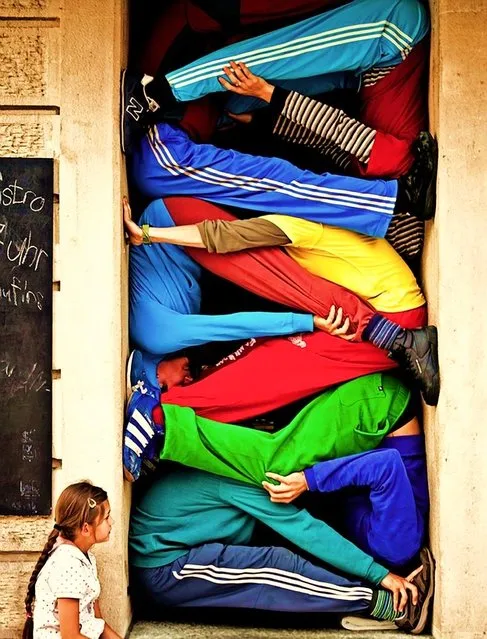
Bodies In Urban Space

“Bodies in urban spaces” is a temporarily intervention in diversified urban architectural environments. The intention of “Bodies in urban spaces” is to point out the urban functional structure and to uncover the restricted movement possibilities and behavior as well as rules and limitations.
Details
31 Jul 2014 13:41:00
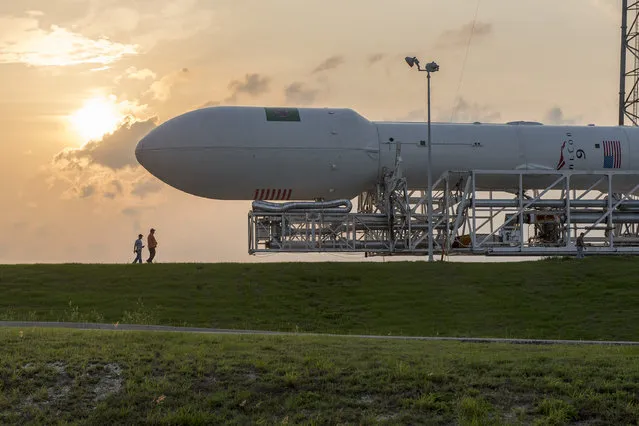
In this handout provided by the National Aeronautics and Space Administration (NASA), SpaceX's Falcon 9 is moved to the launch pad prior to the rocket's Thales Alenia Space launch attempt on April 26, 2015 in Cape Canaveral, Florida. (Photo by NASA via Getty Images)

In this handout provided by the National Aeronautics and Space Administration (NASA), SpaceX's Falcon 9 is moved to the launch pad prior to the rocket's Thales Alenia Space launch attempt on April 26, 2015 in Cape Canaveral, Florida. (Photo by NASA via Getty Images)
Details
05 Jun 2017 07:25:00
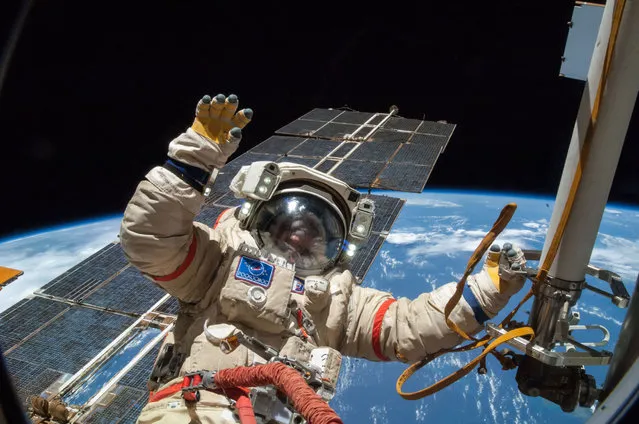
Russian cosmonaut Alexander Skvortsov, Expedition 40 flight engineer, attired in a Russian Orlan spacesuit, participates in a session of extravehicular activity (EVA) in support of science and maintenance on the International Space Station on August 18, 2014. During the five-hour, 11-minute spacewalk, Skvortsov and cosmonaut Oleg Artemyev (out of frame) deployed a small science satellite, retrieved and installed experiment packages and inspected components on the exterior of the orbital laboratory. (Photo by NASA)

Russian cosmonaut Alexander Skvortsov, Expedition 40 flight engineer, attired in a Russian Orlan spacesuit, participates in a session of extravehicular activity (EVA) in support of science and maintenance on the International Space Station on August 18, 2014. During the five-hour, 11-minute spacewalk, Skvortsov and cosmonaut Oleg Artemyev (out of frame) deployed a small science satellite, retrieved and installed experiment packages and inspected components on the exterior of the orbital laboratory. (Photo by NASA)
Details
13 Apr 2022 06:53:00
Viewing The Earth From Space

Despite any political differences between the United States and Russia, the space agencies of the two countries continue their cooperative work in Earth's orbit, aboard the International Space Station. Apart from the research being done in microgravity, ISS crew members continue to send back amazing images of our home world, photographed from low Earth orbit. Gathered here are recent images of Earth from aboard the ISS, and from a handful of other NASA satellites.
Details
01 Jun 2014 12:36:00
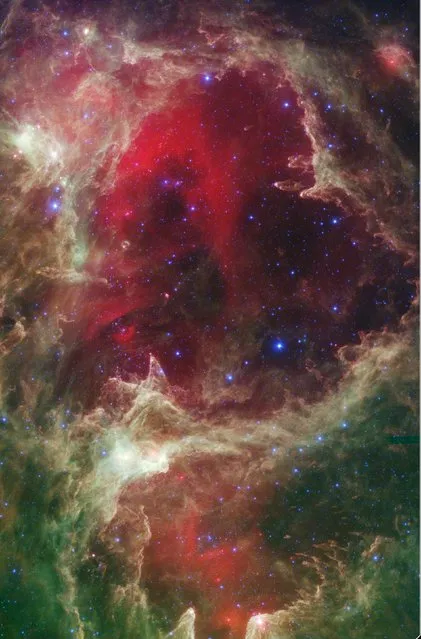
An infrared portrait from NASA's Spitzer Space Telescope which shows generations of stars is seen in this undated NASA handout image released February 14, 2013. In this wispy star-forming region, called W5, the oldest stars can be seen as blue dots in the centers of the two hollow cavities (other blue dots are background and foreground stars not associated with the region). Red shows heated dust that pervades the region's cavities, while green highlights dense clouds. (Photo by NASA/Reuters/JPL-Caltech/Harvard-Smithsonian/Handout)

An infrared portrait from NASA's Spitzer Space Telescope which shows generations of stars is seen in this undated NASA handout image released February 14, 2013. In this wispy star-forming region, called W5, the oldest stars can be seen as blue dots in the centers of the two hollow cavities (other blue dots are background and foreground stars not associated with the region). Red shows heated dust that pervades the region's cavities, while green highlights dense clouds. (Photo by NASA/Reuters/JPL-Caltech/Harvard-Smithsonian/Handout)
Details
03 Mar 2013 08:44:00