Loading...
Done
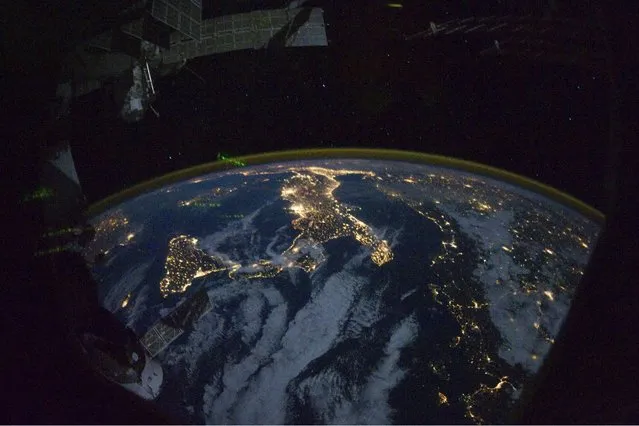
This image provided by NASA shows parts of Europe and Africa very easily recognizable in this night time image shot by one of the Expedition 25 crew members aboard the International Space Station flying 220 miles above Earth on Thursday Oct. 28, 2010. The view “looks” northward over Sicily and the “boot” of Italy, with the Mediterranean Sea representing most of the visible water in the view and the Adriatic Sea to the right of center. Tunisia is partially visible at left. Part of a docked Russian spacecraft and other components of the ISS are in the foreground. (Photo by AP photo/NASA)

This image provided by NASA shows parts of Europe and Africa very easily recognizable in this night time image shot by one of the Expedition 25 crew members aboard the International Space Station flying 220 miles above Earth on Thursday October 28, 2010. The view “looks” northward over Sicily and the “boot” of Italy, with the Mediterranean Sea representing most of the visible water in the view and the Adriatic Sea to the right of center. Tunisia is partially visible at left. Part of a docked Russian spacecraft and other components of the ISS are in the foreground. (Photo by AP Photo/NASA)
Details
11 May 2013 12:29:00
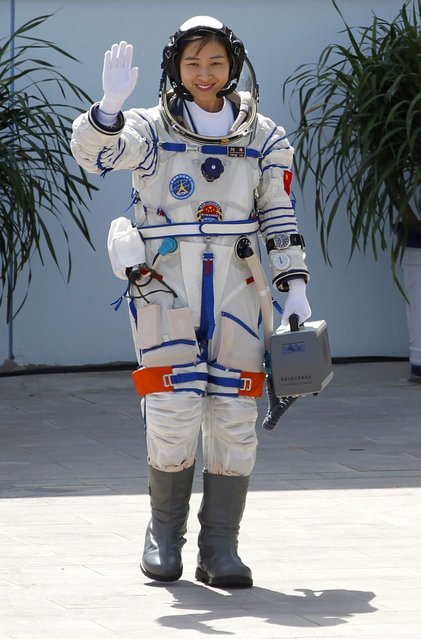
China's first female astronaut Liu Yang, waves during a sending off ceremony before she departs for the Shenzhou 9 spacecraft rocket launch pad at the Jiuquan Satellite Launch Center in Jiuquan, China, Saturday, June 16, 2012

China has sent its first woman into space on a mission to dock with an orbiting station, the latest step in an ambitious programme to go to the moon and on to Mars.

Photo: China's first female astronaut Liu Yang, waves during a sending off ceremony before she departs for the Shenzhou 9 spacecraft rocket launch pad at the Jiuquan Satellite Launch Center in Jiuquan, China, Saturday, June 16, 2012. China will send its first woman and two other astronauts into space Saturday to work on a temporary space station for about a week, in a key step toward becoming only the third nation to set up a permanent base in orbit. (Photo by Ng Han Guan/AP Photo)
Details
17 Jun 2012 09:49:00
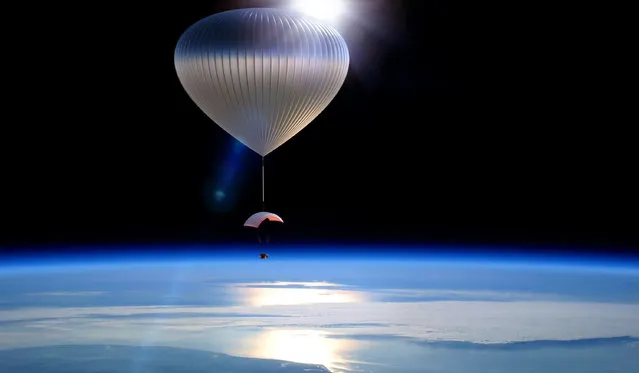
This undated image provided by World View shows World View capsule and balloon spacecraft that will rise to 100,000 feet above Earth for passengers to see the curvature of the planet and the blackness of space. (Photo by World View via AP Photo)

This undated image provided by World View shows World View capsule and balloon spacecraft that will rise to 100,000 feet above Earth for passengers to see the curvature of the planet and the blackness of space. Space tourism companies are employing designs including winged vehicles, vertical rockets with capsules and high-altitude balloons. While developers envision ultimately taking people to orbiting habitats, the moon or beyond, the immediate future involves short flights into or near the lowest reaches of space without going into orbit. (Photo by World View via AP Photo)
Details
15 Feb 2016 10:28:00


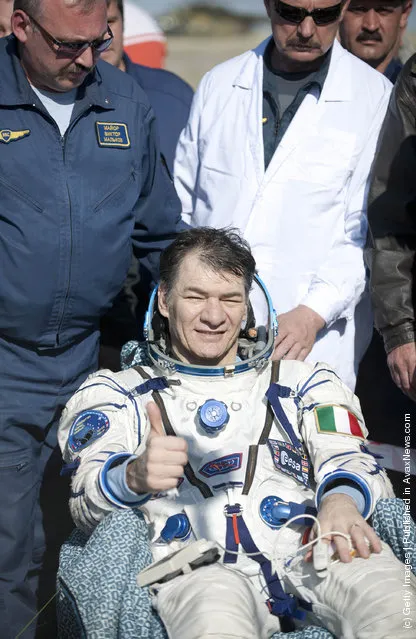
ESA astronaut Paolo Nespoli looks on after landing back on Earth from their Soyuz TMA-20 spacecraft on May 24, 2011 in Zhezkazgan, Kazakhstan. The mission of the Soyuz TMA-20 was launched last December to the International Space Station with the flight engineers Catherine Coleman from the United States, Russian cosmonaut Dmitry Kondratyev and Italian astronaut Paolo Nespoli. The next expedition is expected to launch this June. (Photo by Stephane Corvaja/ESA via Getty Images)
Details
24 May 2011 10:06:00
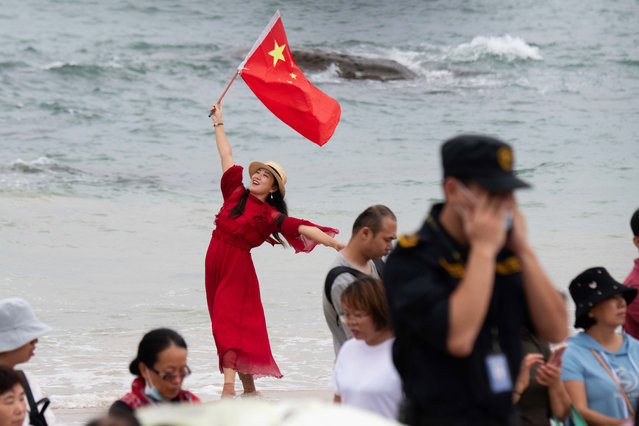
A woman holds up the Chinese national flag as people gather to watch the the launch of the Long March 5B rocket carrying China's Tianhe space station core module from the Wenchang Spacecraft Launch Site in Hainan Province, China, 29 April 2021. China launched into space the core module of its space station, marking the beginning of a series of launch missions to complete the space station by the end of next year. (Photo by Matjaz Tancic/EPA/EFE)

A woman holds up the Chinese national flag as people gather to watch the the launch of the Long March 5B rocket carrying China's Tianhe space station core module from the Wenchang Spacecraft Launch Site in Hainan Province, China, 29 April 2021. China launched into space the core module of its space station, marking the beginning of a series of launch missions to complete the space station by the end of next year. (Photo by Matjaz Tancic/EPA/EFE)
Details
11 May 2021 08:40:00
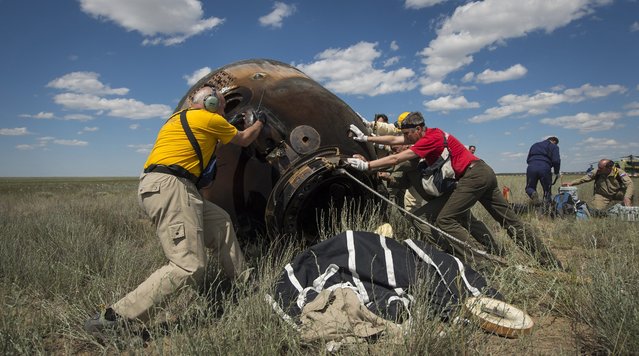
A handout phptopgraph made avaiable by NASA showing Russian support personnel roll the Soyuz TMA-19M spacecraft after it landed with with with Expedition 47 crew members Tim Kopra of NASA, Tim Peake of the European Space Agency, and Yuri Malenchenko of Roscosmos near the town of Zhezkazgan, Kazakhstan 18 June 2016. Kopra, Peake, and Malenchenko are returning after six months in space where they served as members of the Expedition 46 and 47 crews onboard the International Space Station. (Photo by Bill Ingalls/EPA/NASA)

A handout phptopgraph made avaiable by NASA showing Russian support personnel roll the Soyuz TMA-19M spacecraft after it landed with with with Expedition 47 crew members Tim Kopra of NASA, Tim Peake of the European Space Agency, and Yuri Malenchenko of Roscosmos near the town of Zhezkazgan, Kazakhstan 18 June 2016. Kopra, Peake, and Malenchenko are returning after six months in space where they served as members of the Expedition 46 and 47 crews onboard the International Space Station. (Photo by Bill Ingalls/EPA/NASA)
Details
19 Jun 2016 10:20:00
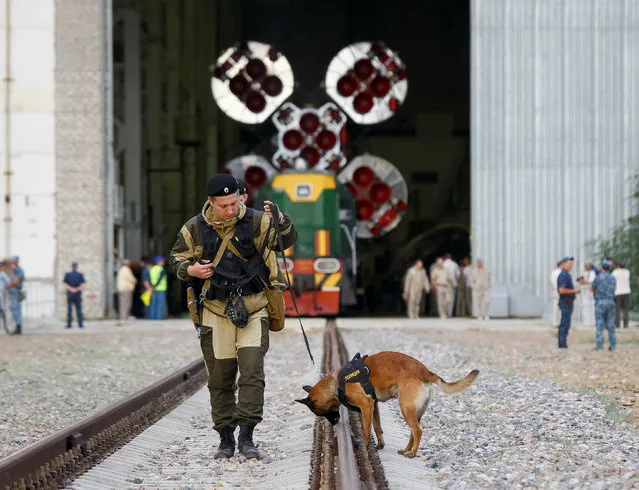
Police officers with a sniffer dog check a railway as the Soyuz MS spacecraft for the next International Space Station (ISS) crew of Kate Rubins of the U.S., Anatoly Ivanishin of Russia and Takuya Onishi of Japan is ready to be transported from an assembling hangar to the launchpad ahead of its launch scheduled on July 7, at the Baikonur cosmodrome in Kazakhstan July 4, 2016. (Photo by Shamil Zhumatov/Reuters)

Police officers with a sniffer dog check a railway as the Soyuz MS spacecraft for the next International Space Station (ISS) crew of Kate Rubins of the U.S., Anatoly Ivanishin of Russia and Takuya Onishi of Japan is ready to be transported from an assembling hangar to the launchpad ahead of its launch scheduled on July 7, at the Baikonur cosmodrome in Kazakhstan July 4, 2016. (Photo by Shamil Zhumatov/Reuters)
Details
06 Jul 2016 16:24:00
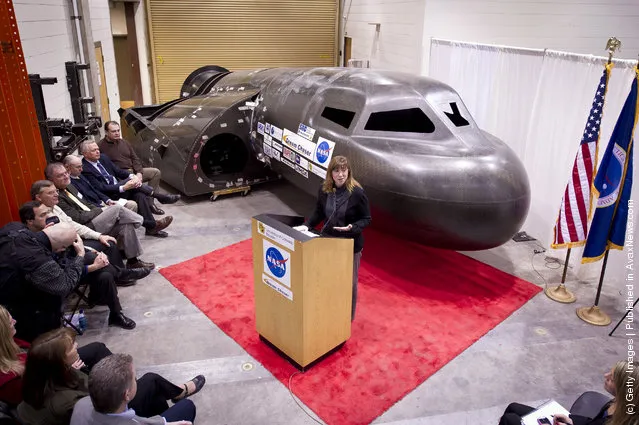
Dream Chaser

“The Dream Chaser is a planned crewed suborbital and orbital vertical-takeoff, horizontal-landing (VTHL) lifting-body spaceplane being developed by SpaceDev, a wholly owned subsidiary of Sierra Nevada Corporation (SNC). The Dream Chaser design is planned to carry seven people to and from low earth orbit. The vehicle would launch vertically on an Atlas V and land horizontally on conventional runways”. – Wikipedia

Photo: NASA Deputy Administrator Lori Garver talks during a press conference with Sierra Nevada's Dream Chaser spacecraft in the background at the University of Colorado at Boulder on February 5, 2011 in Boulder, Colorado. Sierra Nevada's Dream Chaser spacecraft is under development with support from NASA's Commercial Crew Development Program to provide crew transportation to and from low Earth orbit. NASA is helping private companies develop innovative technologies to ensure that the U.S. remains competitive in future space endeavors. (Photo by Bill Ingalls/NASA via Getty Images)
Details
12 Aug 2011 14:16:00