Loading...
Done
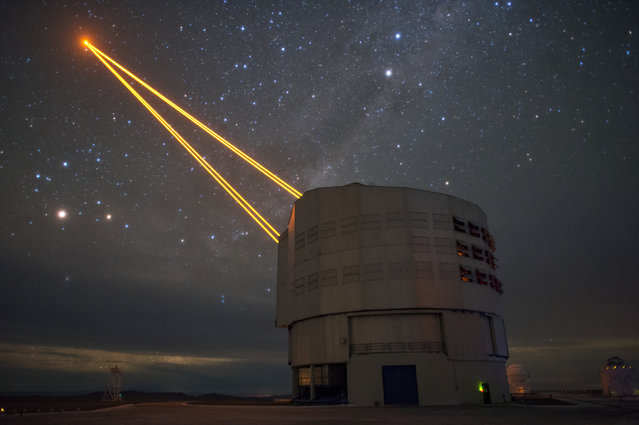
Four pillars of light from the 4 Laser Guide Star Facility on ESO's Very Large Telescope (VLT) are shown reaching into the Chilean night sky in this image from ESO Photo Ambassador Fred Kamphues, on September 2, 2016. The lasers are a key part of the adaptive optics system on the VLT. Adaptive optics allows astronomers to drastically reduce the atmospheric distortion present at even the best sites in the world for astronomy, including Paranal in Chile, the home of the VLT. (Photo by F. Kamphues/ESO)

Four pillars of light from the 4 Laser Guide Star Facility on ESO's Very Large Telescope (VLT) are shown reaching into the Chilean night sky in this image from ESO Photo Ambassador Fred Kamphues, on September 2, 2016. The lasers are a key part of the adaptive optics system on the VLT. Adaptive optics allows astronomers to drastically reduce the atmospheric distortion present at even the best sites in the world for astronomy, including Paranal in Chile, the home of the VLT. (Photo by F. Kamphues/ESO)
Details
23 Feb 2017 00:06:00
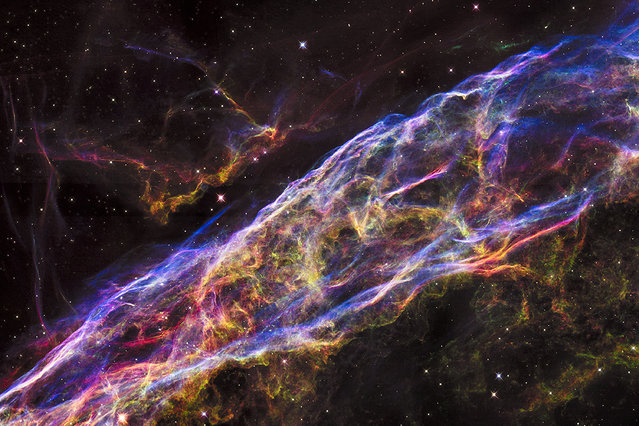
A small section of the expanding remains of the Veil Nebula, a massive star that exploded about 8,000 years ago. The entire nebula is 110 light-years across, covering six full moons on the sky as seen from Earth, and resides about 2,100 light-years away in the constellation Cygnus, the Swan. Image taken by NASA's Hubble Space Telescope. Released September 24, 2015. (Photo by Reuters/NASA/ESA/Hubble Heritage Team)

A small section of the expanding remains of the Veil Nebula, a massive star that exploded about 8,000 years ago. The entire nebula is 110 light-years across, covering six full moons on the sky as seen from Earth, and resides about 2,100 light-years away in the constellation Cygnus, the Swan. Image taken by NASA's Hubble Space Telescope. Released September 24, 2015. (Photo by Reuters/NASA/ESA/Hubble Heritage Team)
Details
10 Dec 2015 08:01:00
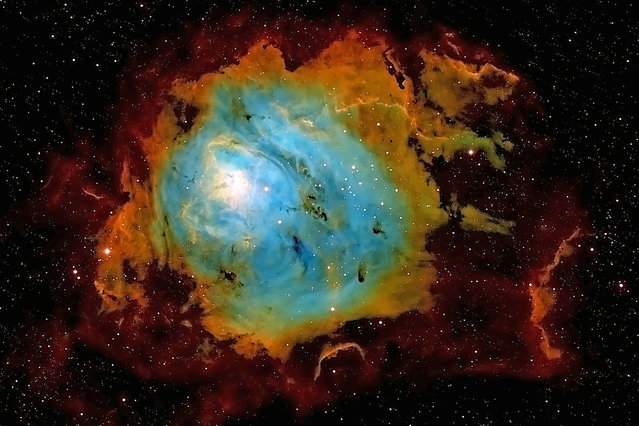
Lagoon Master. These amazing pictures of nebula thousands of light years from Earth have been captured by an amateur astronomer Dr. Dennis Roscoe snapped the beautiful celestial formations from his own personal observatory. His telescope looks into deep space at the nebula, which show both the birth and death of stars, like our very own Sun. (Photo by Dennis Roscoe/Caters News)

Lagoon Master. These amazing pictures of nebula thousands of light years from Earth have been captured by an amateur astronomer Dr. Dennis Roscoe snapped the beautiful celestial formations from his own personal observatory. His telescope looks into deep space at the nebula, which show both the birth and death of stars, like our very own Sun. (Photo by Dennis Roscoe/Caters News)
Details
23 Sep 2014 13:12:00
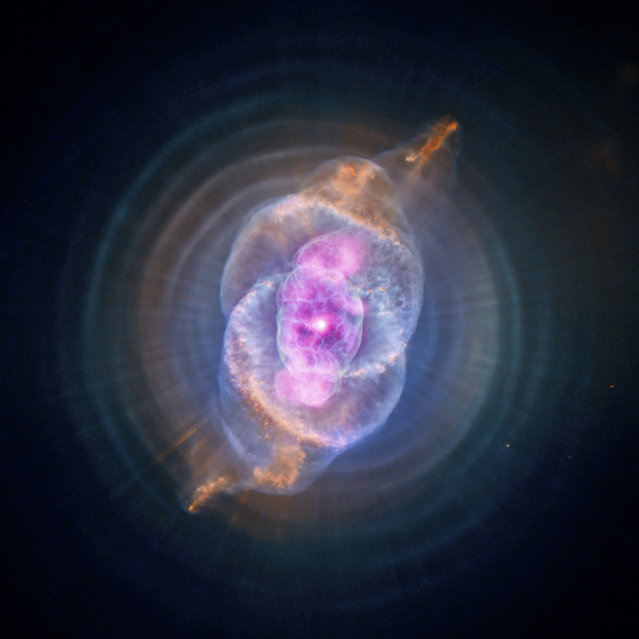
This image is NGC 6543 known as the Cat's Eye Nebula as it appears to the Chandra X-Ray Observatory and Hubble Telescope. A planetary nebula is a phase of stellar evolution that the sun should experience several billion years from now, when it expands to become a red giant and then sheds most of its outer layers, leaving behind a hot core that contracts to form a dense white dwarf star. This image was released October 10, 2012. (Photo by J. Kastner/NASA/CXC/RIT)

This image is NGC 6543 known as the Cat's Eye Nebula as it appears to the Chandra X-Ray Observatory and Hubble Telescope. A planetary nebula is a phase of stellar evolution that the sun should experience several billion years from now, when it expands to become a red giant and then sheds most of its outer layers, leaving behind a hot core that contracts to form a dense white dwarf star. This image was released October 10, 2012. (Photo by J. Kastner/NASA/CXC/RIT)
Details
15 Apr 2013 10:09:00


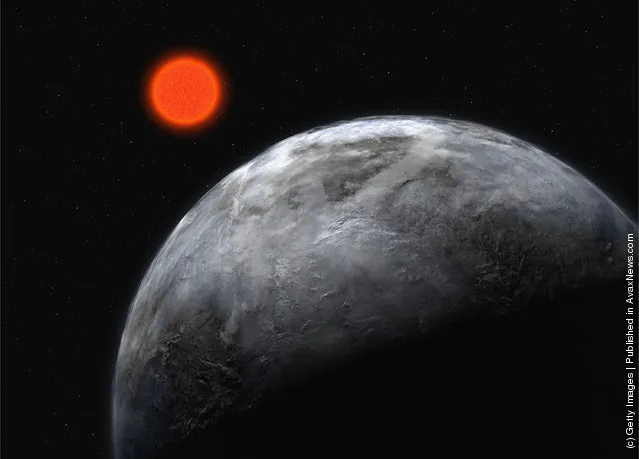
In this artist's impression supplied by the ESO (European Southern Observatory) on April 25, 2007, the planetary system around the red dwarf, Gliese 581, is pictured showing what astronomers believe is the most earth like planet found outside our solar system to date. Using the ESO 3.6-m telescope in Chile, astronomers have uncovered the planet which could have water running on its surface. The planet orbits the faint star Gliese 581, which is 20.5 light-years away in the constellation Libra. (Photo by ESO via Getty Images)
Details
12 Apr 2011 11:00:00
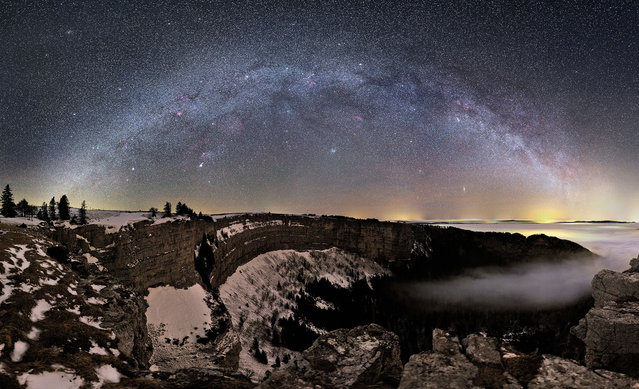
Milky Way over Switzerland

Milky Way over Switzerland

The Milky Way is the galaxy in which Earth is contained. This name derives from its appearance as a dim “milky” glowing band arching across the night sky, in which the naked eye cannot distinguish individual stars. The term “Milky Way” is a translation of the Classical Latin via lactea, from the Hellenistic Greek γαλαξίας κύκλος (pr. galaxías kýklos, “milky circle”). The Milky Way appears like a band because it is a disk-shaped structure being viewed from inside. The fact that this faint band of light is made up of stars was proven in 1610 when Galileo Galilei used his telescope to resolve it into individual stars. In the 1920s, observations by astronomer Edwin Hubble showed that the Milky Way is just one of many galaxies.


Details
20 Jun 2012 10:11:00


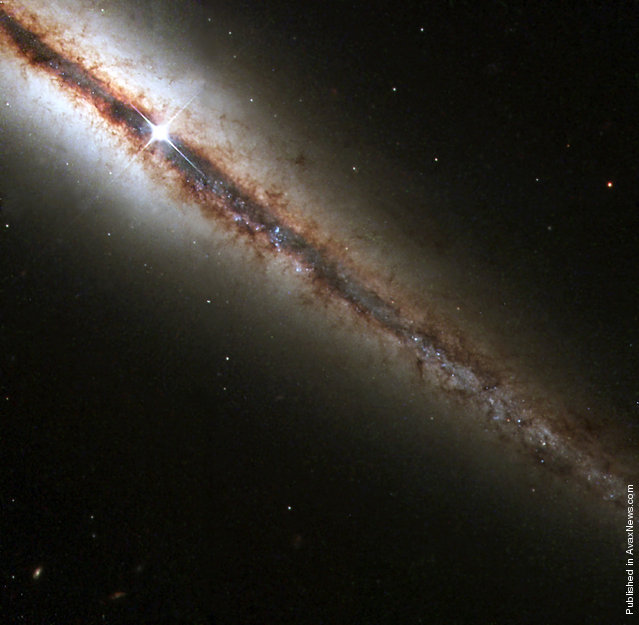
An image produced by the Hubble telescope of the perfectly “edge-on” galaxy, or NGC 4013, March 1, 2001. This new Hubble picture reveals, with great detail, huge clouds of dust and gas extending along, as well as far above, the galaxy's main disk. NGC 4013 is a spiral galaxy, similar to the Milky Way, lying some 55 million light-years from Earth in the direction of the constellation Ursa Major. Viewed face-on, it would look like a nearly circular pinwheel, but NGC 4013 happens to be seen edge-on from our vantage point. Even at 55 million light-years, the galaxy is larger than Hubble's field of view, and the image shows only a little more than half of the object, albeit with unprecedented detail. (Photo Courtesy of NASA/Newsmakers)
Details
28 Feb 2015 22:33:00
British actress Laila Rouass poses during a studio shoot ahead of the new series of “Footballers Wives” at a London studio on January 28, 2004 in London. Rouass plays Conrad's bisexual wife Amber, and the nine-part series begins on ITV1 on February 11, 2004. (Photo by Stephen Perry/Getty Images)

British actress Laila Rouass poses during a studio shoot ahead of the new series of “Footballers Wives” at a London studio on January 28, 2004 in London. Rouass plays Conrad's bisexual wife Amber, and the nine-part series begins on ITV1 on February 11, 2004. (Photo by Stephen Perry/Getty Images)
Details
31 Oct 2024 03:20:00