Loading...
Done
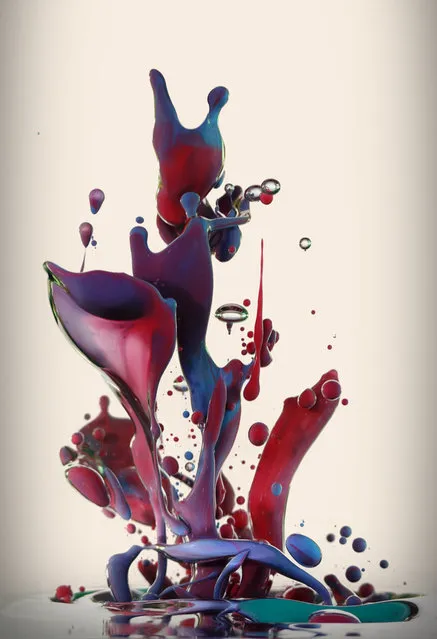
“Dropping” – Artist uses high-speed photography to capture the beauty of ink and oil. (Photo by Alberto Seveso)

“Dropping” is the work of Italian graphic artist Alberto Seveso. Seveso captured these amazing images or “fluid sculpture” with the use of high-speed photography while mixing ink with oil, as a tribute to the dripping technique of Jackson Pollock. Seveso works from his home town of Portoscuso, Italy creating cutting edge imagery for ad campaigns for companies such as Adobe, Sony, ESPN, Nikon and more. Sevese says of his work: “I don't consider myself as an artist, I'm just someone playing with software and creativity”... (Photo by Alberto Seveso)
Details
05 Jun 2015 08:17:00
Photo Project Of Eric Johansson

Erik Johansson is a Swedish photographer and professional retouch artist who likes to create breathtaking photo manipulations from his photographs by using his creative ideas. Photo manipulation or Photoshopping, as most of people know it, is the application of image editing techniques used by professionals as well as amateurs. Today, there are large numbers of numerous photo editing software available in the market. Erik Johansson graduated with a degree in computer engineering, but his passion is photography and he wonderfully mixed photography with creative Photoshopping. You can see in the images below that how beautifully he has created different moments from various fields of life. Erik Johansson lives and work in Berlin, Germany.
Details
21 Feb 2013 10:40:00
Undercats By Sebastian Magnani

They might look like something straight out of a horror film, but these extraordinary images have been created to show the special bond between cats and their owners. Photographer Sebastian Magnani, 28, from Brig, Switzerland, took pictures of dogs and their owners using the same position and camera settings before working his magic with editing software. The result is this startling set of images, which show the pooches with human clothes – one wearing a hoodie, another with a red coat, one with a shirt and cardigan, and another with a blue jacket. (Photos by Sebastian Magnani)
Details
20 May 2015 10:33:00
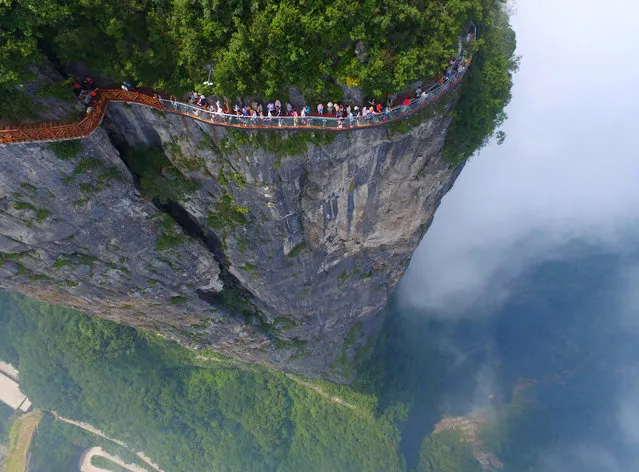
People walk on a sightseeing platform in Zhangjiajie, Hunan Province, China, August 1, 2016. (Photo by Reuters/Stringer)

People walk on a sightseeing platform in Zhangjiajie, Hunan Province, China, August 1, 2016. China has opened a 100-metre-long glass skywalk stretching around a cliff on the side of the Tianmen Mountain. The skywalk provides a view of a 300-metre drop and overlooks Tongtian Avenue, a mountain road with 99 turns that snakes up the mountain. When translated in English, it means “Avenue to the Sky”. (Photo by Reuters/Stringer)
Details
04 Aug 2016 10:39:00
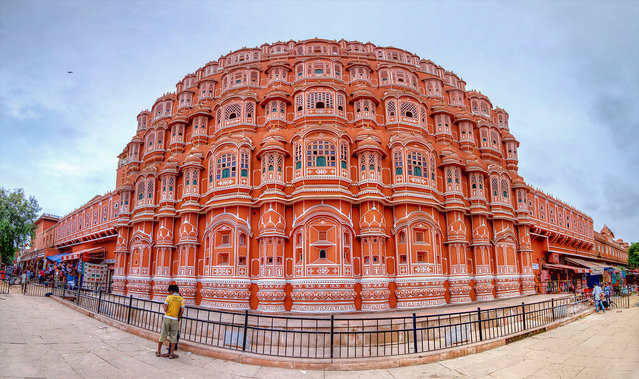
Hawa Mahal India

Hawa Mahal, which translates as the Palace of Winds, was built in 1799 by Maharaja Sawai Pratap Singh. The design of the palace was created by Shreyansh Jain to resemble the crown of Krishna. The design of this unique five-story building is akin to a honeycomb. The main purpose of this building was to allow royal ladies to watch the street below while remaining unseen, since during those times they had a strict code of dressing, which meant covering their faces. The palace was designed to produce the Venturi effect, which created natural air conditioning and kept the interior relatively cool during hot summers.
Details
22 Nov 2014 13:22:00
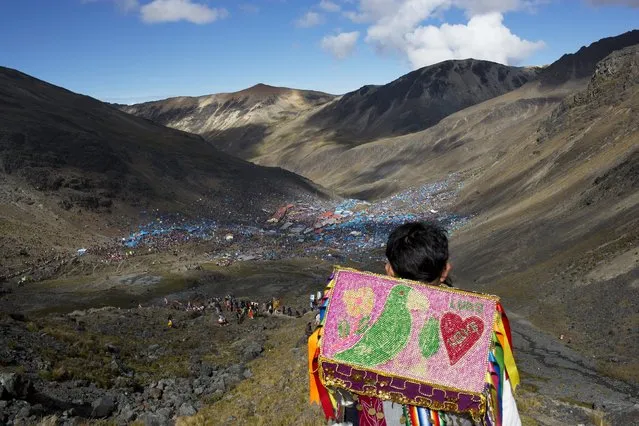
In this May 24, 2016 photo, a young boy descends the Qullqip'unqu mountain looking out at the tens of thousands of pilgrims gathered to celebrate the three-day festival Qoyllur Rit’i, translated from the Quechua language as Snow Star, in the Andean Sinakara Valley, in Peru's Cusco region. The celebration that mixes Catholic and indigenous beliefs honors Jesus as well as the area’s glacier, which is considered sacred among some indigenous people. While the native celebration is far older, the Christian part of the ritual stretches back to the 1700s, when Jesus is said to have appeared to a young shepherd in the form of another boy. (Photo by Rodrigo Abd/AP Photo)

In this May 24, 2016 photo, a young boy descends the Qullqip'unqu mountain looking out at the tens of thousands of pilgrims gathered to celebrate the three-day festival Qoyllur Rit’i, translated from the Quechua language as Snow Star, in the Andean Sinakara Valley, in Peru's Cusco region. The celebration that mixes Catholic and indigenous beliefs honors Jesus as well as the area’s glacier, which is considered sacred among some indigenous people. While the native celebration is far older, the Christian part of the ritual stretches back to the 1700s, when Jesus is said to have appeared to a young shepherd in the form of another boy. (Photo by Rodrigo Abd/AP Photo)
Details
04 Jun 2016 11:52:00
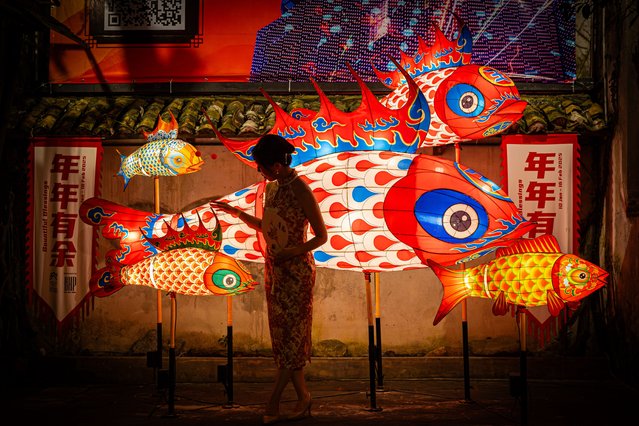
A woman dressed in a cheongsam interacts gracefully with vibrant fish lanterns at Kwai Chai Hong, a heritage revival alley in Chinatown, on January 09, 2025, in Kuala Lumpur, Malaysia. Kwai Chai Hong celebrates the Lunar New Year with an immersive art installation titled Bountiful Blessings, inspired by the idiom “Nian Nian You Yu”, which translates to “Wishing an Abundance Year After Year”, blending traditional fish lanterns with modern lights to inspire abundance and prosperity, inviting visitors to embark on a cultural journey of generosity and abundance for future generations. (Photo by Annice Lyn/Getty Images)

A woman dressed in a cheongsam interacts gracefully with vibrant fish lanterns at Kwai Chai Hong, a heritage revival alley in Chinatown, on January 09, 2025, in Kuala Lumpur, Malaysia. Kwai Chai Hong celebrates the Lunar New Year with an immersive art installation titled Bountiful Blessings, inspired by the idiom “Nian Nian You Yu”, which translates to “Wishing an Abundance Year After Year”, blending traditional fish lanterns with modern lights to inspire abundance and prosperity, inviting visitors to embark on a cultural journey of generosity and abundance for future generations. (Photo by Annice Lyn/Getty Images)
Details
12 Feb 2025 03:54:00
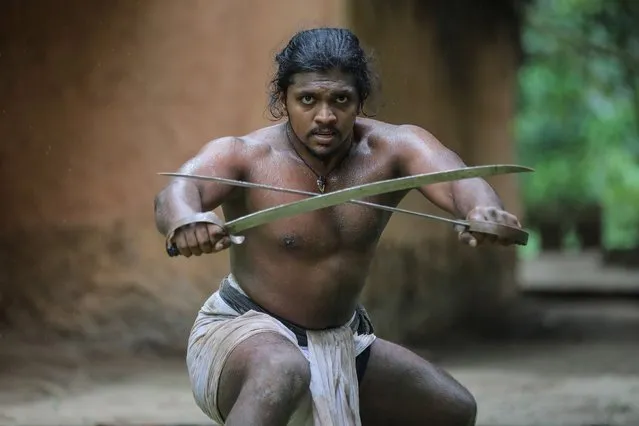
A student of the Sri Lankan ancient martial art “Angampora” performs during a practice session at the angam maduwa or fighting field, in Korathota, a suburb of Colombo, Sri Lanka, 07 September 2022. Sri Lanka's ancient martial art, Angampora, is thought to be thousands of years old. Anga translates to “body parts” and Angampora is a fighting art that uses body parts. Martial arts practitioners in Angampora were mostly in the king's service, and they were tasked with protecting the king and his kingdom. Angampora was practiced in secret for most centuries because the British, who colonized Sri Lanka, banned it in 1818 after seeing it as a threat. (Photo by Chamila Karunarathne/EPA/EFE)

A student of the Sri Lankan ancient martial art “Angampora” performs during a practice session at the angam maduwa or fighting field, in Korathota, a suburb of Colombo, Sri Lanka, 07 September 2022. Sri Lanka's ancient martial art, Angampora, is thought to be thousands of years old. Anga translates to “body parts” and Angampora is a fighting art that uses body parts. Martial arts practitioners in Angampora were mostly in the king's service, and they were tasked with protecting the king and his kingdom. Angampora was practiced in secret for most centuries because the British, who colonized Sri Lanka, banned it in 1818 after seeing it as a threat. (Photo by Chamila Karunarathne/EPA/EFE)
Details
14 Oct 2022 04:47:00