Loading...
Done
Batman Hotel In Taiwan

If you are a big Batman fan with some extra frequent flier miles and cash to burn, you might want to consider staying in this amazing Batman themed hotel room! The bat cave themed hotel room goes for $50 per 3 hour stay. For that price, you not only get to stay in the coolest hotel room of all time, but you get lubrication, s*xy lingerie and other perks. Other than the price, the other downside is that you have to fly to Kaohsiung City in Taiwan to stay there. If I am ever in that part of the world, I will definitely be staying in that room, even if I am not a huge Batman fan.
Details
21 May 2014 13:56:00
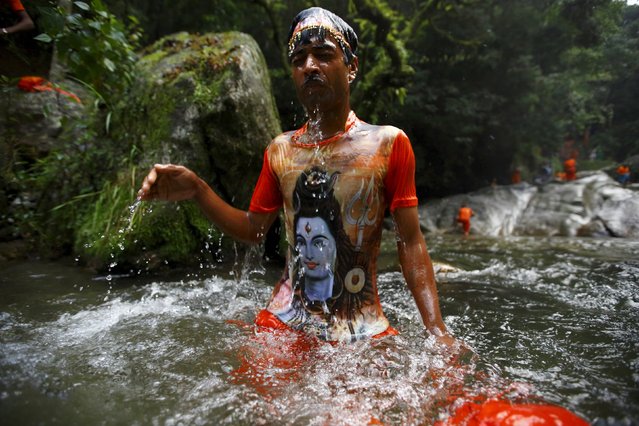
A Hindu devotee wearing a t-shirt printed with a portrait of Lord Shiva takes a holy dip while participating in the “Bol Bom” pilgrimage in Kathmandu August 10, 2015. (Photo by Navesh Chitrakar/Reuters)

A Hindu devotee wearing a t-shirt printed with a portrait of Lord Shiva takes a holy dip while participating in the “Bol Bom” pilgrimage in Kathmandu August 10, 2015. The faithful, chanting the name of Lord Shiva, run about 15 km (9 miles) barefooted toward Pashupatinath temple seeking good health, wealth and happiness. (Photo by Navesh Chitrakar/Reuters)
Details
11 Aug 2015 13:34:00
Portrait of a girl from the neuropsychiatric boarding facility for girls. (Photo by Anastasia Rudenko)

“Elat’ma, the Ryazan Oblast region of Russia. This small town is only 300 kilometers (186 miles) from modern Moscow but remains 60 years in the past, dominated by the spirit of socialism. The air of the communist ‘50s can be seen in the town’s architecture, celebrations and other occurrences. But neither its beauty nor its ties to a socialist past brought photographer Anastasia Rudenko to this village. Elat’ma is unique in that it functions as a town for mentally disabled people”. – Michelle Cohan via CNN. (Photo by Anastasia Rudenko)
Details
09 Sep 2014 08:20:00
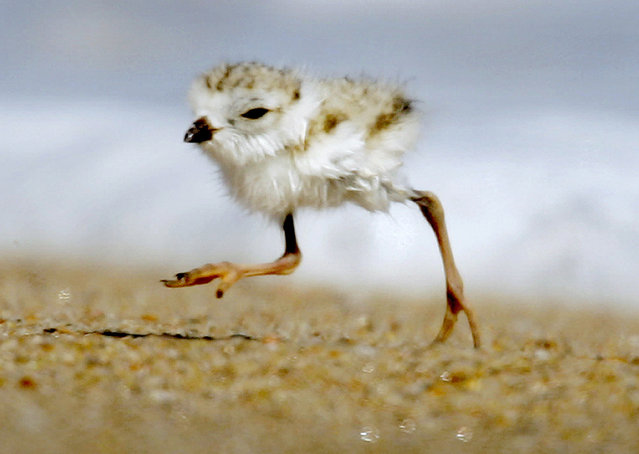
In this July 12, 2007 file photo, a two-day-old piping plover runs along a beach in the Quonochontaug Conservation Area in Westerly, R.I. A court fight to protect the piping plover, a bird listed as “threatened” under the federal Endangered Species Act, is holding up a $207 million plan to replenish sand along a 19-mile stretch of shoreline on New York's Fire Island. The sand was eroded during Superstorm Sandy. (Photo by Steven Senne/AP Photo)

In this July 12, 2007 file photo, a two-day-old piping plover runs along a beach in the Quonochontaug Conservation Area in Westerly, R.I. (Photo by Steven Senne/AP Photo)
Details
25 Nov 2014 11:28:00
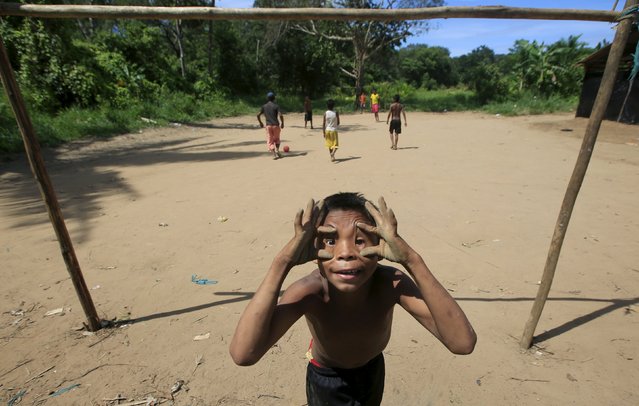
A Colombian Nukak Maku Indian boy gestures in a refugee camp at Agua Bonita near San Jose del Guaviare of Guaviare province September 3, 2015. (Photo by John Vizcaino/Reuters)

A Colombian Nukak Maku Indian boy gestures in a refugee camp at Agua Bonita near San Jose del Guaviare of Guaviare province September 3, 2015. Since emerging from the jungle in 2005, half naked and carrying blowpipes, the Nukak have lived in settlements near the frontier town of San Jose del Guaviare, a humid outpost in the Amazon 400 km (250 miles) southeast of the capital Bogota. (Photo by John Vizcaino/Reuters)
Details
03 Oct 2015 08:01:00
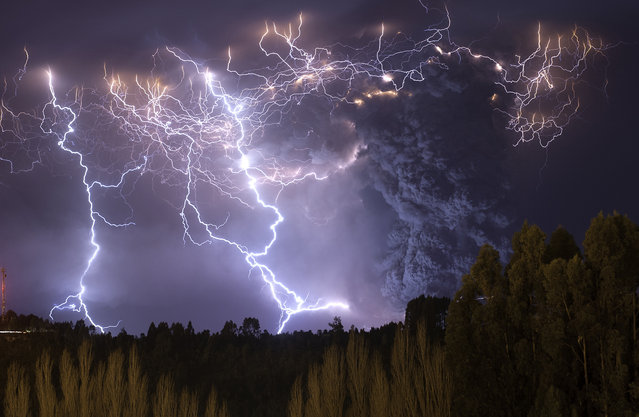
The eruption of Cordon Caulle began on June 4, 2011, located in the Region of Los Rios in Chile. For about 12 months, people and animals became accustomed to living with the daily fall of ash, which also caused problems in the air traffic in South America. The explosions and lightning during first days of the eruption could be seen from hundreds of miles around. This photograph was taken on the second night of eruption from the town of Lago Ranco. (Photo and caption by Francisco Negroni/National Geographic Traveler Photo Contest)

The eruption of Cordon Caulle began on June 4, 2011, located in the Region of Los Rios in Chile. For about 12 months, people and animals became accustomed to living with the daily fall of ash, which also caused problems in the air traffic in South America. The explosions and lightning during first days of the eruption could be seen from hundreds of miles around. This photograph was taken on the second night of eruption from the town of Lago Ranco. (Photo and caption by Francisco Negroni/National Geographic Traveler Photo Contest)

ATTENTION! All pictures are presented in high resolution. To see Hi-Res images – just TWICE click on any picture. In other words, click small picture – opens the BIG picture. Click BIG picture – opens VERY BIG picture.
Details
23 Jun 2013 11:24:00
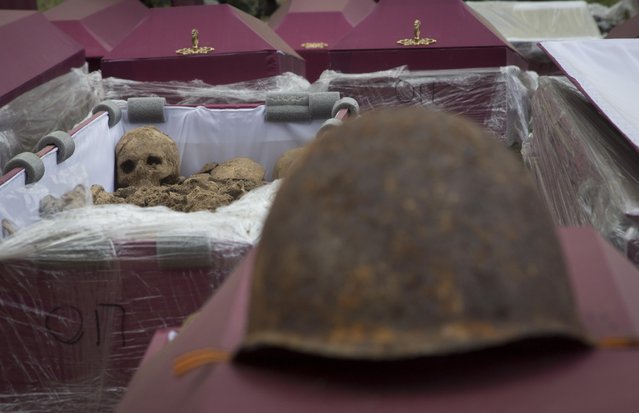
In this photo taken Thursday, May 7, 2015 photo,  remains of Soviet soldiers killed during World War II lay in a coffin prior to a reburial ceremony at the Sinyavino Heights memorial near the village of Sinyavino, 50 km (31 miles) east of  St. Petersburg, Russia. Hundreds of people came to a World War II battleground outside St. Petersburg this week to bury the remains of 964 Soviet soldiers recovered by volunteer search teams. (Photo by Dmitry Lovetsky/AP Photo)

In this photo taken Thursday, May 7, 2015 photo, remains of Soviet soldiers killed during World War II lay in a coffin prior to a reburial ceremony at the Sinyavino Heights memorial near the village of Sinyavino, 50 km (31 miles) east of St. Petersburg, Russia. Hundreds of people came to a World War II battleground outside St. Petersburg this week to bury the remains of 964 Soviet soldiers recovered by volunteer search teams. Fifty crimson coffins containing skulls and bones were solemnly buried at the Sinyavino Heights memorial as Russian war songs played and an honor guard fired a salute. (Photo by Dmitry Lovetsky/AP Photo)
Details
10 May 2015 11:12:00
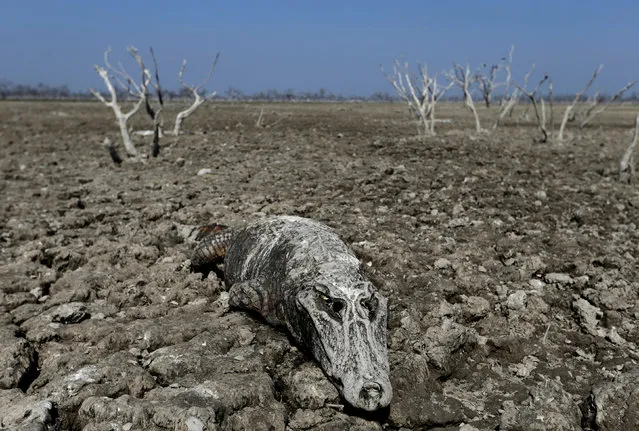
The carcass of a yacare caiman lies in the dried-up river bed of the Pilcomayo river in Boqueron, Paraguay, August 14, 2016. In Paraguay, alongside the Pilcomayo River, black vultures flew over a shrinking pond where a group of crocodilian reptiles known as yacare caimans sought refuge. Water from the river, which divides Paraguay and Argentina in the area of the Gran Chaco, was scarce. This is not an uncommon sight in the region of General Diaz, about 700 kilometres (435 miles) northwest of the country's capital Asuncion, where the Pilcomayo's waters form lakes and streams that give life to capybaras, birds and caimans. “The river's situation is critical. No water is forecast to enter the basin until December, as happens every year”, said Alcides Gonzalez, a resident of the area. (Photo by Jorge Adorno/Reuters)

The carcass of a yacare caiman lies in the dried-up river bed of the Pilcomayo river in Boqueron, Paraguay, August 14, 2016. In Paraguay, alongside the Pilcomayo River, black vultures flew over a shrinking pond where a group of crocodilian reptiles known as yacare caimans sought refuge. Water from the river, which divides Paraguay and Argentina in the area of the Gran Chaco, was scarce. This is not an uncommon sight in the region of General Diaz, about 700 kilometres (435 miles) northwest of the country's capital Asuncion, where the Pilcomayo's waters form lakes and streams that give life to capybaras, birds and caimans. (Photo by Jorge Adorno/Reuters)
Details
03 Nov 2016 12:40:00