Loading...
Done
Fireworks light the sky over Copacabana beach during New Year's Eve celebrations in Rio de Janeiro, Brazil, Thursday, January 1, 2016. (Photo by Mauro Pimentel/AP Photo)

Fireworks light the sky over Copacabana beach during New Year's Eve celebrations in Rio de Janeiro, Brazil, Thursday, January 1, 2016. (Photo by Mauro Pimentel/AP Photo)
Details
02 Jan 2016 08:02:00
A woman toes a tube carrying a man during the Ice and snow carnival at Taoranting park in Beijing, China, January 25, 2016. (Photo by Kim Kyung-Hoon/Reuters)

A woman toes a tube carrying a man during the Ice and snow carnival at Taoranting park in Beijing, China, January 25, 2016. (Photo by Kim Kyung-Hoon/Reuters)
Details
26 Jan 2016 12:39:00
A participant poses backstage before a drag queen competition during carnival festivities in Las Palmas on the Spanish Canary Island of Gran Canaria February 20, 2015. (Photo by Borja Suarez/Reuters)

A participant poses backstage before a drag queen competition during carnival festivities in Las Palmas on the Spanish Canary Island of Gran Canaria February 20, 2015. (Photo by Borja Suarez/Reuters)
Details
22 Feb 2015 10:39:00
A woman visits the mirror installation “Mar de Espelhos” (Sea of Mirrors) ahead of its opening in Rio de Janeiro, Brazil on June 13, 2023. (Photo by Ricardo Moraes/Reuters)

A woman visits the mirror installation “Mar de Espelhos” (Sea of Mirrors) ahead of its opening in Rio de Janeiro, Brazil on June 13, 2023. (Photo by Ricardo Moraes/Reuters)
Details
21 Jul 2023 03:26:00
A farmer harvests tobacco leaves at a plantation in the valley of Vinales, in the western Cuban province of Pinar del Rio, January 27, 2015. (Photo by Pilar Olivares/Reuters)

A farmer harvests tobacco leaves at a plantation in the valley of Vinales, in the western Cuban province of Pinar del Rio, January 27, 2015. (Photo by Pilar Olivares/Reuters)
Details
25 Feb 2015 09:21:00
A drone view shows vehicles in the area affected by the floods, in Encantado, Rio Grande do Sul state, Brazil, on May 3, 2024. (Photo by Diego Vara/Reuters)

A drone view shows vehicles in the area affected by the floods, in Encantado, Rio Grande do Sul state, Brazil, on May 3, 2024. (Photo by Diego Vara/Reuters)
Details
23 May 2024 05:27:00
Revelers look at a cellphone during the annual street block party know as “Explode Coracao” on the third day of Carnival on February 19, 2023 in Sao Paulo, Brazil. According to the São Paulo City Council, during Carnival week more than 500 street blocks (blocos de rua) are held and more than 15 million people are expected to participate in them. Created in 2017, Explode Coracao is one of the most popular street blocks and attracted 150,000 revelers in its last edition, before the pandemic, in 2020. (Photo by Alexandre Schneider/Getty Images)


Revelers look at a cellphone during the annual street block party know as “Explode Coracao” on the third day of Carnival on February 19, 2023 in Sao Paulo, Brazil. According to the São Paulo City Council, during Carnival week more than 500 street blocks (blocos de rua) are held and more than 15 million people are expected to participate in them. Created in 2017, Explode Coracao is one of the most popular street blocks and attracted 150,000 revelers in its last edition, before the pandemic, in 2020. (Photo by Alexandre Schneider/Getty Images)

Details
22 Feb 2023 04:58:00
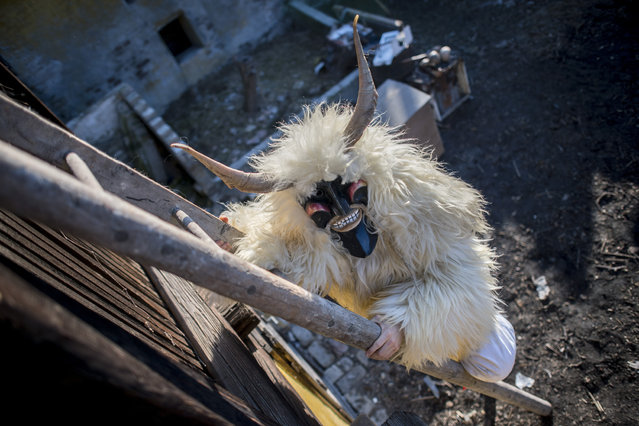
A man wears a busho mask and a costume made of sheep pelt while climbing up a ladder outside a barn in Mohacs, Hungary, 20 February 2020, on the first day of carnival. The traditional Busho carnival, which marks the end of winter, dates back to the 16th century. According to local legend, members of an ethnic South Slavic group living in Mohacs at the time dressed up in similar costumes and wore wooden masks to scare away Ottoman invaders, who mistook them for demons. (Photo by Tamas Soki/EPA/EFE)

A man wears a busho mask and a costume made of sheep pelt while climbing up a ladder outside a barn in Mohacs, Hungary, 20 February 2020, on the first day of carnival. The traditional Busho carnival, which marks the end of winter, dates back to the 16th century. According to local legend, members of an ethnic South Slavic group living in Mohacs at the time dressed up in similar costumes and wore wooden masks to scare away Ottoman invaders, who mistook them for demons. (Photo by Tamas Soki/EPA/EFE)
Details
23 Feb 2020 00:07:00