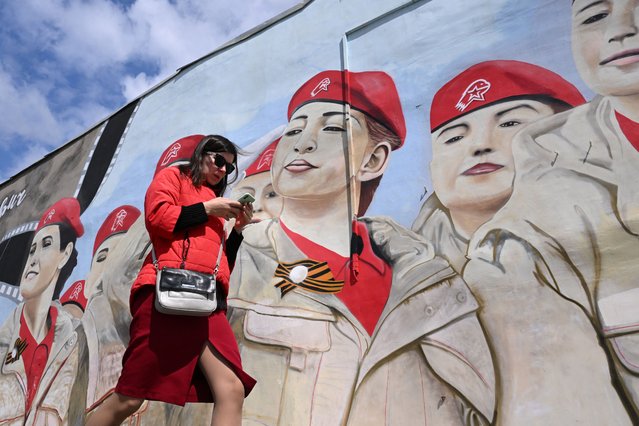
A woman uses her smartphone walking past a mural depicting members of Russia's Yunarmiya (Young Army) youth patriotic movement in Moscow on May 14, 2024. (Photo by Natalia Kolesnikova/AFP Photo)
With Haystack Rock in the background, Julie Amschler, of Springfield, Mo., walks along the beach on Thursday, June 13, 2024, in Cannon Beach, Ore. (Photo by Jenny Kane/AP Photo)
Bradie, a corgi, competes in the dock dive competition during the 147th Westminster Kennel Club Dog show, Saturday, May 6, 2023, at the USTA Billie Jean King National Tennis Center in New York. (Photo by Mary Altaffer/AP Photo)
American rapper Megan Jovon Ruth Pete, known professionally as Megan Thee Stallion promotes a new music video with a topless photo in the first decade of September 2022. (Photo by theestallion/Instagram)
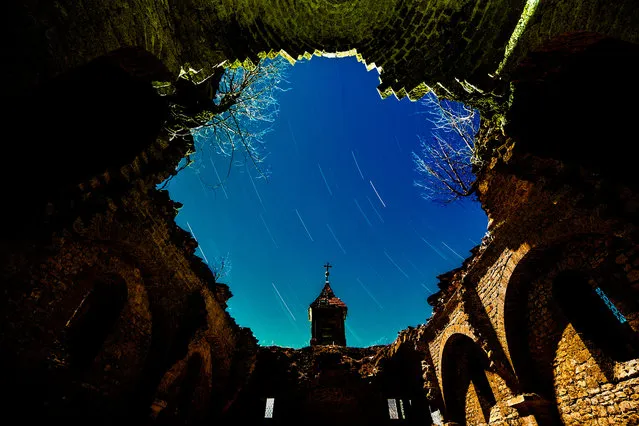
A long exposure image shows star trails from the abandoned submerged orthodox church of St. Nicholas without roof, submerged in the Mavrovo Lake, near Mavrovi Anovi, North Macedonia, 17 March 2019. Constructed in 1850 and submerged in 1952 due to the construction of the hydro system Mavrovo, the church St. Nicholas continues to attract the attention of almost every visitor as it peaks from the water. (Photo by Georgi Licovski/EPA/EFE)
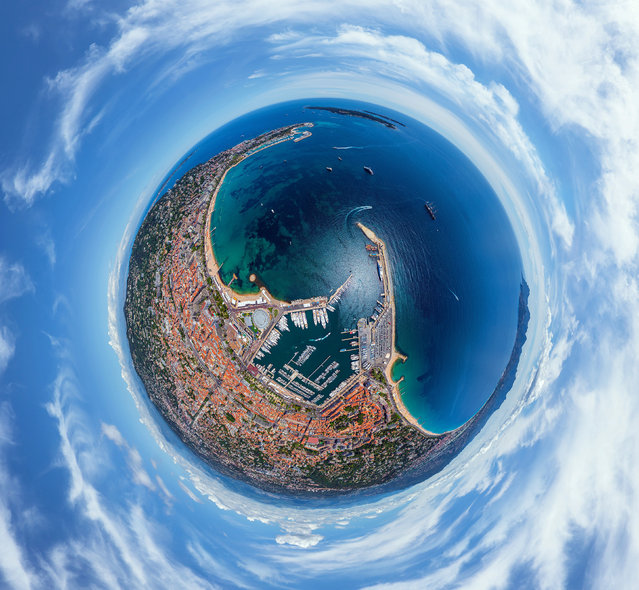
Some of the worlds most iconic cities have been photographed as youve never seen them before in the shape of tiny round planets. By using a pioneering method of aerial photography, each location can be now seen at a full 360 degree angle. After some skilful manipulation on Photoshop known technically as stereographic projection, each sweeping panorama is then turned into a small circular shaped image. Whether its the Eiffel Tower, The Empire State Building or the Shanghai Skyline, each image manages to show hundreds of miles of city landscape. Here: the French Riveria of Cannes, France. (Photo by Airpano/Caters News)
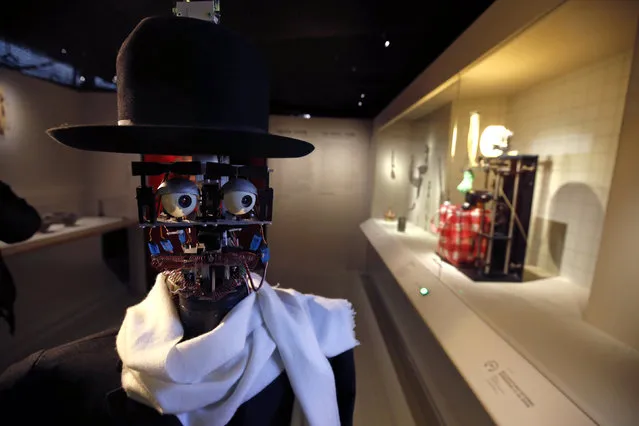
The Berenson robot strolls among visitors during the exhibition “Persona : Oddly Human” at the Quai Branly museum in Paris, France, February 23, 2016. The Berenson robot, developed in France in 2011, is the brainchild of anthropologist Denis Vidal and robotics engineer Philippe Gaussier. Its programming allows it to record reactions of museum visitors to certain pieces of art and then use the data to develop its own unique taste, which allows “Berenson” to judge whether or not it likes a certain work of art within an exhibition. (Photo by Philippe Wojazer/Reuters)