Loading...
Done
Beautiful Photography By Daniel Rericha

Daniel Rericha born in 1972 in the Czech Republic. Living in a small town, located near the mountain ridge, from childhood he was inspired by the mountains and fell in love with them. In his spare time he enjoys traveling with his wife. In these travels, he tries to capture in his lens as many beautiful places. His work is imbued with the spirit through the mountains, air and space.
Details
06 Sep 2015 13:03:00
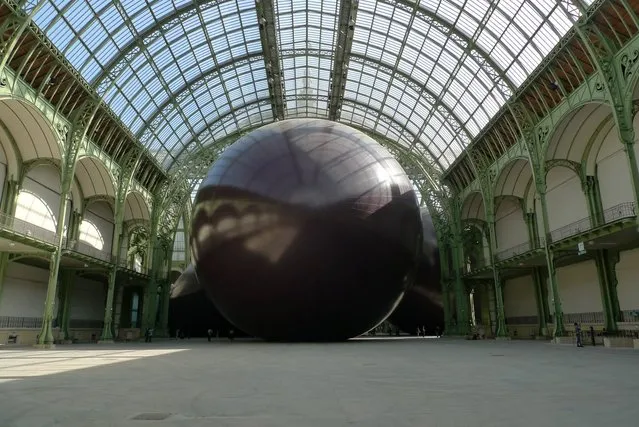
Leviathan By Anish Kapoor

A single object, a single shape, a single colour,' is how Anish Kapoor summed up Leviathan, his response to the Monumenta challenge this year. Radically departing from Christian Boltanski’s busy collage-like approach in Personnes for Monumenta 2010, Kapoor has filled the 13,500 square metre space with a single cavernous entity which surges through the Grand Palais roof.
Details
06 May 2014 13:11:00
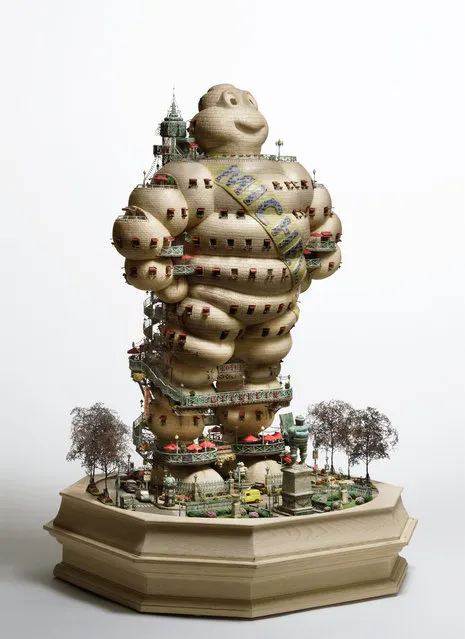
Miniature Architecture By Takanori Aiba

The Japanese art of raising bonsai trees is a beautiful way to infuse greenery into indoor spaces. But artist Takanori Aiba takes the art to a new level with his incredibly intricate series of bonsai castles. The Japanese artist carves miniature masterpieces that weave in and out of the miniature trees, creating cohesive architectural marvels that burst forth with life!
Details
15 Jun 2014 12:38:00
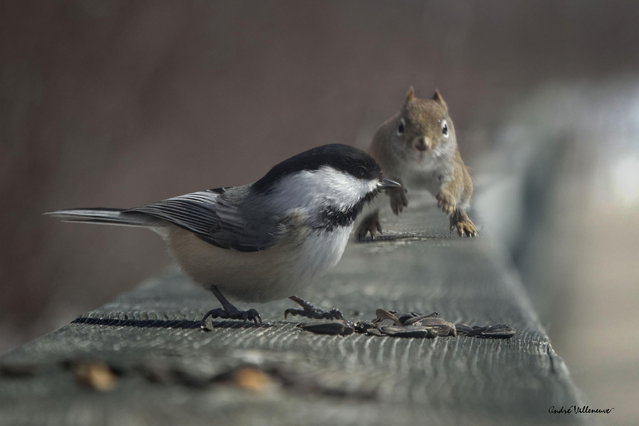
“Eat and run”. (Photo by Andre Villeneuve)

“Self-educated photographer, Quebec. I always impassioned myself for the animal world and natural spaces, in particular for the red squirrels and the titmouses. Having reached sixty and more, I am nothing any more has to prove but all has to show”. – Andre Villeneuve. Photo: “Eat and run”. (Photo by Andre Villeneuve)
Details
10 Apr 2014 09:59:00
The National Geographic Photo Ark is a travelling exhibition of photographer Joel Sartore’s quest to create a photo archive of biodiversity around the world. So far, Sartore has captured studio portraits of more than 6,000 species – a number that he hopes to double. On 1 July, the ark will open at Melbourne zoo – the first time it has been exhibited in the southern hemisphere. More than 50 portraits will be on display, including many of Australian endangered animals being protected by programs at the zoo itself. These captions have been edited from text supplied by Melbourne zoo. Here: Barking owl. So-named because its call sounds like a barking dog, these birds are native to Australia, Indonesia and Papua New Guinea. In Victoria they are listed as an endangered species, and in 2003 there were estimated to be fewer than 50 breeding pairs. The main threat to the species in Victoria is loss of habitat, especially large trees with hollows in which they can nest and on which many of their prey depend. Apart from a bark, they may utter a chilling scream when they feel threatened. (Photo by Joel Sartore/National Geographic Photo Ark/The Guardian)

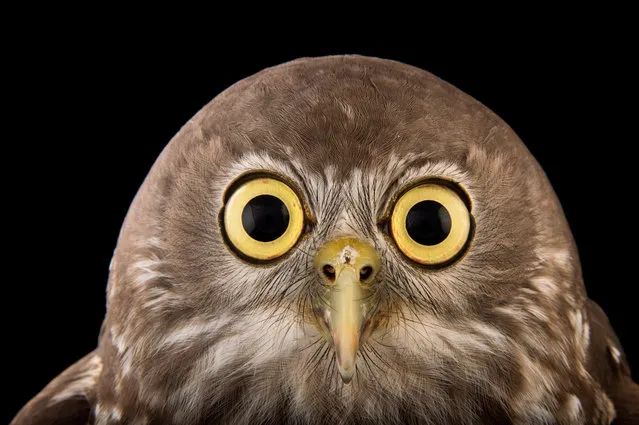
The National Geographic Photo Ark is a travelling exhibition of photographer Joel Sartore’s quest to create a photo archive of biodiversity around the world. So far, Sartore has captured studio portraits of more than 6,000 species – a number that he hopes to double. On 1 July, the ark will open at Melbourne zoo – the first time it has been exhibited in the southern hemisphere. More than 50 portraits will be on display, including many of Australian endangered animals being protected by programs at the zoo itself. These captions have been edited from text supplied by Melbourne zoo. Here: Barking owl. (Photo by Joel Sartore/National Geographic Photo Ark/The Guardian)
Details
01 Jul 2017 07:45:00
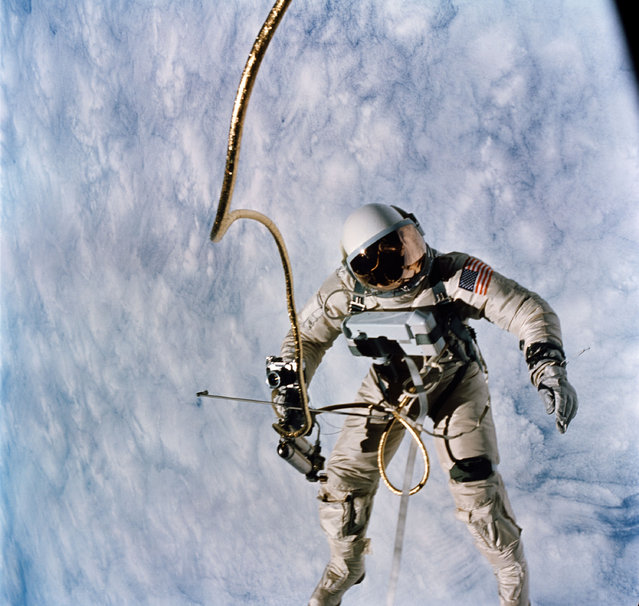
Astronaut Edward H. White II, pilot for the Gemini-Titan 4 (GT-4) spaceflight, floats in the zero-gravity of space during the third revolution of the GT-4 spacecraft on June 3, 1965. White wears a specially designed spacesuit. His face is shaded by a gold-plated visor to protect him from unfiltered rays of the sun. (Photo by NASA)

Astronaut Edward H. White II, pilot for the Gemini-Titan 4 (GT-4) spaceflight, floats in the zero-gravity of space during the third revolution of the GT-4 spacecraft on June 3, 1965. White wears a specially designed spacesuit. His face is shaded by a gold-plated visor to protect him from unfiltered rays of the sun. In his right hand he carries a Hand-Held Self-Maneuvering Unit (HHSMU) that gives him control over his movements in space. White also wears an emergency oxygen chest pack; and he carries a camera mounted on the HHSMU for taking pictures of the sky, Earth and the GT-4 spacecraft. He is secured to the spacecraft by a 25-feet umbilical line and a 23-feet tether line. Both lines are wrapped together in gold tape to form one cord. Astronaut James A. McDivitt, command pilot, remained inside the spacecraft during the extravehicular activity (EVA). Astronaut White died in the Apollo/Saturn 204 fire at Cape Kennedy on January 27, 1967. (Photo by NASA)
Details
22 Jul 2014 12:05:00
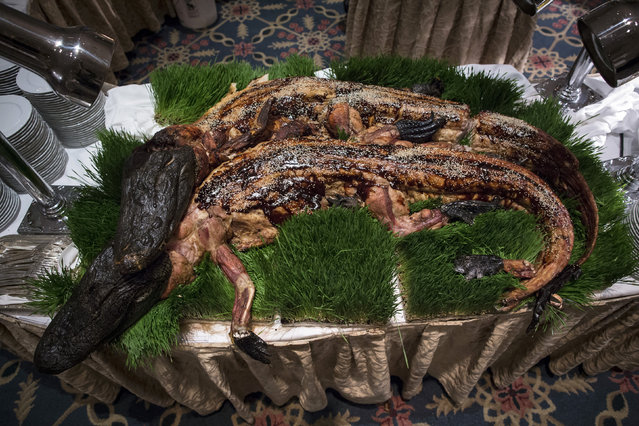
Whole cooked alligators are displayed before being served at the 110th Explorers Club Annual Dinner at the Waldorf Astoria in New York March 15, 2014. The club, which promotes the scientific exploration of land, sea, air and space featured catering by chef and exotic creator Gene Rurka. Chef Rurka prepared a variety of dishes featuring an array of insects, wildlife, animal body parts and invasive species. (Photo by Andrew Kelly/Reuters)

Whole cooked alligators are displayed before being served at the 110th Explorers Club Annual Dinner at the Waldorf Astoria in New York March 15, 2014. The club, which promotes the scientific exploration of land, sea, air and space featured catering by chef and exotic creator Gene Rurka. Chef Rurka prepared a variety of dishes featuring an array of insects, wildlife, animal body parts and invasive species. (Photo by Andrew Kelly/Reuters)
Details
20 Mar 2014 10:03:00
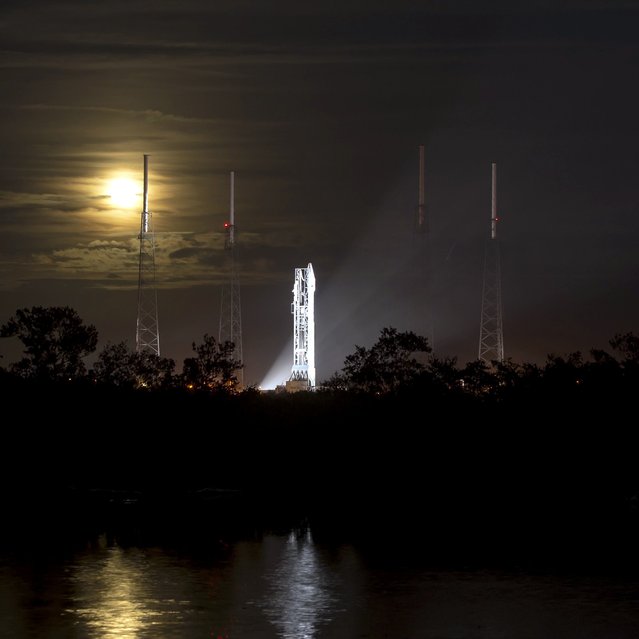
This photo provided by NASA shows a full moon rising behind the United Launch Alliance Atlas V rocket with NASA's Mars Atmosphere and Volatile Evolution (MAVEN) spacecraft onboard at the Cape Canaveral Air Force Station Space Launch Complex 41, Sunday, Nov. 17, 2013, Cape Canaveral, Florida. NASA's next Mars-bound spacecraft, the Mars Atmosphere and Volatile Evolution, or MAVEN, is the first spacecraft devoted to exploring and understanding the Martian upper atmosphere. (AP Photo/NASA, Bill Ingalls)

This photo provided by NASA shows a full moon rising behind the United Launch Alliance Atlas V rocket with NASA's Mars Atmosphere and Volatile Evolution (MAVEN) spacecraft onboard at the Cape Canaveral Air Force Station Space Launch Complex 41, Sunday, November 17, 2013, Cape Canaveral, Florida. NASA's next Mars-bound spacecraft, the Mars Atmosphere and Volatile Evolution, or MAVEN, is the first spacecraft devoted to exploring and understanding the Martian upper atmosphere. (Photo by Bill Ingalls/AP Photo/NASA)
Details
19 Nov 2013 06:42:00