Loading...
Done
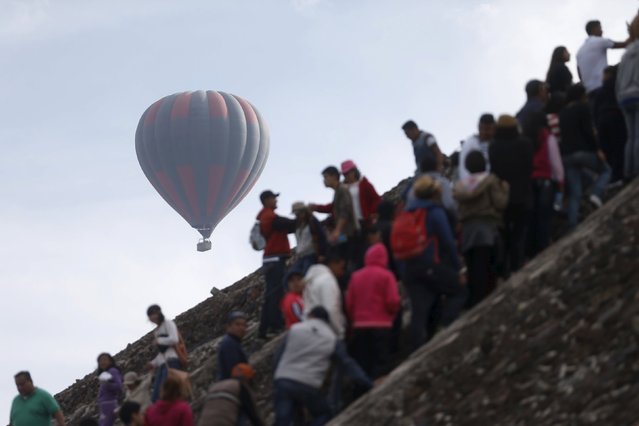
A hot air ball balloon floats past while people stand in line to climb the Pyramid of the Sun and welcome the spring equinox in the pre-hispanic city of Teotihuacan, on the outskirts of Mexico City, Mexico, March 20, 2016. Spring equinox in Teotihuacán is an annual event which takes place around the 20th and 21st of March at the pre-Hispanic site of Teotihuacán, Mexico. This event is mirrored by other similar events in other pre-Hispanic sites such as Chichén Itzá and Malinalco, Mexico State. (Photo by Edgard Garrido/Reuters)

A hot air ball balloon floats past while people stand in line to climb the Pyramid of the Sun and welcome the spring equinox in the pre-hispanic city of Teotihuacan, on the outskirts of Mexico City, Mexico, March 20, 2016. Spring equinox in Teotihuacán is an annual event which takes place around the 20th and 21st of March at the pre-Hispanic site of Teotihuacán, Mexico. This event is mirrored by other similar events in other pre-Hispanic sites such as Chichén Itzá and Malinalco, Mexico State. (Photo by Edgard Garrido/Reuters)
Details
21 Mar 2016 13:01:00
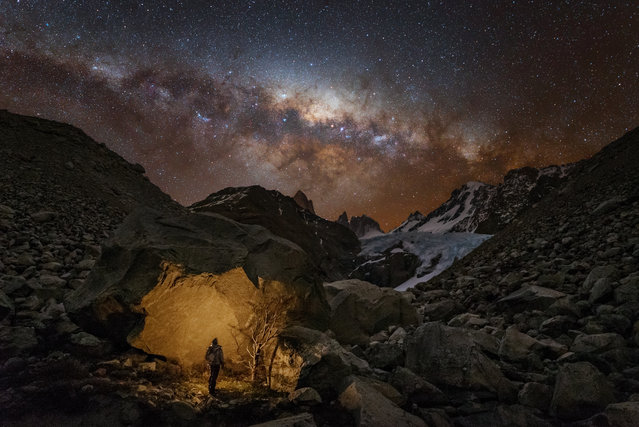
“People and Space”. Winner: Wanderer in Patagonia by Yuri Zvezdny (Russia) A lone stargazer stares up at the stars of our galaxy, the Milky Way, as they stretch across the night sky over the glacier “White Stones” (Piedras Blancas) in the Los Glaciares National Park, Argentina. El Chaltén, Santa Cruz Province, Argentina, 27 September 2016 iOptron Sky-Tracker mount, Sony A7S camera, 18 mm f/2.8 lens, ISO 5000, 30-second exposure Wanderer in Patagonia. (Photo by Yuri Zvezdny/Insight Astronomy Photographer of the Year 2017)

“People and Space”. Winner: Wanderer in Patagonia by Yuri Zvezdny (Russia) A lone stargazer stares up at the stars of our galaxy, the Milky Way, as they stretch across the night sky over the glacier “White Stones” (Piedras Blancas) in the Los Glaciares National Park, Argentina. El Chaltén, Santa Cruz Province, Argentina, 27 September 2016 iOptron Sky-Tracker mount, Sony A7S camera, 18 mm f/2.8 lens, ISO 5000, 30-second exposure Wanderer in Patagonia. (Photo by Yuri Zvezdny/Insight Astronomy Photographer of the Year 2017)
Details
18 Sep 2017 07:09:00
Images created with Post-it notes are seen in the windows of offices at 75 Varick Street in lower Manhattan, New York, U.S., May 18, 2016, where advertising agencies and other companies have started what is being called a “Post-it note art war” with employees creating colorful images in their windows with Post-it notes. (Photo by Mike Segar/Reuters)

Images created with Post-it notes are seen in the windows of offices at 75 Varick Street in lower Manhattan, New York, U.S., May 18, 2016, where advertising agencies and other companies have started what is being called a “Post-it note art war” with employees creating colorful images in their windows with Post-it notes. (Photo by Mike Segar/Reuters)
Details
20 May 2016 13:05:00
Viewing The Earth From Space

Despite any political differences between the United States and Russia, the space agencies of the two countries continue their cooperative work in Earth's orbit, aboard the International Space Station. Apart from the research being done in microgravity, ISS crew members continue to send back amazing images of our home world, photographed from low Earth orbit. Gathered here are recent images of Earth from aboard the ISS, and from a handful of other NASA satellites.
Details
01 Jun 2014 12:36:00
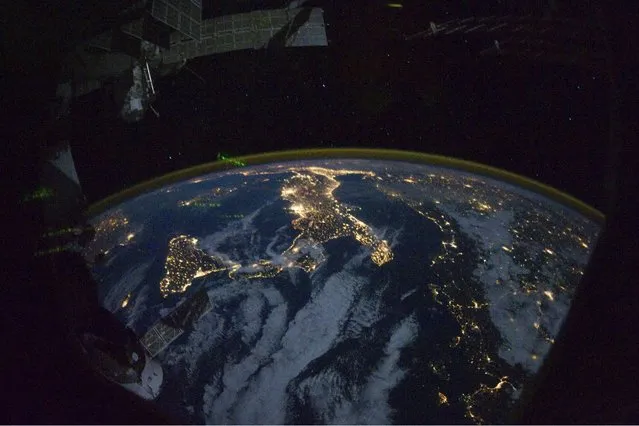
This image provided by NASA shows parts of Europe and Africa very easily recognizable in this night time image shot by one of the Expedition 25 crew members aboard the International Space Station flying 220 miles above Earth on Thursday Oct. 28, 2010. The view “looks” northward over Sicily and the “boot” of Italy, with the Mediterranean Sea representing most of the visible water in the view and the Adriatic Sea to the right of center. Tunisia is partially visible at left. Part of a docked Russian spacecraft and other components of the ISS are in the foreground. (Photo by AP photo/NASA)

This image provided by NASA shows parts of Europe and Africa very easily recognizable in this night time image shot by one of the Expedition 25 crew members aboard the International Space Station flying 220 miles above Earth on Thursday October 28, 2010. The view “looks” northward over Sicily and the “boot” of Italy, with the Mediterranean Sea representing most of the visible water in the view and the Adriatic Sea to the right of center. Tunisia is partially visible at left. Part of a docked Russian spacecraft and other components of the ISS are in the foreground. (Photo by AP Photo/NASA)
Details
11 May 2013 12:29:00
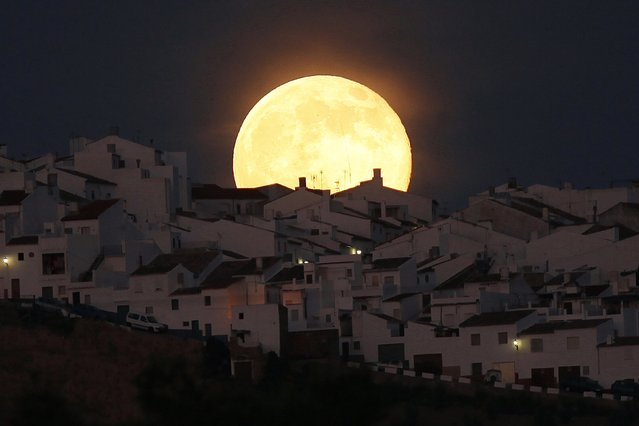
The Supermoon rises over houses in Olvera, in the southern Spanish province of Cadiz, July 12, 2014. Occurring when a full moon or new moon coincides with the closest approach the moon makes to the Earth, the Supermoon results in a larger-than-usual appearance of the lunar disk. (Photo by Jon Nazca/Reuters)

The Supermoon rises over houses in Olvera, in the southern Spanish province of Cadiz, July 12, 2014. Occurring when a full moon or new moon coincides with the closest approach the moon makes to the Earth, the Supermoon results in a larger-than-usual appearance of the lunar disk. (Photo by Jon Nazca/Reuters)
Details
14 Jul 2014 13:03:00
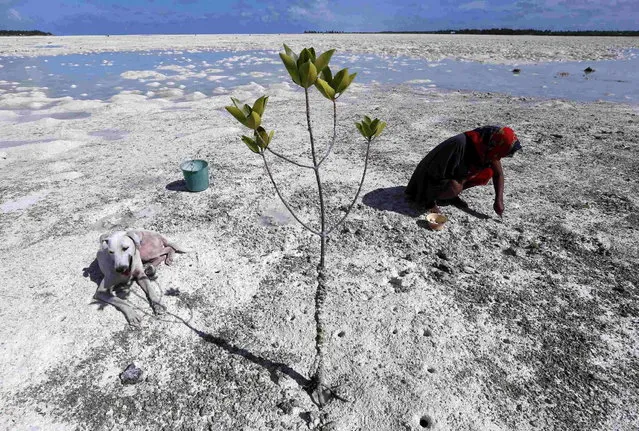
A dog sits in the shade of a mangrove tree as a woman uses a fork to dig for shellfish on the reef-mud flats of a lagoon located at South Tarawa in the central Pacific island nation of Kiribati May 23, 2013. (Photo by David Gray/Reuters)

A dog sits in the shade of a mangrove tree as a woman uses a fork to dig for shellfish on the reef-mud flats of a lagoon located at South Tarawa in the central Pacific island nation of Kiribati May 23, 2013. Kiribati consists of a chain of 33 atolls and islands that stand just metres above sea level, spread over a huge expanse of otherwise empty ocean. With surrounding sea levels rising, Kiribati President Anote Tong has predicted his country will likely become uninhabitable in 30-60 years because of inundation and contamination of its freshwater supplies. (Photo by David Gray/Reuters)
Details
13 Jun 2013 09:23:00
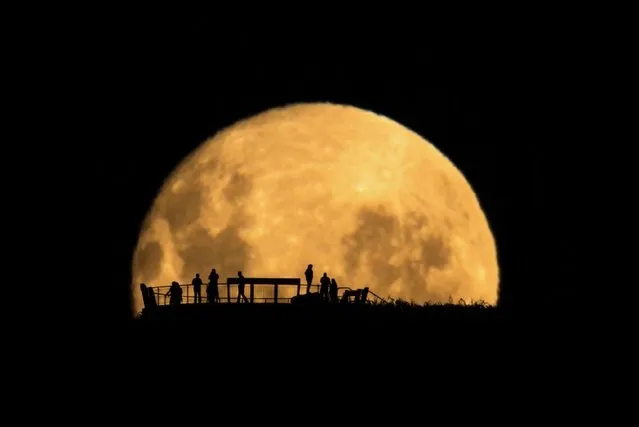
Astronomy Photographer Of The Year 2013 Part1

The Royal Observatory just announced its Astronomy Photographer Of The Year 2013 winners. Australian photographer Mark Gee was chosen among a thousand amateur and professional photographers around the globe to win the top title. His work is part of an exhibition of the winning photographers, which opened on Sept. 19 at the Royal Observatory Greenwich. The Royal Observatory shared with us the winners and notable mentions of the competition. Their descriptions of the prizewinners can be found below the images.
Details
04 Oct 2013 11:45:00