The sun rises over the north sea as The Couple by artist Sean Henery sits just of the coast at Newbiggin-by-the-Sea, England, Wednesday October 8, 2014. (Photo by Owen Humphreys/AP Photo/PA Wire)
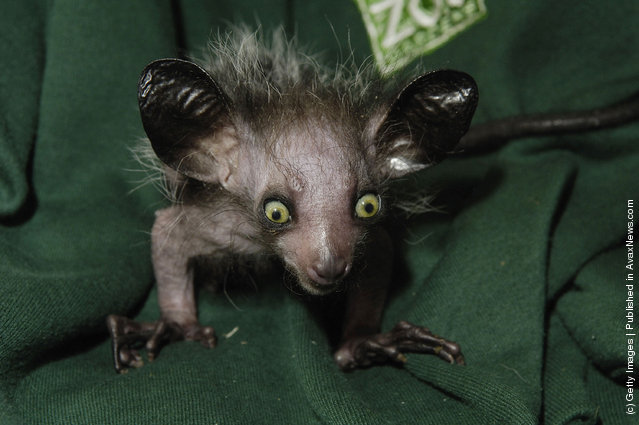
“The aye-aye (Daubentonia madagascariensis) is a lemur, a strepsirrhine primate native to Madagascar that combines rodent-like teeth and a special thin middle finger to fill the same ecological niche as a woodpecker. It is the world's largest nocturnal primate, and is characterized by its unusual method of finding food; it taps on trees to find grubs, then gnaws holes in the wood and inserts its narrow middle finger to pull the grubs out. The only other animal species known to find food in this way is the striped possum. From an ecological point of view the aye-aye fills the niche of a woodpecker as it is capable of penetrating wood to extract the invertebrates within”. – Wikipedia
Photo: In this handout image from Bristol Zoo is seen the first captive bred aye-aye in the UK named “Kintana” (meaning star in Malagasy) April 15, 2005 at Bristol Zoo Gardens, England. The zoo announced today only the second baby aye-aye to be hand-reared in the world (the first was in Jersey Zoo) and has now made his first public appearance since his birth on 11 February 2005. (Photo by Rob Cousins/Bristol Zoo via Getty Images)
An open water swimmer surfaces as she enjoys a socially-distanced dawn swim after breaking the ice on the surface of a lake near Scunthorpe, northern England, January 9, 2021. Faced by a sharp rise in coronavirus infections, driven by the new strain, England entered a strict lockdown on January 5, 2021, with schools and non-essential shops closed for at least six weeks after previous measures failed to halt the steep rise in cases. (Photo by Lindsey Parnaby/AFP Photo)
A man does physical exercise during sunset over the Finnish Gulf coast in St. Petersburg, Russia, Wednesday, April 14, 2021. (Photo by Dmitri Lovetsky/AP Photo)
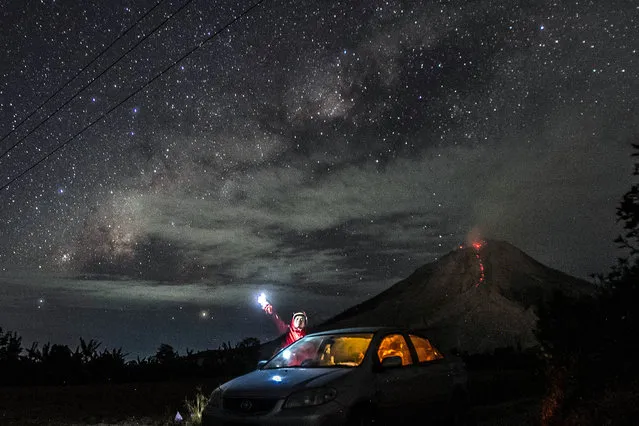
Long Exposure pictures showing Mount Sinabung spewing out hot lava on August 2, 2017 in Karo, Indonesia. Sinabung located in North Sumatra Province roared back to life in 2010 for the first time in 400 years. After another period of inactivity it erupted once more in 2013, and has remained highly active since. (Photo by Albert Damanik/Barcroft Images)
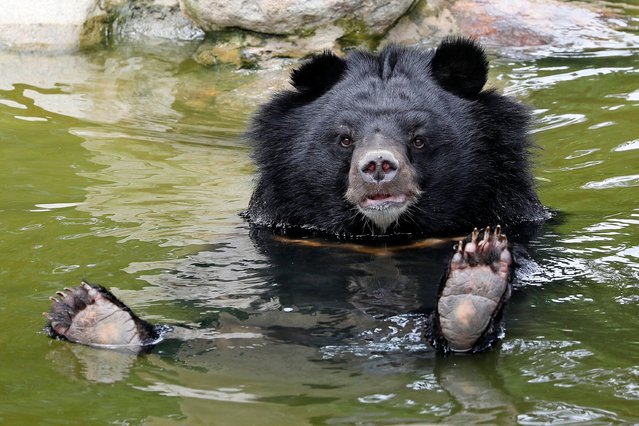
A moon bear rests in a pool inside an enclosure at the Vietnam bear rescue centre, in Tam Dao national park, Vinh Phuc, Vietnam, 09 July 2019. The center is operated by international organization Animals Asia. There are currently 184 bears living at the the Vietnam Bear Rescue Centre. It is estimated that there are less than a few hundred bears left in the wild in Vietnam. According to the latest data from the Ministry of Agriculture and Rural development, around 600 bears are still being kept on farms. In Vietnam, Animals Asia has rescued a total of 209 sun bears and moon bears. (Photo by Minh Hoang/EPA/EFE/Rex Features/Shutterstock)
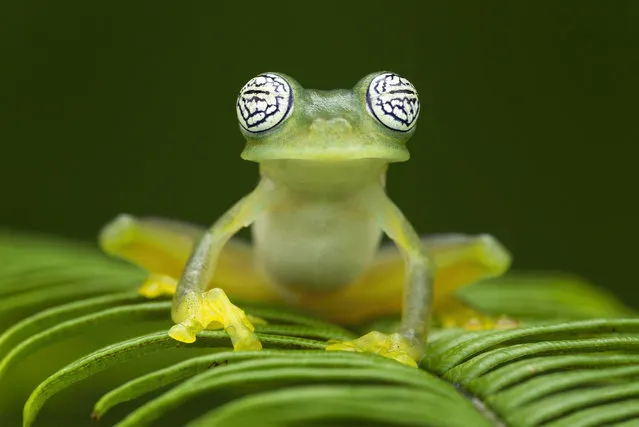
A ghost glass frog in the Chocó rainforest, Ecuador in November 2020. The marbled swirling “hypnotising” eyes are thought to be helpful in attracting a mate. (Photo by David Weiller/WENN)