Loading...
Done
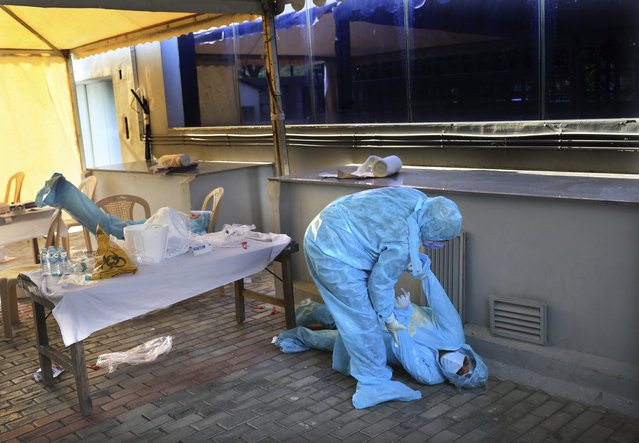
In this April 27, 2020 photo, a health worker helps another as she fainted because of exhaustion and long working hours during a swab test drive for COVID 19, in New Delhi, India. Two and a half months of nationwide lockdown kept numbers of infections relatively low in India. But with restrictions easing in recent weeks, cases have shot up, raising questions about whether authorities have done enough to avert catastrophe. Half of Delhi’s 8,200 hospital beds dedicated to COVID-19 patients are already full and officials are projecting more than half a million cases in the city alone by July 31. (Photo by Manish Swarup/AP Photo)

In this April 27, 2020 photo, a health worker helps another as she fainted because of exhaustion and long working hours during a swab test drive for COVID 19, in New Delhi, India. Two and a half months of nationwide lockdown kept numbers of infections relatively low in India. But with restrictions easing in recent weeks, cases have shot up, raising questions about whether authorities have done enough to avert catastrophe. Half of Delhi’s 8,200 hospital beds dedicated to COVID-19 patients are already full and officials are projecting more than half a million cases in the city alone by July 31. (Photo by Manish Swarup/AP Photo)
Details
08 Jan 2021 00:01:00
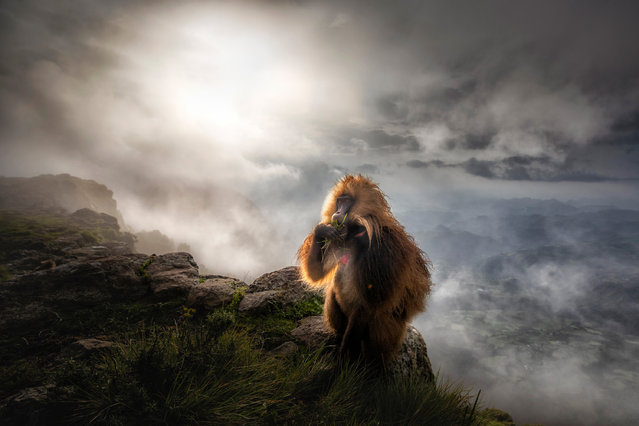
Highly commended, mammals: Gelada after the storm – Marco Gaiotti (Italy). “Gelada baboons are the only monkey species in the world that feed on grasses. They are native to the tableland of Ethiopia. Every morning large family groups wander from their sleeping places in the steep rock face, up to 1,000 metres high, to the feeding grounds at the tablelands. This image clearly depicts their feeding strategy: they pull out bunches of grass, sort the stalks and then lift them to their mouth. This shot was taken towards the end of the rainy season after a heavy storm”. (Photo by Marco Gaiotti/2019 GDT European Wildlife Photographer of the Year)

Highly commended, mammals: Gelada after the storm – Marco Gaiotti (Italy). “Gelada baboons are the only monkey species in the world that feed on grasses. They are native to the tableland of Ethiopia. Every morning large family groups wander from their sleeping places in the steep rock face, up to 1,000 metres high, to the feeding grounds at the tablelands. This image clearly depicts their feeding strategy: they pull out bunches of grass, sort the stalks and then lift them to their mouth. This shot was taken towards the end of the rainy season after a heavy storm”. (Photo by Marco Gaiotti/2019 GDT European Wildlife Photographer of the Year)
Details
31 Oct 2019 00:03:00
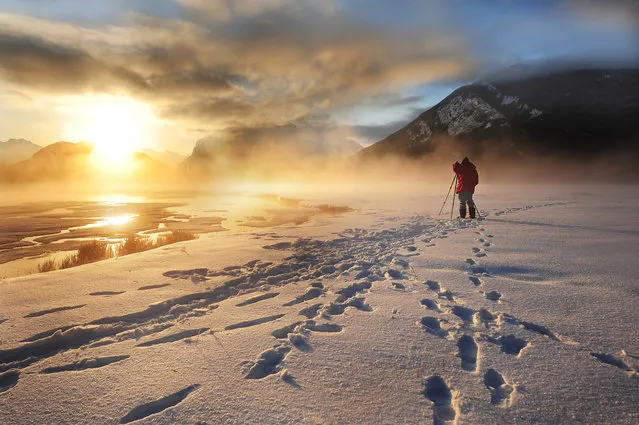
“Artist of the light”. While shooting sunrise in the Vermilion lakes area of Banff national park, Canada, I met a fellow photographer on the scene. Most of the time, we tried not to get in each other's way, however, just by accident, I snapped a picture with him in it working on his tripod settings, and it turned out to be a great photo compared to my sunrise shots. (Photo and caption by Victor Liu/National Geographic Traveler Photo Contest)

“Artist of the light”. While shooting sunrise in the Vermilion lakes area of Banff national park, Canada, I met a fellow photographer on the scene. Most of the time, we tried not to get in each other's way, however, just by accident, I snapped a picture with him in it working on his tripod settings, and it turned out to be a great photo compared to my sunrise shots. (Photo and caption by Victor Liu/National Geographic Traveler Photo Contest)

ATTENTION! All pictures are presented in high resolution. To see Hi-Res images – just TWICE click on any picture. In other words, click small picture – opens the BIG picture. Click BIG picture – opens VERY BIG picture.
Details
27 Jun 2013 13:11:00
A photographer has shot this series of scenic selfies – scaling freezing mountain tops to snap himself in front of stunning scenery. Paul Zizkas breath-taking work features himself in front of beautiful backdrops such as shimmering lakes, snowy mountains and vibrant auroras. He has travelled to a number of different locations worldwide including Canada, New Zealand, Niue the South Pacific and French Polynesia. (Photo by Paul Zizkas/Caters News)

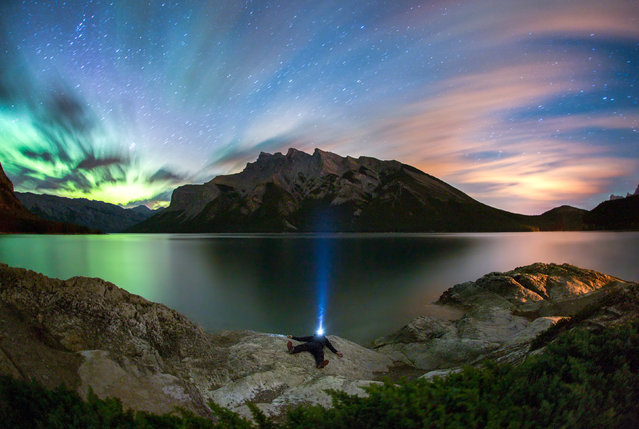
A photographer has shot this series of scenic selfies – scaling freezing mountain tops to snap himself in front of stunning scenery. Paul Zizkas breath-taking work features himself in front of beautiful backdrops such as shimmering lakes, snowy mountains and vibrant auroras. He has travelled to a number of different locations worldwide including Canada, New Zealand, Niue the South Pacific and French Polynesia. Explorer Paul, from Banff, Alberta, Canada, saw his selfies go viral early in 2014 – and has now unveiled his latest work. He said: I find that sometimes including a person in a landscape scene adds to the photograph – that it conveys a different story. Here: lake Minnewanka, Banff National Park, Alberta, Canada. (Photo by Paul Zizkas/Caters News)
Details
14 Dec 2014 12:18:00
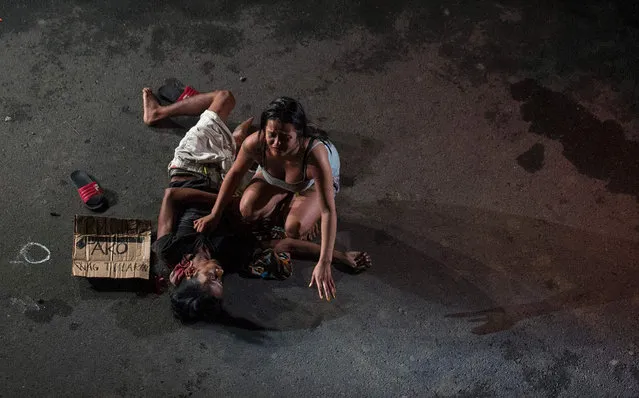
A woman mourns the loss of her husband, next to a placard which reads “I'm a pusher”, who was shot dead by an unidentified gunman in Manila on July 23, 2016. Philippine President Rodrigo Duterte swept to power in May on a promise to clampdown on drugs, and police have since confirmed killing nearly 200 people in a two-month crime blitz. There has also been a surge in killings by anti-drug vigilantes who leave victims' corpses on city streets wrapped in packaging tape with signs accusing them of being drug dealers. (Photo by Noel Celis/AFP Photo)

A woman mourns the loss of her husband, next to a placard which reads “I'm a pusher”, who was shot dead by an unidentified gunman in Manila on July 23, 2016. Philippine President Rodrigo Duterte swept to power in May on a promise to clampdown on drugs, and police have since confirmed killing nearly 200 people in a two-month crime blitz. There has also been a surge in killings by anti-drug vigilantes who leave victims' corpses on city streets wrapped in packaging tape with signs accusing them of being drug dealers. (Photo by Noel Celis/AFP Photo)
Details
24 Jul 2016 11:12:00
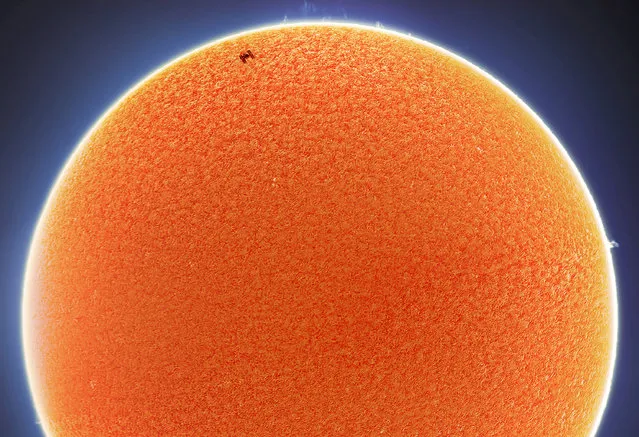
The International Space Station (ISS) moving in front of the sun in November 2020 by astrophotographer Andrew McCarthy. These incredible photos capture the clearest images ever taken of the International Space Station (ISS) moving in front of both the moon and the sun. The photos, taken within days of one another, were captured in the space of less than a second, as the space station could be clearly seen zooming across against the bright backdrops of both moon and sun. Photographer Andrew McCarthy, from California, USA, said the photo of the ISS in front of the sun, in broad daylight, was “one of my trickiest shots ever”. (Photo by Andrew McCarthy/South West News Service)

The International Space Station (ISS) moving in front of the sun in November 2020 by astrophotographer Andrew McCarthy. These incredible photos capture the clearest images ever taken of the International Space Station (ISS) moving in front of both the moon and the sun. The photos, taken within days of one another, were captured in the space of less than a second, as the space station could be clearly seen zooming across against the bright backdrops of both moon and sun. Photographer Andrew McCarthy, from California, USA, said the photo of the ISS in front of the sun, in broad daylight, was “one of my trickiest shots ever”. (Photo by Andrew McCarthy/South West News Service)
Details
28 Nov 2020 00:05:00
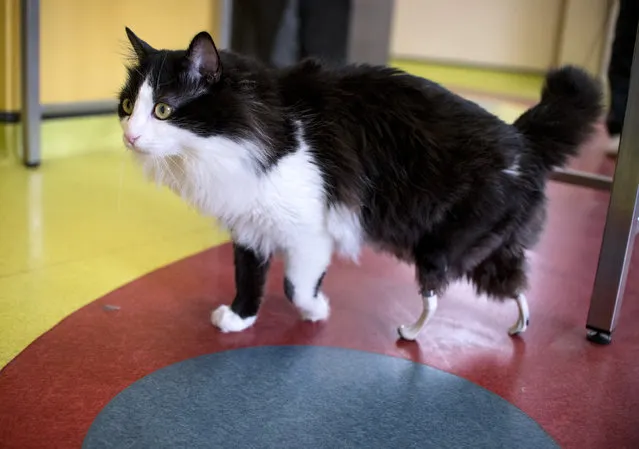
Pooh, a one-year-old cat, who lost his hind legs in an accident and has been given bionic paws, walks in a vet clinic in Sofia on January 31, 2017. Pooh, who is thought to have lost his legs in a car or train accident last April, is back on the prowl thanks to Bulgarian veterinary surgeon Vladislav Zlatinov. He is the first vet in Europe to successfully apply the pioneering method of Irish neuro-orthopaedic surgeon Noel Fitzpatrick, who shot to fame in 2009 when making Oscar the first bionic cat by fitting him with new hind legs in Britain. (Photo by Nikolay Doychinov/AFP Photo)

Pooh, a one-year-old cat, who lost his hind legs in an accident and has been given bionic paws, walks in a vet clinic in Sofia on January 31, 2017. Pooh, who is thought to have lost his legs in a car or train accident last April, is back on the prowl thanks to Bulgarian veterinary surgeon Vladislav Zlatinov. He is the first vet in Europe to successfully apply the pioneering method of Irish neuro-orthopaedic surgeon Noel Fitzpatrick, who shot to fame in 2009 when making Oscar the first bionic cat by fitting him with new hind legs in Britain. (Photo by Nikolay Doychinov/AFP Photo)
Details
03 Feb 2017 07:35:00
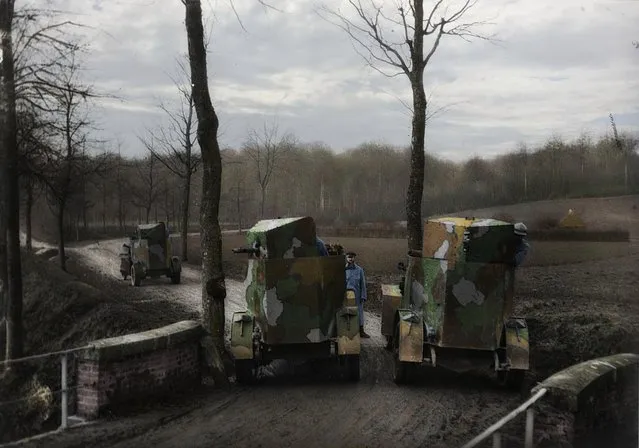
The expertly colourised shots were brought to life by French bank technician, Frédéric Duriez (51). The images were provided by the Valois collection which belongs to the BDIC. “By colourising these photos, I reduce the time that separates us today from this conflict”, said Frédéric. “A black and white photo does not attract the attention of young people, if you colour it, then people will look at it with curiosity. After this, we see the greater the misery and distress of these French fighters”. The total number of casualties in WW1 was more that 38 million. By the end of the war, over eight-million men had been called up to fight in the French army. France suffered 4.2 million casualties during the war with 1.3 million people dead. Here: Car cannon sections in firing position, Auxi-le-Château. (Photo by Frédéric Duriez/BDIC/Mediadrumworld.com)

The expertly colourised shots were brought to life by French bank technician, Frédéric Duriez (51). The images were provided by the Valois collection which belongs to the BDIC. “By colourising these photos, I reduce the time that separates us today from this conflict”, said Frédéric. Here: Car cannon sections in firing position, Auxi-le-Château. (Photo by Frédéric Duriez/BDIC/Mediadrumworld.com)
Details
03 May 2017 08:41:00