Loading...
Done
German film actress Lilly Krug, daughter of Veronica Ferres and Martin Krug, attends the screening of “Armageddon Time” during the 75th annual Cannes film festival at Palais des Festivals on May 19, 2022 in Cannes, France. (Photo by Piroschka Van De Wouw/Reuters)

German film actress Lilly Krug, daughter of Veronica Ferres and Martin Krug, attends the screening of “Armageddon Time” during the 75th annual Cannes film festival at Palais des Festivals on May 19, 2022 in Cannes, France. (Photo by Piroschka Van De Wouw/Reuters)
Details
21 May 2022 05:19:00
In this January 27, 2020 photo, Jessica Hahn-Chaplin applies make up before a rehearsal of the Paraiso de Tuiuti samba school in Rio de Janeiro, Brazil. Hahn-Chaplin dances samba annually in Bath, England. (Photo by Silvia Izquierdo/AP Photo)

In this January 27, 2020 photo, Jessica Hahn-Chaplin applies make up before a rehearsal of the Paraiso de Tuiuti samba school in Rio de Janeiro, Brazil. Hahn-Chaplin dances samba annually in Bath, England. (Photo by Silvia Izquierdo/AP Photo)
Details
13 Feb 2020 00:05:00
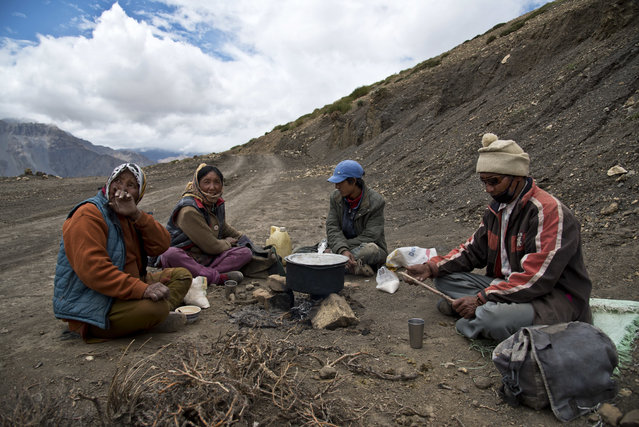
In this August 17, 2016, photo, from left to right, Chhering Chodom, 60, Tashi Yangzom, 50, Lobsang Chhering, 27, and Dorje Tandup, 58, drink milk tea on the side of the road. For centuries, the sleepy valley nestled in the Indian Himalayas remained a hidden Buddhist enclave forbidden to outsiders. Enduring the harsh year-round conditions of the high mountain desert, the people of Spiti Valley lived by a simple communal code – share the Earth's bounty, be hospitable to neighbors, and eschew greed and temptation at all turns. That's all starting to change, for better or worse. Since India began allowing its own citizens as well as outsiders to visit the valley in the early 1990s, tourism and trade have boomed. And the marks of modernization, such as solar panels, asphalt roads and concrete buildings, have begun to appear around some of the villages that dot the remote landscape at altitudes above 4,000 meters (13,000 feet). (Photo by Thomas Cytrynowicz/AP Photo)

In this August 17, 2016, photo, from left to right, Chhering Chodom, 60, Tashi Yangzom, 50, Lobsang Chhering, 27, and Dorje Tandup, 58, drink milk tea on the side of the road. For centuries, the sleepy valley nestled in the Indian Himalayas remained a hidden Buddhist enclave forbidden to outsiders. Enduring the harsh year-round conditions of the high mountain desert, the people of Spiti Valley lived by a simple communal code – share the Earth's bounty, be hospitable to neighbors, and eschew greed and temptation at all turns. That's all starting to change, for better or worse. (Photo by Thomas Cytrynowicz/AP Photo)

Details
15 Sep 2016 09:22:00
Galapagos – Rocking the Cradle: Four major ocean currents converge along the Galapagos archipelago, creating the conditions for an extraordinary diversity of animal life, April 25, 2016. The islands are home to at least 7,000 flora and fauna species, of which 97 percent of the reptiles, 80 percent of the land birds, 50 percent of the insects and 30 percent of the plants are endemic. The local ecosystem is highly sensitive to the changes in temperature, rainfall and ocean currents that characterize the climatic events known as El Niño and La Niña. These changes cause marked fluctuations in weather and food availability. Many scientists expect the frequency of El Niño and La Niña to increase as a result of climate change, making the Galapagos a possible early-warning location for its effects. (Photo by Thomas P. Peschak for National Geographic/World Press Photo)

Galapagos – Rocking the Cradle: Four major ocean currents converge along the Galapagos archipelago, creating the conditions for an extraordinary diversity of animal life, April 25, 2016. The islands are home to at least 7,000 flora and fauna species, of which 97 percent of the reptiles, 80 percent of the land birds, 50 percent of the insects and 30 percent of the plants are endemic. (Photo by Thomas P. Peschak for National Geographic/World Press Photo)
Details
16 Apr 2018 00:01:00
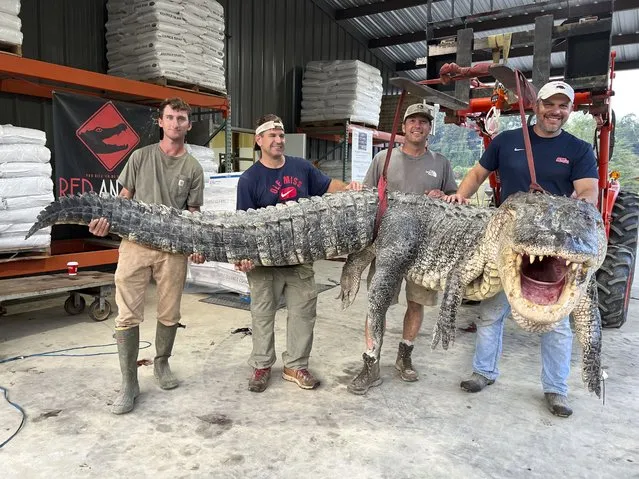
This photo provided by Red Antler Processing shows the alligator sport hunting team made up of, from left, Tanner White, tag-holder Donald Woods, Will Thomas and Joey Clark as they hoist, with the help of a forklift, the longest alligator officially harvested in Mississippi, Saturday, August 26, 2023, at Red Antler Processing in Yazoo City, Miss. The male alligator weighed 802.5 pounds and measured 14 feet, 3 inches long, and its length broke the state record as the longest alligator ever caught, according to the Mississippi Department of Wildlife, Fisheries and Parks. (Phoot by Shane Smith/Red Antler Processing via AP Photo)

This photo provided by Red Antler Processing shows the alligator sport hunting team made up of, from left, Tanner White, tag-holder Donald Woods, Will Thomas and Joey Clark as they hoist, with the help of a forklift, the longest alligator officially harvested in Mississippi, Saturday, August 26, 2023, at Red Antler Processing in Yazoo City, Miss. The male alligator weighed 802.5 pounds and measured 14 feet, 3 inches long, and its length broke the state record as the longest alligator ever caught, according to the Mississippi Department of Wildlife, Fisheries and Parks. (Phoot by Shane Smith/Red Antler Processing via AP Photo)
Details
17 Sep 2023 03:05:00
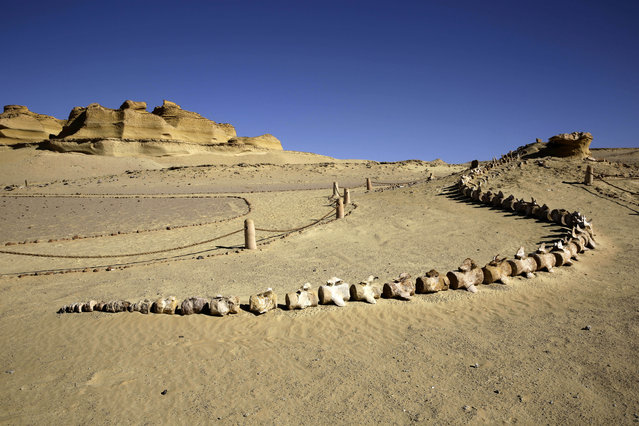
Fossilized whale bones are on display  outside the Wati El Hitan Fossils and Climate Change Museum, a UNESCO natural World Heritage site, on the opening day, in the Fayoum oasis, Egypt, Thursday, January 14, 2016. Egypt has cut the ribbon on the Middle East's first fossil museum housing the world's largest intact skeleton of a "walking whale" in an attempt to attract much-needed tourists driven off by recent militant attacks. The construction of the much-hyped Fossils and Climate Change Museum was covered a 2 billion euros (2. 17 billion dollars) grant from Italy, according to Italian Ambassador Maurizio Massari. (Photo by Thomas Hartwell/AP Photo)

Fossilized whale bones are on display outside the Wati El Hitan Fossils and Climate Change Museum, a UNESCO natural World Heritage site, on the opening day, in the Fayoum oasis, Egypt, Thursday, January 14, 2016. Egypt has cut the ribbon on the Middle East's first fossil museum housing the world's largest intact skeleton of a "walking whale" in an attempt to attract much-needed tourists driven off by recent militant attacks. The construction of the much-hyped Fossils and Climate Change Museum was covered a 2 billion euros (2. 17 billion dollars) grant from Italy, according to Italian Ambassador Maurizio Massari. Its centerpiece is an intact, 37-million-year-old and 20-meter-long skeleton of a legged form of whale that testifies to how modern-day whales evolved from land mammals. The sand-colored, dome-shaped museum is barely discernible in the breathtaking desert landscape that stretches all around. (Photo by Thomas Hartwell/AP Photo)
Details
16 Jan 2016 08:06:00
Revellers take part in an annual block party before Carnival in downtown Rio de Janeiro, Brazil, January 16, 2016. The Rio de Janeiro Carnival will be held from February 5 to February 9. (Photo by Pilar Olivares/Reuters)

Revellers take part in an annual block party before Carnival in downtown Rio de Janeiro, Brazil, January 16, 2016. The Rio de Janeiro Carnival will be held from February 5 to February 9. (Photo by Pilar Olivares/Reuters)
Details
19 Jan 2016 08:04:00
Arcelia Aguilar, a resident of “Hogar Jardin De Los Abuelitos”, receives a hug from her niece Maria Aguilar through “El muro de los Abrazos” (The Wall of Hugs) which is a wall made from plastic sheets to protect against the coronavirus, in San Salvador, El Salvador on September 1, 2020. (Photo by Jose Cabezas/Reuters)

Arcelia Aguilar, a resident of “Hogar Jardin De Los Abuelitos”, receives a hug from her niece Maria Aguilar through “El muro de los Abrazos” (The Wall of Hugs) which is a wall made from plastic sheets to protect against the coronavirus, in San Salvador, El Salvador on September 1, 2020. (Photo by Jose Cabezas/Reuters)
Details
03 Sep 2020 00:07:00