Loading...
Done
Midas Cichlid a.k.a. Amphilophus Citrinellus

“Amphilophus citrinellus is a large cichlid fish endemic to the San Juan River and adjacent watersheds in Costa Rica and Nicaragua. In the aquarium trade A. citrinellus is often sold under the trade name of Midas cichlid. A. citrinellus are omnivorous and their diet consists of plant material, molluscs and smaller fish”. – Wikipedia

Photo: Two Midas Cichlid (lat: amphilophus citrinellus) fish are seen in an aquarium at Hellabrunn zoo on December 23, 2009 in Munich, Germany. (Photo by Alexandra Beier/Getty Images)
Details
17 Aug 2011 11:29:00
In this photo taken with long time exposure, a woman wears a hat at Churchill Downs before the 145th running of the Kentucky Derby horse race Saturday, May 4, 2019, in Louisville, Ky. (Photo by Charlie Riedel/AP Photo)

In this photo taken with long time exposure, a woman wears a hat at Churchill Downs before the 145th running of the Kentucky Derby horse race Saturday, May 4, 2019, in Louisville, Ky. (Photo by Charlie Riedel/AP Photo)
Details
06 May 2019 00:07:00
Northern lights (Aurora borealis) glow brightly over an Inupiaq fish camp along the arctic coast in North Slope, Alaska. (Photo by Steven Kazlowski/Barcroft Media)

Northern lights (Aurora borealis) glow brightly over an Inupiaq fish camp along the arctic coast in North Slope, Alaska. (Photo by Steven Kazlowski/Barcroft Media)
Details
28 Aug 2013 11:46:00
Boeing X-45A

“The Boeing X-45 unmanned combat air vehicle is a concept demonstrator for a next generation of completely autonomous military aircraft, developed by Boeing's Phantom Works. Manufactured by Boeing Integrated Defense Systems, the X-45 was a part of DARPA's J-UCAS project”. – Wikipedia

Photo: Two X-45A Unmanned Combat Air Vehicles (UCAV) are shown to members of the news media July 11, 2002 at Edwards Air Force Base, California. The X-45A, developed by The Defense Advanced Research Projects Agency and the Boeing Company, is the first unmanned system designed from inception for combat missions. (Photo by David McNew/Getty Images)
Details
22 Aug 2011 13:00:00
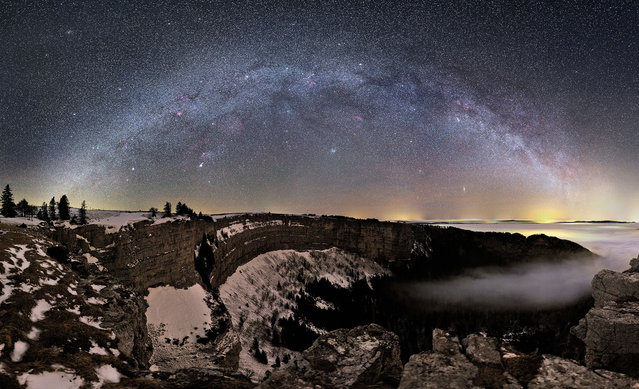
Milky Way over Switzerland

Milky Way over Switzerland

The Milky Way is the galaxy in which Earth is contained. This name derives from its appearance as a dim “milky” glowing band arching across the night sky, in which the naked eye cannot distinguish individual stars. The term “Milky Way” is a translation of the Classical Latin via lactea, from the Hellenistic Greek γαλαξίας κύκλος (pr. galaxías kýklos, “milky circle”). The Milky Way appears like a band because it is a disk-shaped structure being viewed from inside. The fact that this faint band of light is made up of stars was proven in 1610 when Galileo Galilei used his telescope to resolve it into individual stars. In the 1920s, observations by astronomer Edwin Hubble showed that the Milky Way is just one of many galaxies.


Details
20 Jun 2012 10:11:00
A visitor takes a picture of goldfish at the Art Aquarium exhibition in Tokyo Friday, August 12, 2016. The exhibition, featuring around 8,000 goldfish in tanks themed on Japan's Edo Period. (Photo by Koji Sasahara/AP Photo)

A visitor takes a picture of goldfish at the Art Aquarium exhibition in Tokyo Friday, August 12, 2016. The exhibition, featuring around 8,000 goldfish in tanks themed on Japan's Edo Period. (Photo by Koji Sasahara/AP Photo)
Details
14 Aug 2016 10:46:00
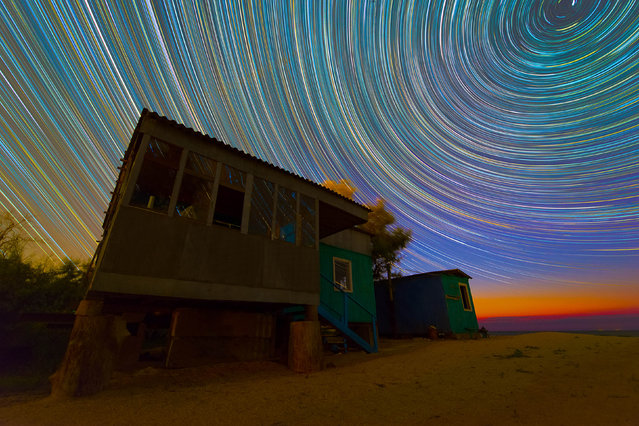
These are the spectacular snaps of swirling star trails which transform the night sky into a kaleidoscope of color. Keen photographer Evgeniy Zaytsev, 24, captured the stunning shots on trips to Crimea, Altai and Murom, Russia. The pictures of circular star trails are formed by merging multiple photos taken over the course of several hours. Here: vibrate, colorful star trails over an abandoned beach house. (Photo by Evgeniy Zaytsev/Caters News)

These are the spectacular snaps of swirling star trails which transform the night sky into a kaleidoscope of color. Keen photographer Evgeniy Zaytsev, 24, captured the stunning shots on trips to Crimea, Altai and Murom, Russia. The pictures of circular star trails are formed by merging multiple photos taken over the course of several hours. Movement of the Earth causes the stars appear in different places in each image. Here: vibrate, colorful star trails over an abandoned beach house. (Photo by Evgeniy Zaytsev/Caters News)
Details
12 Feb 2015 12:50:00
Polish photographer David Kaszlikowski took a series of stunning photographs of a glacier in the Karakoram region of Pakistan while on a film expedition. At the Baltoro and Godwin-Austen glaciers near K2, the second highest mountain in the world, he sent his drone on flights to scout the surrounding landscape. Here: at the heart of Karakoram, a glacier formation found at Concordia at the very beginning of one of the longest glaciers on the planet, Baltoro. (Photo by David Kaszlikowski/Rex Features)

Polish photographer David Kaszlikowski took a series of stunning photographs of a glacier in the Karakoram region of Pakistan while on a film expedition. At the Baltoro and Godwin-Austen glaciers near K2, the second highest mountain in the world, he sent his drone on flights to scout the surrounding landscape. Here: at the heart of Karakoram, a glacier formation found at Concordia at the very beginning of one of the longest glaciers on the planet, Baltoro. (Photo by David Kaszlikowski/Rex Features)
Details
17 Nov 2015 08:02:00